Health & Medical · Vital Signs
Respiratory Rate Chart by Age and Breathing Pattern
Compare resting breaths per minute by age, learn how to count a respiratory rate, distinguish screening thresholds, and recognize breathing effort and urgent warning signs.
A respiratory-rate number cannot determine the cause or urgency alone. Severe trouble breathing, blue or gray color, pauses or gasping, chest retractions, grunting, new confusion, inability to wake, or persistent chest pain needs immediate assessment at any rate. Read the ChartsLoom Disclaimer.
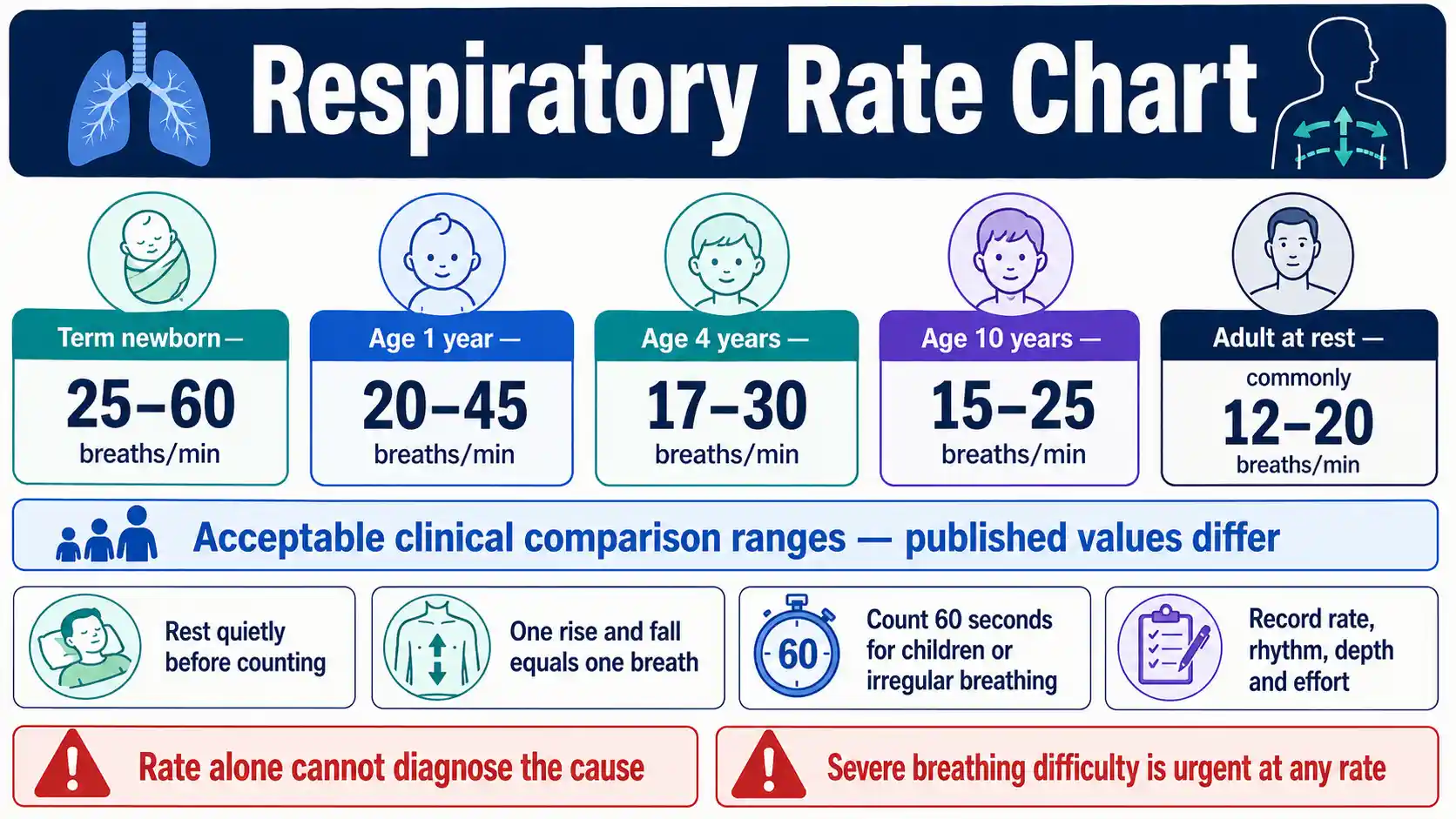
What is a normal respiratory rate?
A common adult resting respiratory rate is 12–20 breaths per minute. Infants and younger children normally breathe faster, and the expected rate decreases with age.
The MedlinePlus rapid-breathing reference uses 12–20 breaths per minute for an adult at rest and 30–60 for an infant. A range is only a comparison: rest state, age, symptoms, breathing effort, medications, health, altitude, and trend determine how useful it is.
Adults at rest
12–20/min
This is a common reference; MedlinePlus also publishes a narrower 12–18 range for average healthy adults.
Infants and children
Age-specific
Expected rates fall as children grow, and published pediatric ranges differ by purpose and setting.
Full count
60 seconds
Use a full minute for infants, children, irregular rhythms, or when a short sample may miss variation.
Best interpretation
Rate + effort
Rhythm, depth, retractions, color, symptoms, alertness, and trend give the number meaning.
Respiratory Rate by Age Reference Chart
Pediatric values below are Royal Children’s Hospital acceptable clinical ranges for unwell children—not universal healthy-at-home limits. The adult row uses a common MedlinePlus resting reference.
Swipe horizontally inside the table to view every column.
| Age | Reference range | Reference type | How to use it |
|---|---|---|---|
| Term newborn | 25–60 breaths/min — Term newborn comparison | Acceptable clinical range | Count for a full minute; rhythm can be irregular |
| 3 months | 25–60 breaths/min | Acceptable clinical range | Measure while calm, not crying or feeding |
| 6 months | 20–55 breaths/min | Acceptable clinical range | Add work of breathing, color, feeding, and alertness |
| 1 year | 20–45 breaths/min | Acceptable clinical range | Do not substitute for WHO pneumonia screening thresholds |
| 2 years | 20–40 breaths/min — Age two comparison | Acceptable clinical range | Compare with the child’s trend and symptoms |
| 4 years | 17–30 breaths/min | Acceptable clinical range | Repeat an unexpected count after quiet rest |
| 6 years | 16–30 breaths/min | Acceptable clinical range | Fever, pain, and anxiety may raise the rate |
| 8 years | 16–30 breaths/min | Acceptable clinical range | Visible breathing effort can be urgent at any rate |
| 10 years | 15–25 breaths/min | Acceptable clinical range | Trend is often more useful than one reading |
| 12 years | 15–25 breaths/min | Acceptable clinical range | Clinical cutoffs differ by purpose and setting |
| 14 years | 14–25 breaths/min | Acceptable clinical range | Record rest state and associated symptoms |
| 16 years | 14–25 breaths/min | Acceptable clinical range | Use the person’s usual baseline when known |
| Adults | Commonly 12–20 breaths/min — Common adult resting reference | Resting reference | Some MedlinePlus material uses the narrower 12–18 range |
breaths/min = complete breathing cycles per minute.
- • Reference ranges differ because populations, measurement methods, health states, and clinical purposes differ.
- • A value inside a range does not rule out respiratory distress; a value outside a range does not identify the cause.
- • Count at rest. Exercise, crying, talking, feeding, fever, pain, anxiety, and recent movement can change the result.
Download or export
How to count respiratory rate
Count without asking the person to change their breathing. Watch the chest or abdomen, note the starting time, and count each complete rise-and-fall cycle.
1
Rest before counting
Use a calm, resting baseline—not a reading taken just after activity, crying, or talking.
2
Watch one full cycle
One rise and fall of the chest or abdomen counts as one breath.
3
Use enough time
Count 60 seconds for infants, children, or any irregular breathing pattern.
4
Add breathing effort
Record depth, rhythm, noise, color, alertness, and whether ribs pull inward.
Respiratory rate is one vital sign. Breathing effort, symptoms, oxygen saturation, temperature, pulse, age, usual baseline, and the trend can matter more than one isolated count.
Respiratory Rate Counter
Convert a breath count to breaths per minute
Enter the breaths you observed and the counting interval. The result is compared with a clearly labeled age reference; it does not classify illness. Calculations stay in your browser.
16/min
16 breaths × 60 ÷ 60 seconds
12–20/min
Adult at rest
within
This describes position relative to the selected band, not normality or urgency.
Qualification: Adult references differ slightly by source. Symptoms, medications, illness, altitude, pregnancy, and baseline change interpretation.
Do not delay urgent care to repeat or calculate a rate.
Severe trouble breathing, blue or gray color, pauses in breathing, chest retractions, grunting, new confusion, inability to wake, or persistent chest pain needs immediate assessment regardless of the displayed number.
How to Measure Respiratory Rate
A reliable resting count needs a quiet subject, a clear breath definition, enough observation time, and a note about rhythm and effort.
Swipe horizontally inside the table to view every column.
| Step | What to do | Why it matters | Common error |
|---|---|---|---|
| Prepare | Let the person rest quietly | Activity and talking can increase the rate | Counting immediately after walking or crying |
| Position | Use a comfortable seated, reclined, or usual clinical position | Posture and distress can alter breathing | Forcing a position that worsens symptoms |
| Observe | Watch the chest or abdomen without coaching breathing | Awareness can change the natural rate | Saying “breathe normally” repeatedly |
| Define one breath | Count one rise and fall as one complete breath — One complete breath | Prevents counting inhalation and exhalation separately | Counting each movement as a breath |
| Choose time | Use 60 seconds for infants, children, or irregular rhythms — Full-minute count | Short samples magnify error | Multiplying a brief uneven sample |
| Regular adult option | A clinician may count 30 seconds and double it | Can be efficient when rhythm is clearly regular | Using 15 seconds for a borderline or irregular count |
| Describe pattern | Record rate, rhythm, depth, effort, noise, and symptoms — Add effort and symptoms | The number alone misses respiratory distress | Writing only “normal” without the count |
| Repeat | Recheck an unexpected value under comparable conditions | Confirms trend and reduces counting error | Averaging away a clinically important change |
Rate = breaths counted × 60 ÷ seconds observed.
- • Do not delay emergency help to obtain a perfect count.
- • For a sleeping infant, observe without disturbing safe sleep positioning; if color or breathing effort is concerning, seek help.
- • Document oxygen therapy, recent medication, fever, pain, activity, altitude, and body position when relevant.
Download or export
A reference range is not the same as a clinical threshold
The Royal Children’s Hospital guidance explicitly describes its pediatric numbers as acceptable ranges for unwell children and notes that publications differ. WHO fast-breathing cutoffs and NICE sepsis criteria answer narrower screening questions, so they should not be relabeled as universal “normal” limits.
Pediatric Fast-Breathing Screening Thresholds
These are purpose-specific clinical screening thresholds. They are not interchangeable with resting reference ranges and should not be used alone to diagnose pneumonia or sepsis.
Swipe horizontally inside the table to view every column.
| Framework and age | Threshold | Clinical purpose | Required context |
|---|---|---|---|
| WHO IMCI: young infant up to 2 months | 60/min or more | Very severe disease assessment | Repeat an elevated count; infant calm; assess feeding, temperature, movement, and chest indrawing |
| WHO IMCI: 2 to under 12 months | 50/min or more — WHO infant fast-breathing threshold | Pneumonia classification with cough or difficult breathing | Count one full minute while calm; add chest indrawing, stridor, and danger signs |
| WHO IMCI: 12 months to under 5 years | 40/min or more — WHO child fast-breathing threshold | Pneumonia classification with cough or difficult breathing | Count one full minute while calm; use the full IMCI assessment |
| NICE suspected sepsis: under 1 year | 50–59/min | Moderate-to-high risk criterion | Only within suspected-sepsis risk assessment |
| NICE suspected sepsis: under 1 year | 60/min or more | High-risk criterion | Combine with behavior, oxygen, circulation, temperature, and other findings |
| NICE suspected sepsis: 1–2 years | 40–49/min | Moderate-to-high risk criterion | Only within suspected-sepsis risk assessment |
| NICE suspected sepsis: 1–2 years | 50/min or more | High-risk criterion | Do not diagnose sepsis from respiratory rate alone |
| NICE suspected sepsis: 3–4 years | 35–39/min | Moderate-to-high risk criterion | Only within suspected-sepsis risk assessment |
| NICE suspected sepsis: 3–4 years | 40/min or more | High-risk criterion | Assess the whole child and escalate per clinical pathway |
| Any child with severe effort or color change | Any numeric rate — Emergency signs override count | Emergency recognition | Retractions, blue or gray color, grunting, apnea, stridor, or reduced alertness can be urgent |
Thresholds are breaths per minute and apply to the named framework only.
- • WHO IMCI thresholds are used for a calm child with cough or difficult breathing in a defined age group.
- • NICE values shown here are risk criteria for suspected sepsis, not “normal” cutoffs for every child.
- • Local pediatric early-warning systems may use different bands; follow the child’s care plan and local clinical protocol.
Download or export
Respiratory Rate and Breathing Pattern Terms
Clinical terms describe rate, depth, rhythm, sensation, or sound. A term does not identify the underlying cause.
Swipe horizontally inside the table to view every column.
| Term | What it describes | What to observe | Why context matters |
|---|---|---|---|
| Eupnea | Quiet, unlabored breathing at an expected resting rate | Regular rhythm, comfortable effort | Expected rate varies by age and setting |
| Tachypnea — Fast breathing term | Breathing faster than the applicable reference or clinical threshold | Rate, depth, effort, fever, pain, oxygen, trend | Causes range from exercise and anxiety to serious illness |
| Bradypnea — Slow breathing term | Breathing slower than the applicable reference | Alertness, medications, neurologic signs, oxygen, pauses | Sleep or fitness may differ from medication or brain-related suppression |
| Apnea | A pause or stop in breathing | Duration, color, responsiveness, recurrence | New prolonged pauses or unresponsiveness can be an emergency |
| Hyperpnea | Deeper breathing, often with a higher minute ventilation | Depth and activity context | Can occur with exercise or metabolic demand |
| Hypopnea | Shallower or reduced breathing | Chest movement, sleep context, oxygen, alertness | May be used in sleep testing and requires technical definitions |
| Dyspnea | The person’s sensation of difficult or uncomfortable breathing | Speech, effort, triggers, onset, position | Severe dyspnea can occur with a rate inside a reference band |
| Kussmaul pattern | Deep, labored breathing associated with severe metabolic acidosis | Depth, illness signs, diabetes history, dehydration | Requires urgent medical assessment; do not diagnose from appearance alone |
| Cheyne–Stokes pattern | Cyclic waxing and waning depth with pauses | Cycle timing, sleep or wake state, neurologic and heart context | Can have several causes and needs clinical interpretation |
| Agonal breathing — Emergency gasping | Abnormal gasping that is not normal effective breathing | Unresponsiveness and absent normal breathing | Treat as an emergency and follow local resuscitation instructions |
Terms describe observations; formal diagnostic definitions depend on age, setting, and clinical criteria.
- • Rate, depth, rhythm, effort, sounds, skin color, mental state, and symptoms should be documented separately.
- • Noisy breathing can arise from different airway levels: wheeze, stridor, snoring, and grunting are not interchangeable.
- • If a person is unresponsive and not breathing normally, call emergency services and begin dispatcher-guided care.
Download or export
Common Factors That Change Respiratory Rate
A faster or slower rate is a nonspecific sign. Recent activity, environment, symptoms, medicines, and medical history help narrow the possibilities.
Swipe horizontally inside the table to view every column.
| Factor | Common direction | Context clues | Practical response |
|---|---|---|---|
| Exercise or recent activity | Usually faster and deeper — Expected activity response | Occurs during effort and slows during recovery | Measure a resting baseline after recovery |
| Fever | Often faster | Temperature, infection symptoms, dehydration | Record temperature and repeat as the person settles |
| Pain | Often faster or irregular | Visible discomfort, injury, recent procedure | Assess pain and associated warning signs |
| Anxiety or panic | Often faster | Tingling, fear, trigger, prior episodes | Do not assume anxiety until urgent causes are considered |
| Altitude | May be faster | Recent ascent, headache, nausea, poor sleep | Use altitude context; severe symptoms need assessment |
| Pregnancy | Ventilation increases; resting rate may remain near baseline | Gestational age, breathlessness, anemia or clot symptoms | New severe or sudden breathlessness is not a normal chart finding |
| Respiratory infection | May be faster | Cough, fever, mucus, wheeze, fatigue | Use symptoms, effort, oxygen context, and trend |
| Asthma or airway narrowing | May be faster | Wheeze, cough, chest tightness, reduced peak flow if prescribed | Follow the action plan; severe effort needs urgent care |
| Heart or lung disease | May be faster | Breathlessness, swelling, chest pain, lower exercise tolerance | Compare with baseline and clinician-set action thresholds |
| Metabolic acidosis | Often faster and deeper — Deep fast breathing | Diabetes, kidney illness, severe dehydration, toxic exposure | Urgent clinical assessment is required |
| Opioids, sedatives, or neurologic depression | May be slower or shallow — Slow breathing concern | Sleepiness, pinpoint pupils, weak breathing, overdose risk | Possible overdose or hard-to-wake state is an emergency |
| Sleep | Often slower; pattern may vary by age | Sleep stage, snoring, pauses, daytime symptoms | Repeated pauses, gasping, or color change needs evaluation |
Direction describes a common tendency, not a diagnostic rule.
- • More than one factor can act at the same time—for example, fever, pain, dehydration, and anxiety.
- • A normal respiratory rate does not exclude asthma, pulmonary embolism, heart disease, or another serious cause of breathlessness.
- • Medication changes and overdose concerns require prompt professional or poison-center guidance.
Download or export
Breathing effort can matter more than the count
The CDC respiratory warning-sign guidance includes fast or difficult breathing, blue color, ribs pulling inward, chest pain, dehydration, and reduced alertness. These findings can require urgent care even when a calculated rate appears to fit a broad age range.
Work of Breathing and Respiratory Distress Signs
Breathing effort can signal urgency even when the calculated respiratory rate is inside an age reference range.
Swipe horizontally inside the table to view every column.
| Sign | What it may look or sound like | Why it matters | Action |
|---|---|---|---|
| Retractions — Chest retractions | Skin pulls inward between or below ribs or above the breastbone | Accessory muscles are working harder | Prompt assessment; severe retractions are urgent |
| Nasal flaring | Nostrils widen with each breath | Often signals breathing difficulty, especially in infants | Assess promptly with rate, color, and feeding |
| Grunting — Grunting | Short sound on exhalation | May reflect an attempt to keep small airways open | Urgent assessment, particularly in a newborn or infant |
| Stridor | Harsh, high-pitched sound, often on inhalation | May indicate upper-airway narrowing | Stridor at rest or with distress is urgent |
| Wheeze | Musical or whistling sound, often on exhalation | Can occur with narrowed lower airways | Use the person’s action plan; severe symptoms are urgent |
| Tripod posture | Leaning forward and bracing arms to breathe | Can signal substantial breathing effort | Urgent assessment when new or severe |
| Unable to speak or feed normally | Only short words, weak cry, poor feeding, or pauses | Breathing demand is interfering with basic function | Emergency assessment if severe or worsening |
| Color change — Emergency color change | Lips, face, tongue, nail beds, or skin appear blue, gray, pale, or ashen | May reflect inadequate oxygen or circulation | Emergency care |
| Reduced alertness | Confusion, unusual sleepiness, poor interaction, or hard to wake | Can accompany low oxygen, high carbon dioxide, or severe illness | Emergency care |
These are visual or audible signs, not numeric respiratory-rate categories.
- • Look for signs across different skin tones and compare with the person’s usual color.
- • Do not wait for a pulse-oximeter reading before responding to severe breathing difficulty.
- • A quiet chest in a person with severe asthma symptoms can reflect very limited airflow rather than improvement.
Download or export
Respiratory Rate Compared With Other Measurements
Respiratory rate, oxygen saturation, pulse, temperature, and breathing symptoms describe different parts of the clinical picture.
Swipe horizontally inside the table to view every column.
| Measurement | What it measures | What it does not prove | Use together with |
|---|---|---|---|
| Respiratory rate — Breaths per minute | Complete breaths per minute | Oxygen level, cause, or breathing effectiveness by itself | Effort, rhythm, depth, symptoms, trend |
| Oxygen saturation (SpO₂) — Separate oxygen measure | Estimated percentage of oxygen-saturated hemoglobin | Ventilation, carbon dioxide level, or cause of breathlessness | Symptoms, device limitations, baseline, clinician instructions |
| Pulse or heart rate | Heartbeats per minute | Respiratory adequacy or oxygenation | Respiratory rate, blood pressure, symptoms, rhythm |
| Temperature | Body heat at a specified measurement site | Infection cause or severity by itself | Age, symptoms, hydration, respiratory and heart rates |
| Peak expiratory flow | Fastest exhaled flow using a peak-flow meter | Oxygen saturation or a complete asthma diagnosis | Personal asthma action plan and best baseline |
| Capnography or blood gas | Carbon dioxide or acid–base information in clinical care | A general home wellness score | Clinical examination and the reason for testing |
| Subjective breathlessness | How difficult breathing feels to the person | The numeric respiratory rate or oxygen level — Symptoms can precede abnormal readings | Onset, triggers, function, chest symptoms, objective signs |
SpO₂ is a percentage; respiratory and pulse rates are per minute; temperature uses °C or °F.
- • A person can feel very breathless with a near-reference respiratory rate or oxygen reading.
- • Pulse oximeters have accuracy limitations; follow device instructions and clinician-set thresholds.
- • Known chronic lung disease or high altitude may require an individualized oxygen baseline and action plan.
Download or export
When a Breathing Change Needs Medical Care
Symptoms and breathing effort determine urgency more reliably than a single respiratory-rate number. Use local emergency services for severe or rapidly worsening signs.
Swipe horizontally inside the table to view every column.
| Situation | Examples | Suggested timing | Do not rely on |
|---|---|---|---|
| Emergency breathing difficulty | Struggling for breath, severe retractions, unable to speak or feed, gasping, or stopping breathing | Emergency services now — Emergency response | Repeating the count or waiting for a device |
| Color or alertness change | Blue, gray, pale, or ashen color; new confusion; hard to wake; poor interaction | Emergency services now — Emergency response | A rate inside the chart range |
| Chest warning signs | Persistent chest pain or pressure, collapse, seizure, or severe weakness | Emergency services now | Home respiratory-rate interpretation |
| Infant red flags | Grunting, marked retractions, poor feeding, fever in a young infant, apnea, or color change | Urgent or emergency assessment | The infant appearing quiet |
| Rapidly worsening illness | Breathing becomes faster or harder, symptoms return worse, or oxygen need rises | Urgent same-day assessment | One earlier reassuring measurement |
| Repeated unexpected resting rate | Rate remains outside the relevant reference after calm rest | Prompt clinical advice, sooner with symptoms — Repeated unexpected rate | Self-diagnosing the cause |
| New persistent breathlessness | Breathlessness with ordinary activity, lying flat, swelling, cough, wheeze, or fatigue | Arrange clinical evaluation | Assuming deconditioning or anxiety |
| Known-condition action threshold | Asthma, COPD, heart disease, neuromuscular disease, or home oxygen plan | Follow the written action plan | A generic online range over personal instructions |
Timing is general safety guidance; local emergency numbers and clinical pathways apply.
- • Trust severe symptoms and visible breathing effort even if the respiratory rate or pulse oximeter appears reassuring.
- • For an unresponsive person who is not breathing normally, call emergency services and follow dispatcher instructions.
- • This table cannot account for every age, pregnancy, chronic condition, recent procedure, or clinician-provided action plan.
Download or export
Respiratory Rate Tracking and Common Mistakes
Comparable measurements make a trend more useful. Record the circumstances instead of collecting disconnected numbers.
Swipe horizontally inside the table to view every column.
| Tracking item | Record this | Why it helps | Mistake to avoid |
|---|---|---|---|
| Date and time | Exact observation time | Shows progression and relation to treatment or sleep | Using “morning” without a time |
| Rest state | Sleeping, awake-resting, crying, feeding, exercising, or recovering | Separates baseline from expected temporary increases | Comparing exercise with resting values |
| Count method | Breaths counted and seconds observed — Preserve the raw count | Allows the calculation to be checked | Recording only a multiplied result |
| Pattern | Regular or irregular; shallow, normal, or deep | Adds ventilation clues beyond rate | Treating every breath as identical |
| Effort and sounds | Retractions, flaring, grunting, wheeze, stridor, cough — Breathing effort signs | Identifies possible distress | Waiting for the rate to cross a threshold |
| Associated signs | Temperature, pulse, oxygen if directed, color, alertness, pain | Connects the vital-sign pattern | Using oxygen saturation as the same measure |
| Recent influences | Activity, crying, medicine, caffeine, altitude, anxiety, position | Explains expected short-term changes | Ignoring a medication or exposure |
| Baseline and action plan | Usual rate and clinician-set thresholds — Personal action plan | Personalizes trend interpretation | Replacing a written plan with an internet range |
Keep the original count and interval, for example “18 breaths in 60 seconds.”
- • Use the same body position and rest period when practical, but never force a position that worsens breathing.
- • A sudden worsening trend matters even if every number remains within a broad reference band.
- • Bring the record to a clinician when seeking care, along with medication and condition details.
Download or export
Frequently asked questions
What is a normal respiratory rate for an adult?
A common adult resting reference is 12–20 breaths per minute. MedlinePlus also lists 12–18 for the average healthy adult at rest, showing that sources differ slightly. Symptoms, effort, medications, illness, altitude, and a change from baseline can matter more than one boundary.
What is a normal respiratory rate for a child?
Children normally breathe faster than adults, and expected rates fall with age. Pediatric charts vary by population and clinical purpose, so use an age-specific source and assess the child’s calm state, trend, breathing effort, color, feeding, and alertness.
How do you count breaths per minute?
Let the person rest, watch the chest or abdomen, and count one complete rise and fall as one breath. Observe for 60 seconds when the person is an infant or child, when the rhythm is irregular, or when accuracy matters.
Can you count respiratory rate for 30 seconds?
A 30-second count doubled may be reasonable for a calm adult with a clearly regular rhythm. Count a full 60 seconds for infants, children, irregular breathing, borderline results, or any situation in which a short sample could miss pauses or variability.
Does one inhale and exhale count as one or two breaths?
One inhalation followed by one exhalation is one complete breath. Counting the rise and fall separately would double the result and can make a normal rate appear dangerously fast.
What does tachypnea mean?
Tachypnea means breathing that is faster than the applicable age, setting, or clinical threshold. It is a descriptive sign—not a diagnosis—and may occur with activity, fever, pain, anxiety, infection, airway disease, heart disease, or metabolic illness.
What does bradypnea mean?
Bradypnea means breathing that is slower than the applicable reference. Sleep and individual baseline can influence the rate, but opioids, sedatives, neurologic problems, severe fatigue, or worsening illness can also cause slow or shallow breathing.
Does fever increase respiratory rate?
Fever commonly raises respiratory and heart rates, especially in children, but the size of the change varies. Record the temperature, hydration, symptoms, and breathing effort, then repeat the rate under comparable resting conditions.
Is respiratory rate the same as oxygen saturation?
No. Respiratory rate counts breaths per minute, while pulse oximetry estimates oxygen saturation in the blood. Either measurement can look reassuring while the other—or the person’s breathing effort and symptoms—shows concern.
Does fast breathing mean pneumonia?
Fast breathing can support a pneumonia assessment in a child when used within a defined framework such as WHO IMCI, but it does not prove pneumonia by itself. Cough, age, calm state, chest indrawing, danger signs, examination, and clinical context are required.
Can anxiety cause a high respiratory rate?
Anxiety and panic can cause faster breathing, but it is unsafe to assume anxiety is the cause of a new or severe episode before urgent heart, lung, metabolic, medication, or other medical causes have been considered.
Should respiratory rate be measured during sleep?
A sleeping rate can be useful when the person is breathing naturally and safely positioned, especially for a child who will not settle while awake. Record that the count was asleep and watch for pauses, gasping, color change, retractions, or difficulty waking.
When is an irregular breathing pattern an emergency?
Irregularity needs emergency help when breathing stops, becomes gasping or ineffective, or occurs with blue or gray color, severe effort, chest pain, confusion, collapse, or inability to wake. Do not delay care to complete another count.
How long should you wait after exercise to count a resting rate?
Wait until breathing has returned near the person’s usual comfortable resting pattern rather than using one fixed number of minutes. Record the activity and recovery time if the purpose is to track exercise response.
Can a normal respiratory rate rule out breathing trouble?
No. A person may have serious breathlessness, airway obstruction, altered oxygen or carbon dioxide, or increasing work of breathing while the rate remains inside a broad reference range. Symptoms, effort, color, alertness, and trend remain essential.
Sources
Age-based references, measurement guidance, pediatric screening thresholds, oxygen context, and respiratory warning signs were checked against the following organizations and publications.
MedlinePlus, U.S. National Library of Medicine — Vital Signs
Defines respiratory rate as a vital sign and gives a 12–18 breaths-per-minute resting range for the average healthy adult while noting that age and health change vital signs.
https://medlineplus.gov/ency/article/002341.htm
MedlinePlus, U.S. National Library of Medicine — Rapid Shallow Breathing
Uses 12–20 breaths per minute for an adult at rest and 30–60 for an infant, and defines tachypnea as breathing that is too fast.
https://medlineplus.gov/ency/article/007198.htm
Royal Children’s Hospital Melbourne — Acceptable Ranges for Physiological Variables
Provides age-specific acceptable respiratory-rate ranges for unwell children and emphasizes repeated observations, trends, and clinical context.
https://www.rch.org.au/clinicalguide/guideline_index/normal_ranges_for_physiological_variables/
The Lancet and PubMed Central — Normal Ranges of Heart Rate and Respiratory Rate in Children
Systematic review showing that pediatric respiratory rate declines with age and that centile-based reference values differ from many guideline cutoffs.
https://pmc.ncbi.nlm.nih.gov/articles/PMC3789232/
World Health Organization — Integrated Management of Childhood Illness Chart Booklet
Directs clinicians to count for one minute while the child is calm and provides fast-breathing pneumonia screening thresholds for children under five.
https://cdn.who.int/media/docs/default-source/mca-documents/child/imci-integrated-management-of-childhood-illness/imci-in-service-training/imci-chart-booklet.pdf
National Institute for Health and Care Excellence — Suspected Sepsis in Under 16s: Evaluating Risk Level
Lists age-specific raised respiratory-rate criteria used only within suspected-sepsis risk stratification together with behavior, oxygen, circulation, temperature, and other findings.
https://www.nice.org.uk/guidance/ng254/chapter/Evaluating-risk-level
Centers for Disease Control and Prevention — About Respiratory Illnesses
Lists emergency warning signs such as fast or difficult breathing, blue color, ribs pulling inward, chest pain, dehydration, and reduced alertness.
https://www.cdc.gov/respiratory-viruses/about/index.html
MedlinePlus, U.S. National Library of Medicine — Pulse Oximetry
Explains what oxygen saturation measures, common reference values, symptom context, and why an oxygen reading is different from respiratory rate.
https://medlineplus.gov/lab-tests/pulse-oximetry/
U.S. Food and Drug Administration — Pulse Oximeters
Describes pulse-oximeter limitations and factors that can affect accuracy, including circulation, skin pigmentation, skin temperature, tobacco use, and nail polish.
https://www.fda.gov/medical-devices/products-and-medical-procedures/pulse-oximeters
National Heart, Lung, and Blood Institute — How the Lungs Work
Explains ventilation, the diaphragm, airways, alveoli, and gas exchange between the lungs and blood.
https://www.nhlbi.nih.gov/health/lungs/respiratory-system
MedlinePlus, U.S. National Library of Medicine — Nasal Flaring
Explains that widening of the nostrils during breathing is often a sign of breathing difficulty.
https://medlineplus.gov/ency/article/003055.htm
MedlinePlus, U.S. National Library of Medicine — Transient Tachypnea of the Newborn
Describes rapid breathing, grunting, nasal flaring, retractions, and blue color as findings that require newborn medical assessment.
https://medlineplus.gov/ency/article/007233.htm