Health & Medical · Vital Signs
Resting Heart Rate Chart by Age and Pulse Pattern
Compare resting beats per minute by age, learn how to count a pulse, distinguish rate from rhythm, and recognize persistent changes and symptoms that need medical care.
A heart-rate number cannot determine the rhythm, cause, or urgency alone. Chest pain or pressure, severe shortness of breath, fainting, collapse, severe dizziness, confusion, or a suddenly very high or low rate for the person needs immediate assessment. Read the ChartsLoom Disclaimer.
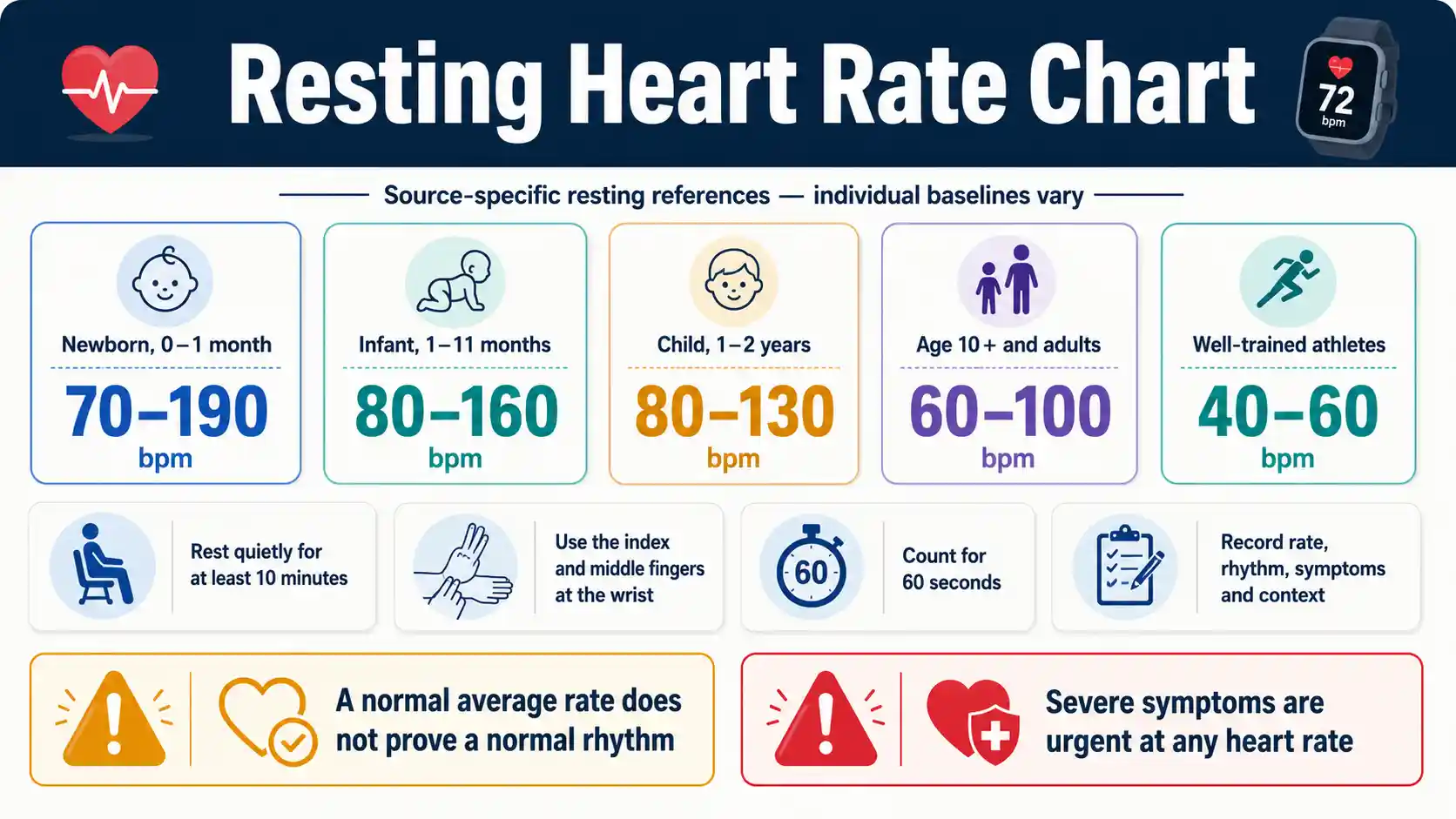
What is a normal resting heart rate?
A common resting heart rate for adults is 60–100 beats per minute. Infants and young children normally have faster pulses, while some well-trained athletes have lower resting rates.
The MedlinePlus pulse reference lists age-specific ranges from newborn through adulthood and a separate 40–60 bpm group reference for well-trained athletes. Use these as comparisons, not targets: rhythm, symptoms, rest state, medicines, illness, baseline, and trend can matter more than one boundary.
Most adults
60–100 bpm
This broad resting reference applies while sitting or lying, calm, and feeling well.
Children
Age-specific
Resting pulse is usually faster in younger children and falls toward adult values with age.
Best manual count
60 seconds
A full minute gives bpm directly and is especially important when the pulse feels irregular.
Best interpretation
Rate + rhythm
Symptoms, medicines, illness, rest state, personal baseline, and trend complete the picture.
Resting Heart Rate by Age Chart
These source-specific MedlinePlus resting pulse ranges are broad educational references. A personal baseline, measurement conditions, rhythm, symptoms, medicines, and health history affect interpretation.
Swipe horizontally inside the table to view every column.
| Age or group | Published resting range | Reference type | Interpretation note |
|---|---|---|---|
| Newborn, 0–1 month | 70–190 bpm — Newborn reference | MedlinePlus reference | Measure calmly; newborn pulse varies with sleep, feeding, crying, and illness |
| Infant, 1–11 months | 80–160 bpm | MedlinePlus reference | Use an age-appropriate method and assess feeding, color, breathing, and alertness |
| Child, 1–2 years | 80–130 bpm | MedlinePlus reference | Crying, fever, pain, and movement can raise a short reading |
| Child, 3–4 years | 80–120 bpm | MedlinePlus reference | Repeat an unexpected result after quiet rest when safe |
| Child, 5–6 years | 75–115 bpm | MedlinePlus reference | A trend and symptoms are more informative than one boundary |
| Child, 7–9 years | 70–110 bpm | MedlinePlus reference | Do not apply adult bradycardia or tachycardia labels |
| Age 10+ and adults, including seniors | 60–100 bpm — Age ten and older reference | MedlinePlus resting reference | An adult-range result does not prove that the rhythm is normal |
| Well-trained athletes | 40–60 bpm — Well-trained athlete reference | MedlinePlus group reference | A low rate is not automatically due to fitness; symptoms and baseline still matter |
bpm = beats per minute.
- • Published pediatric ranges differ by source, measurement method, state, and clinical setting.
- • Resting means calm and not exercising; MedlinePlus recommends at least 10 minutes of rest before determining a resting pulse.
- • A rate inside a broad range cannot rule out an arrhythmia, and a rate outside it does not identify the cause.
Download or export
How to count resting heart rate
Use a quiet, comfortable position and keep the measurement reproducible. Count every beat felt at the wrist, preserve the raw count, and note whether the timing felt regular.
1
Rest for 10 minutes
Use a calm baseline—not a reading taken just after exercise, walking, caffeine, or stress.
2
Find the wrist pulse
Place the index and middle fingers lightly over the inner wrist; do not use the thumb.
3
Count for 60 seconds
A full-minute count gives bpm directly and is important when the rhythm feels irregular.
4
Add rhythm and symptoms
Record regularity, palpitations, dizziness, chest symptoms, breathlessness, and baseline.
Resting heart rate is one vital sign. Rhythm, symptoms, blood pressure, breathing, medicines, age, health history, usual baseline, and the trend give the number meaning.
Resting Heart Rate Counter
Convert a pulse count to beats per minute
Enter the beats you counted and the observation interval. The result is compared with a clearly labeled MedlinePlus age or group reference; it does not classify a heart rhythm. Calculations stay in your browser.
Calculated rate
72 bpm
72 beats × 60 ÷ 60 seconds
Comparison band
60–100 bpm
Age 10+ and adults
Position
within the band
Not a diagnosis or emergency cutoff
This broad band includes adults and seniors. Fitness, sleep, medicines, illness, pregnancy, rhythm, symptoms, and baseline affect interpretation.
A suddenly very high or low rate for the person with chest pain, severe shortness of breath, fainting, collapse, severe dizziness, confusion, or other alarming signs needs emergency assessment. The counter cannot evaluate rhythm or circulation.
How to Measure a Resting Pulse
A comparable resting heart rate needs quiet rest, light finger pressure, enough counting time, and a note about rhythm and symptoms.
Swipe horizontally inside the table to view every column.
| Step | What to do | Why it matters | Common error |
|---|---|---|---|
| Rest first | Sit or lie quietly for at least 10 minutes — Resting preparation | Recent movement, talking, and emotion can raise the result | Calling an immediate post-activity reading “resting” |
| Choose a site | Use the inner wrist when the pulse is easy to feel | The radial pulse is practical for a home count | Jumping between sites during one measurement |
| Use two fingers | Place the index and middle fingers lightly over the artery | Light pressure helps detect each beat | Using the thumb or pressing until the pulse disappears |
| Count the beats | Count every pulse felt during the interval | The raw count supports a checkable calculation | Estimating instead of counting |
| Use a full minute | Count 60 seconds for the most direct bpm result — Full-minute count | A full minute reduces multiplication error | Using a very short interval for an uneven pulse |
| Regular-pulse option | Count 30 seconds and multiply by two when clearly regular | Can give the same bpm with a stable rhythm | Doubling a count that changed during the interval |
| Irregular pulse | Count for 60 seconds and record the irregularity — Irregular pulse method | Rate alone can hide timing changes | Averaging irregular beats into “normal rhythm” |
| Record context | Note position, rest time, symptoms, medicines, illness, caffeine, and temperature | Context explains short-term changes | Saving only the final bpm |
| Repeat thoughtfully | Recheck an unexpected value after comparable rest when safe | Confirms persistence and catches counting error | Delaying emergency help to collect more readings |
Heart rate = beats counted × 60 ÷ seconds counted.
- • Do not massage the neck or press both sides of the neck at once.
- • If the pulse is difficult to find, a clinician can use other pulse sites, a stethoscope, ECG, or monitor.
- • Do not delay emergency care for chest pain, severe shortness of breath, fainting, or collapse to obtain a perfect count.
Download or export
The adult 60–100 bpm range is a starting point
The American Heart Association heart-rate guidance defines 60–100 bpm as a normal adult resting range when calm and well, while noting lower rates during sleep, with fitness, or with rate-slowing medicines. It also advises medical review for a slower or faster rate than usual and emergency help for a sudden major change with concerning symptoms.
Adult Resting Heart Rate Interpretation
The 60 and 100 bpm boundaries name broad adult rate categories; they are not stand-alone diagnoses, treatment thresholds, or emergency cutoffs.
Swipe horizontally inside the table to view every column.
| Finding | Common term or reference | What it can mean | What to check next |
|---|---|---|---|
| Below 60 bpm at rest — Adult bradycardia category | Bradycardia by common adult definition | Can occur during sleep, with fitness, or with rate-slowing medicine; can also reflect a conduction or health problem | Baseline, symptoms, medicines, sleep state, and clinician advice |
| 40–60 bpm in a well-trained athlete | Published athlete reference | May reflect efficient conditioning when the person feels well | Do not assume fitness explains a new low rate or symptoms |
| 60–100 bpm at rest — Common adult range | Common adult resting reference | Fits a broad population range while calm and well | Still record rhythm, symptoms, trend, and measurement conditions |
| Above 100 bpm at rest — Adult tachycardia category | Tachycardia by common adult definition | May be temporary or may signal an illness, medicine effect, stimulant exposure, or rhythm disorder | Rest, repeat when safe, and assess triggers and symptoms |
| Suddenly very high or low for the person | Important change from baseline | The size and speed of change can matter even without a universal emergency number | Use symptoms and onset to determine urgency |
| Irregular at any rate | Possible rhythm irregularity | A calculated average can sit inside 60–100 while beat timing is abnormal | Record duration and symptoms; ECG-based evaluation may be needed |
| Clinician-set target differs | Individualized range | Medicines, rhythm conditions, pacemakers, pregnancy, or other health factors can change the expected rate | Follow the personal care plan over a generic chart |
Adult rate categories are beats per minute at rest.
- • A lower resting rate is not always “better,” and a higher rate does not reveal the cause.
- • Children need age-specific references; do not apply adult 60/100 definitions to young children.
- • Symptoms such as chest pain, severe shortness of breath, fainting, confusion, or collapse override chart categories.
Download or export
Pulse Rate, Rhythm and Strength Terms
A pulse assessment includes more than beats per minute. These descriptive terms document what was felt; they do not identify the rhythm or cause by themselves.
Swipe horizontally inside the table to view every column.
| Feature or term | What it describes | How to document it | Limitation |
|---|---|---|---|
| Rate — Rate measurement | Number of palpable beats in a minute | Raw count, interval, and calculated bpm | Does not show the electrical rhythm by itself |
| Regular rhythm | Similar spacing between felt beats | “Regular during 60-second radial count” | A brief count can miss intermittent irregularity |
| Irregular rhythm — Irregular pulse | Uneven spacing, pauses, or changing timing | Duration, pattern if clear, symptoms, and 60-second rate | Cannot identify atrial fibrillation or another rhythm without testing |
| Palpitation — Palpitation symptom | Awareness of pounding, racing, fluttering, or skipped beats | Sensation, onset, duration, trigger, and measured pulse | The sensation may occur with a normal or abnormal rhythm |
| Premature or extra beat sensation | An early beat followed by a pause can feel “skipped” | Frequency and grouping if noticed | Pulse sensation cannot classify PACs versus PVCs |
| Pulse strength | How strong each pulsation feels under the fingers | Use consistent light pressure and compare with prior findings | Subjective and affected by site, pressure, and circulation |
| Bounding pulse | Unusually forceful pulse sensation | Duration, site, fever, exercise, and symptoms | Does not identify blood pressure or cause |
| Weak or thready pulse | Pulse feels faint or difficult to detect | Site, position, skin temperature, alertness, and symptoms | Can reflect technique or circulation and needs context |
| Pulse deficit | Heartbeats heard at the chest exceed pulses felt at the wrist | Clinician compares apical and radial counts together | Not reliably assessed by one person using a single home count |
Rate uses bpm; rhythm and strength are separately documented observations.
- • A normal average rate can coexist with an irregular rhythm.
- • An ECG records the heart’s electrical activity and is the most common test used to diagnose an arrhythmia.
- • Intermittent symptoms may require a Holter monitor, event monitor, wearable ECG, or another clinician-selected test.
Download or export
Factors That Can Change Resting Heart Rate
Heart rate responds to activity, temperature, body position, emotion, substances, medicines, and illness. A factor is context—not proof of the cause.
Swipe horizontally inside the table to view every column.
| Factor | Common direction | Context clues | Safer interpretation |
|---|---|---|---|
| Recent exercise | Usually higher — Expected exercise response | Activity intensity and recovery time | Wait for recovery before labeling a rate as resting |
| Sleep | Often lower | Sleep stage and usual overnight pattern | A low sleeping rate is different from symptomatic daytime bradycardia |
| Fever or higher body temperature | Often higher | Temperature, infection symptoms, hydration | Record temperature and repeat as illness changes |
| Dehydration | Can be higher | Thirst, reduced intake, vomiting, diarrhea, heat, dizziness | Assess the whole illness; the pulse does not measure hydration alone |
| Stress, anxiety, excitement, or pain | Often higher | Trigger, onset, symptoms, recovery after settling | Do not assume anxiety explains a new severe episode |
| Standing up | May rise briefly | Position change and symptoms such as lightheadedness | Persistent symptoms may need orthostatic assessment |
| Heat or cold exposure | Can change | Environment, body temperature, exertion | Return to a safe environment and assess symptoms |
| Caffeine or nicotine | May raise rate or palpitations | Dose, timing, individual sensitivity | Avoid using exposure as the only explanation for concerning symptoms |
| Alcohol or stimulant drugs | Can raise or disrupt rhythm | Amount, timing, other substances, symptoms | Seek urgent help for severe symptoms or suspected toxicity |
| Beta blockers and some calcium-channel blockers | Often lower — Rate-slowing medicines | Prescription, dose timing, clinician-set target | Do not change or stop medicine from a chart result |
| Cold/allergy medicines and some asthma medicines | May raise rate or palpitations | Product ingredients and dose timing | Review all prescription and nonprescription products with a clinician |
| Illness or medical condition | Can be higher, lower, or irregular | Anemia, thyroid disease, infection, low oxygen, heart or electrolyte problems | A pulse cannot distinguish among causes — Multiple possible causes |
Direction describes a common response, not a guaranteed change.
- • Several factors can act at the same time.
- • A new persistent change from the person’s baseline deserves clinical review even when a possible trigger is present.
- • Never use a generic chart to change beta blockers, rhythm medicines, stimulants, thyroid medicine, or any other treatment.
Download or export
Resting Heart Rate in Different Contexts
The same number can carry different meaning across sleep, training, childhood, pregnancy, illness, medicines, and known heart conditions.
Swipe horizontally inside the table to view every column.
| Context | Expected consideration | Useful comparison | Avoid this mistake |
|---|---|---|---|
| Children | Resting rate generally decreases with age | Use a source-specific pediatric range and calm state | Applying the adult 60–100 range to every child |
| Well-trained athletes | Resting rates of 40–60 bpm are published for this group — Athlete group reference | Usual symptom-free baseline and training history | Assuming every low rate is athletic conditioning |
| Sleep | Rate may fall below the daytime resting value | Usual overnight pattern and symptoms on waking | Treating a sleep value as directly comparable with awake sitting |
| Pregnancy | Cardiovascular changes can shift pulse from the pre-pregnancy baseline | Prenatal team guidance, gestational context, symptoms, and trend | Using a general adult chart as a prenatal target |
| Acute illness | Fever, dehydration, pain, breathing problems, and infection may change rate | Temperature, hydration, respiratory signs, and recovery | Judging severity from heart rate alone |
| Rate-slowing medicine | The clinician may set an individualized pulse range | Written monitoring instructions and symptom thresholds — Medicine monitoring plan | Skipping, doubling, or stopping a dose independently |
| Pacemaker or known arrhythmia | Programmed settings and rhythm plan may define expected values | Device clinic or cardiology plan — Known rhythm plan | Replacing the personal plan with 60–100 bpm |
| Older adult | The broad adult resting range is commonly unchanged | Function, medicines, conduction disease, and change from baseline | Assuming an abnormal new pulse is “just aging” |
| Exercise recovery | Heart rate remains elevated for a period after activity | Same exercise, recovery interval, fitness level, and symptoms | Calling the recovery value a resting heart rate |
Use a measured rate, rhythm description, rest state, and personal baseline together.
- • Individualized clinical targets override broad online references.
- • This table does not define fetal heart rate, exercise zones, or pacemaker programming.
- • A symptom-free low rate in a trained person is different from a new low rate with dizziness, weakness, confusion, or fainting.
Download or export
A pulse count cannot name the heart rhythm
The NHLBI arrhythmia-diagnosis guide identifies an ECG as the most common test for diagnosing arrhythmias. A manual pulse, cuff, pulse oximeter, or smartwatch can reveal a rate or trend, but intermittent or irregular symptoms may require an ECG, Holter monitor, event monitor, or another test selected by a clinician.
Manual Pulse, Wearable and ECG Comparison
Manual counts and consumer devices estimate rate; ECG-based tools record electrical signals. Their roles and limitations are not interchangeable.
Swipe horizontally inside the table to view every column.
| Method | What it provides | Useful role | Main limitation |
|---|---|---|---|
| Manual radial pulse — Manual pulse count | Palpable beats and an impression of regularity | Quick resting count without equipment | Technique, short intervals, and weak pulses can affect the result |
| Automatic blood-pressure cuff | Pulse rate during cuff measurement | Adds a simultaneous blood-pressure reading | Motion and irregular rhythm can reduce reliability |
| Pulse oximeter | Pulse rate plus estimated oxygen saturation | Short spot check when used as directed | Pulse rate is not oxygen level; poor signal can affect both |
| Fitness tracker or smartwatch optical sensor | Repeated pulse estimates and trends | Shows patterns across rest, sleep, and activity | Fit, motion, skin contact, algorithms, and signal quality affect readings — Wearable limitations |
| Single-lead wearable ECG feature | Brief electrical rhythm tracing on supported devices | May capture a symptom episode for clinician review | Does not detect every rhythm or replace a medical ECG |
| 12-lead ECG | Electrical activity from multiple views | Most common test for diagnosing an arrhythmia — Diagnostic ECG role | A short test may miss intermittent episodes |
| Holter monitor | Continuous ECG over a prescribed period | Connects frequent intermittent symptoms with rhythm | Only records during the monitoring window |
| Event or longer-term monitor | Triggered or automatic ECG recordings over longer periods | Useful when symptoms are less frequent | Choice and interpretation require clinical guidance |
Device outputs may show bpm; ECG outputs also include electrical timing and waveform information.
- • Confirm a surprising device result with a calm manual count when safe, and record any symptoms.
- • Do not ignore severe symptoms because a wearable displays a reassuring number or “normal” message.
- • Bring saved device data to a clinician, but do not use it to self-diagnose atrial fibrillation or another arrhythmia.
Download or export
When a Resting Heart Rate Change Needs Care
Urgency depends on symptoms, onset, rhythm, personal baseline, age, medicines, and health conditions—not a single universal bpm cutoff.
Swipe horizontally inside the table to view every column.
| Situation | Examples | Suggested timing | Do not rely on |
|---|---|---|---|
| Possible cardiac emergency | Chest pain or pressure, severe shortness of breath, collapse, or fainting | Emergency services now — Emergency response | Repeating the pulse until it changes |
| Unresponsive or not breathing normally | No response, absent normal breathing, or only gasping | Emergency services and dispatcher-guided CPR/AED care | A wearable, pulse count, or online chart |
| Suddenly very high or very low for the person with symptoms | Dizziness, weakness, near-fainting, chest symptoms, or breathing difficulty | Emergency assessment — Sudden symptomatic change | Whether the number crosses one generic cutoff |
| New neurologic symptoms | New one-sided weakness, trouble speaking, severe confusion, or sudden severe imbalance | Emergency services now | Assuming the heart-rate change explains everything |
| Infant or child appears seriously unwell | Poor color, breathing trouble, unusual sleepiness, poor feeding, limpness, or collapse | Urgent or emergency pediatric assessment | An age range alone |
| Persistent resting rate above or below the applicable reference | Repeated while calm and measured correctly | Prompt clinician advice, sooner with symptoms | Self-diagnosing tachycardia or bradycardia |
| New irregular pulse or recurrent palpitations | Fluttering, racing, skipped beats, or episodes that return | Arrange clinical evaluation; urgent if symptomatic — New irregular pulse | An average bpm inside the broad range |
| Medicine-monitoring concern | Rate outside the clinician-set range or new dizziness, fatigue, or weakness | Follow the prescribed action plan or contact the care team | Changing the dose independently |
| Stable personal baseline | Expected resting rate, regular pulse, no new symptoms | Continue routine tracking if useful | Obsessive repeated checking without a clinical purpose |
Timing is general safety guidance; use local emergency services and personal care instructions.
- • American Heart Association guidance advises emergency help when the rate is suddenly very high or very low for the person with chest pain, shortness of breath, dizziness, fainting, or other concerning signs.
- • An emergency can occur at a rate that looks “normal,” and a rate outside a reference can be nonemergency in some contexts.
- • Do not drive yourself when severe symptoms, fainting risk, or collapse may make travel unsafe.
Download or export
Resting Heart Rate Tracking and Common Mistakes
A consistent, contextual record makes trends useful. Keep the original count and circumstances instead of collecting isolated device numbers.
Swipe horizontally inside the table to view every column.
| Tracking item | Record this | Why it helps | Mistake to avoid |
|---|---|---|---|
| Date and time | Exact measurement time | Shows daily pattern and episode timing | Using “morning” without a time |
| Rest conditions | Minutes rested, awake or asleep, and body position | Separates comparable baselines | Comparing sleep, standing, and post-exercise readings |
| Raw count | Beats counted and seconds observed — Preserve the raw count | Allows the bpm calculation to be checked | Saving only the multiplied number |
| Rate | Calculated beats per minute | Supports trend comparison | Treating one bpm as a diagnosis |
| Rhythm | Regular, irregular, or uncertain during the count — Record rhythm | Prevents a normal average from hiding uneven timing | Recording “normal” when only rate was checked |
| Symptoms | Palpitations, chest symptoms, breathlessness, dizziness, weakness, or fainting — Record symptoms | Connects the number with clinical significance | Ignoring symptoms because the rate is in range |
| Recent influences | Exercise, fever, pain, stress, caffeine, nicotine, alcohol, illness, or poor sleep | Explains short-term variation | Assuming a trigger proves the cause |
| Medicines and doses | Relevant prescription and nonprescription products and timing | Helps evaluate rate-slowing or stimulating effects | Changing treatment without advice |
| Device and confirmation | Device used, signal quality, and manual recheck if performed | Separates device variation from a persistent pattern | Mixing devices without labeling them |
Example record: “72 beats in 60 seconds, regular, seated after 10 minutes, no symptoms.”
- • Measure under similar conditions when tracking a baseline, such as after waking and before caffeine or exercise.
- • A meaningful change from the person’s usual trend may deserve review even before it crosses a broad reference boundary.
- • Bring the log and medication list to a clinician; intermittent symptoms may guide the choice of ECG monitoring.
Download or export
Frequently asked questions
What is a normal resting heart rate for an adult?
A common resting reference for adults is 60–100 beats per minute while sitting or lying, calm, and feeling well. Fitness, sleep, medicines, illness, pregnancy, rhythm, symptoms, and a person’s usual baseline can change how a result should be interpreted.
What is a normal resting heart rate for a child?
Children usually have faster resting rates than adults, and the expected rate decreases with age. MedlinePlus lists 80–160 bpm for infants 1–11 months, 80–130 for ages 1–2, and progressively lower ranges through age 10, but published pediatric ranges can differ.
How do you measure resting heart rate?
Rest quietly for at least 10 minutes, place the index and middle fingers lightly over the inner wrist, and count the pulse for 60 seconds. Record the rate, whether the rhythm felt regular, your position, symptoms, medicines, illness, and recent caffeine or activity.
Can you count a pulse for 30 seconds?
A clearly regular pulse can be counted for 30 seconds and multiplied by two. Use a full 60-second count when the rhythm feels irregular, the result is unexpected, the pulse is difficult to feel, or accurate documentation is important.
Is a resting heart rate below 60 dangerous?
Not always. Rates below 60 can occur during sleep, in well-trained people, or with rate-slowing medicine. A new low rate with dizziness, weakness, confusion, shortness of breath, chest pain, near-fainting, or fainting needs prompt or emergency assessment.
Is a resting heart rate over 100 dangerous?
A resting adult rate over 100 is commonly called tachycardia, but the number does not reveal the cause or urgency. Fever, dehydration, pain, stress, medicines, stimulants, thyroid problems, anemia, low oxygen, and arrhythmias can contribute, so symptoms and persistence matter.
What is a normal resting heart rate for an athlete?
MedlinePlus publishes 40–60 bpm for well-trained athletes. This group reference should not be used to explain every low rate: a new change, poor exercise tolerance, dizziness, weakness, confusion, breathing difficulty, chest pain, or fainting requires medical evaluation.
Is resting heart rate the same as blood pressure?
No. Heart rate counts beats per minute, while blood pressure measures the force of blood against artery walls. Either can change without the other, and neither number alone describes the heart rhythm, oxygen level, circulation, or cause of symptoms.
Can anxiety cause a high resting heart rate?
Stress, anxiety, excitement, and pain can raise heart rate. However, a new, persistent, or severe episode should not be assigned to anxiety before urgent heart, lung, medicine, stimulant, endocrine, infection, or other causes have been considered.
Do caffeine and nicotine raise heart rate?
Caffeine and nicotine can increase pulse or trigger palpitations in some people, and sensitivity varies. Record the amount and timing, but do not assume an exposure safely explains chest pain, severe breathlessness, fainting, or a sudden major change.
Why is my heart rate lower during sleep?
Heart rate commonly slows during rest and sleep as the body’s demand changes. Compare sleep readings with the person’s usual overnight pattern rather than an awake seated value, and seek advice for new symptoms, prolonged pauses, or concerning device alerts.
Can a smartwatch diagnose an irregular heartbeat?
A supported wearable may estimate pulse, flag irregularity, or record a brief single-lead tracing, but it can miss rhythms and create false alerts. An ECG is the most common diagnostic test, and intermittent symptoms may require clinician-selected monitoring.
What does an irregular pulse mean?
An irregular pulse means the spacing or timing of felt beats is uneven. It can occur with premature beats or an arrhythmia, but a fingertip count cannot identify the specific rhythm. Record duration and symptoms and arrange clinical evaluation, urgently if symptomatic.
When should a heart rate change be an emergency?
Call local emergency services for a suddenly very high or low rate for the person with chest pain, severe shortness of breath, fainting, collapse, severe dizziness, confusion, or other alarming symptoms. Do not wait for the rate to cross one universal cutoff.
Can a normal resting heart rate rule out a heart problem?
No. A 60–100 bpm adult average can coexist with an irregular rhythm, intermittent arrhythmia, heart disease, or serious symptoms. Rate, rhythm, onset, symptoms, blood pressure, breathing, medicines, medical history, and ECG findings answer different questions.
Sources
Age-based pulse references, measurement guidance, rate and rhythm interpretation, diagnostic context, and warning signs were checked against the following organizations.
American Heart Association — All About Heart Rate
Defines heart rate and pulse, gives the 60–100 bpm adult resting reference, explains wrist measurement, lists common influences, and identifies symptoms that need emergency care.
https://www.heart.org/en/health-topics/high-blood-pressure/the-facts-about-high-blood-pressure/all-about-heart-rate-pulse
MedlinePlus, U.S. National Library of Medicine — Pulse
Provides source-specific resting pulse ranges from newborn through adulthood, a 40–60 bpm reference for well-trained athletes, and measurement instructions.
https://medlineplus.gov/ency/article/003399.htm
MedlinePlus, U.S. National Library of Medicine — Vital Signs
Places pulse beside blood pressure, breathing rate, and temperature and gives a 60–100 bpm resting range for the average healthy adult.
https://medlineplus.gov/ency/article/002341.htm
MedlinePlus, U.S. National Library of Medicine — Heart Palpitations
Explains pounding, racing, skipped-beat sensations, common triggers, associated conditions, and symptoms that require prompt or emergency evaluation.
https://medlineplus.gov/ency/article/003081.htm
American Heart Association — Bradycardia: Slow Heart Rate
Defines adult bradycardia as a rate below 60 bpm while noting exceptions during sleep and in physically active adults, and lists symptoms of inadequate blood flow.
https://www.heart.org/en/health-topics/arrhythmia/about-arrhythmia/bradycardia--slow-heart-rate
American Heart Association — Tachycardia: Fast Heart Rate
Explains tachycardia as a fast heart rate, distinguishes expected increases from rhythm disorders, and emphasizes cause, rhythm, symptoms, and clinical assessment.
https://www.heart.org/en/health-topics/arrhythmia/about-arrhythmia/tachycardia--fast-heart-rate
National Heart, Lung, and Blood Institute — What Is an Arrhythmia?
Explains that arrhythmia is a problem with heart rate or rhythm and that a frequent irregular rhythm can impair blood flow even when a single rate is not extreme.
https://www.nhlbi.nih.gov/health/arrhythmias
National Heart, Lung, and Blood Institute — Arrhythmia Symptoms
Lists slow, fast, irregular, skipped, fluttering, pounding, dizzy, fainting, breathing, chest, fatigue, and weakness symptoms associated with arrhythmias.
https://www.nhlbi.nih.gov/health/arrhythmias/symptoms
National Heart, Lung, and Blood Institute — Arrhythmia Diagnosis
Identifies an electrocardiogram as the most common arrhythmia test and describes longer monitoring and other tests selected from the symptom pattern.
https://www.nhlbi.nih.gov/health/arrhythmias/diagnosis
American Heart Association — Common Tests for Arrhythmia
Describes ECG, ambulatory monitors, event recording, stress testing, and other methods used to connect intermittent symptoms with the heart rhythm.
https://www.heart.org/en/health-topics/arrhythmia/symptoms-diagnosis--monitoring-of-arrhythmia/common-tests-for-arrhythmia
American Heart Association — Target Heart Rates Chart
Separates resting heart rate from estimated exercise target zones and notes that medicines and health conditions can change training targets.
https://www.heart.org/en/healthy-living/exercise-and-physical-activity/fitness-basics/target-heart-rates