Family & Parenting
Reward Chart
Build a clear, age-appropriate reward chart with observable goals, meaningful rewards, specific praise, predictable scoring, and a plan to fade external rewards as habits strengthen.
A reward chart is a teaching tool, not a measure of a child’s worth. Do not use charts to withhold food, sleep, medicine, safety, needed care, affection, or other basic needs, and do not remove rewards that were already earned.
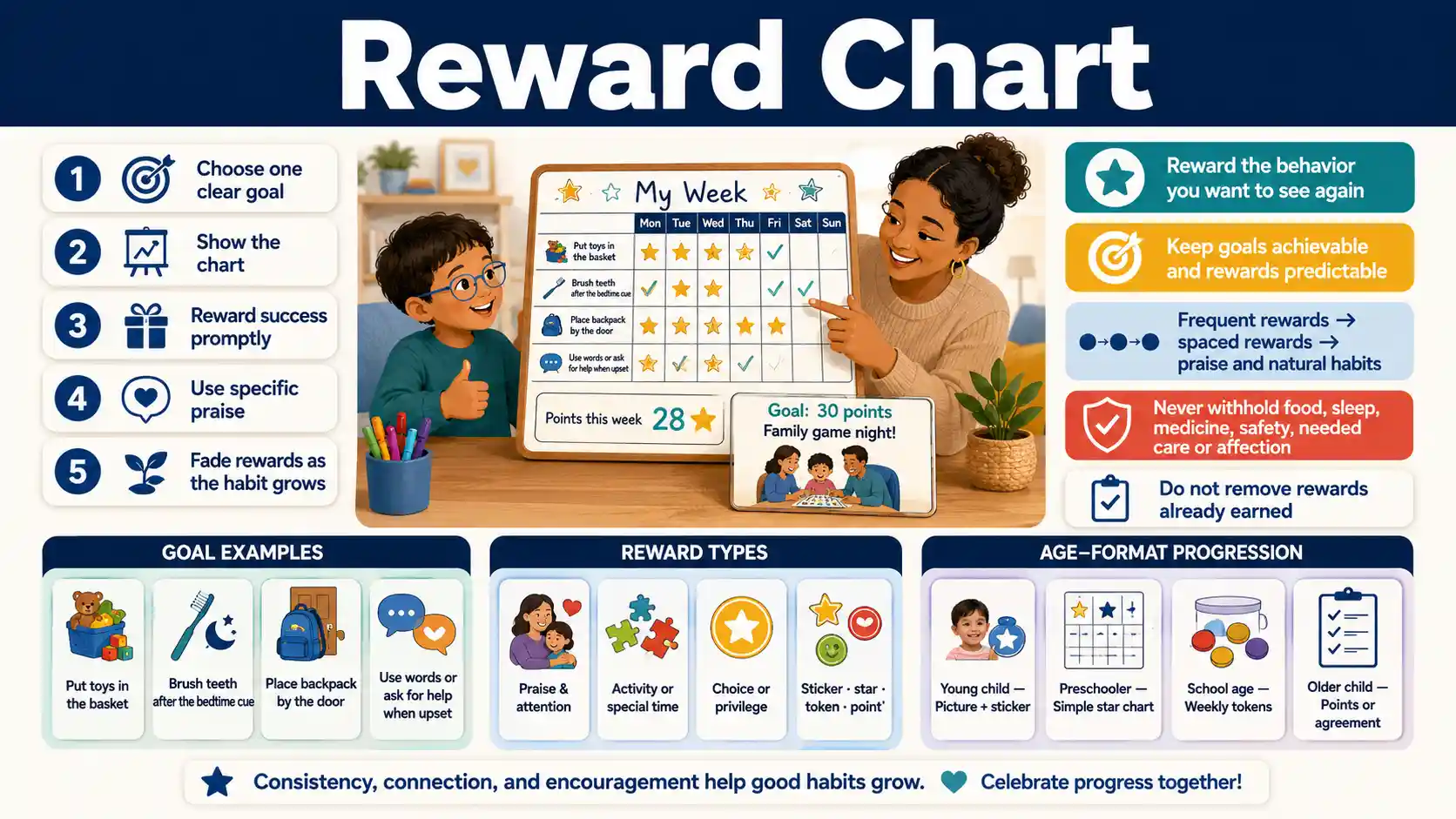
How do you make a reward chart that works?
Choose one specific behavior, make the goal easy to understand, and give positive feedback soon after success. The CDC reward-program guidance recommends clear behaviors, rewards the child values, immediate reinforcement for young children, visible tracking, and gradual changes as the behavior improves.
Goal
One observable behavior
Write exactly what the child should do, when it should happen, and what counts as success.
Feedback
Fast and specific
Give the mark and labeled praise soon after the behavior, especially when the skill is new.
Reward
Meaningful, not necessarily material
Praise, attention, activities, choices, privileges, stickers, tokens, and points can all reinforce progress.
End goal
Fade the chart gradually
As the behavior becomes reliable, space out external rewards while keeping connection, recognition, and natural consequences.
Direct answers to common reward chart questions
What is a reward chart?
A reward chart tracks one or more specific positive behaviors and pairs success with a planned mark, token, point, privilege, activity, or other reward.
Do reward charts work?
Reward charts can increase a clearly defined behavior when the child can do the task, understands the goal, values the reward, and receives consistent feedback.
How many goals should be on a reward chart?
Start with one to three goals. A short chart is easier to understand and score consistently.
Should rewards happen right away?
For young children and new behaviors, give the reward or chart mark immediately or very soon after success.
What type of praise works best?
Specific or labeled praise works best because it names the behavior the caregiver wants to see again.
Can I remove stars after bad behavior?
No. CDC guidance says rewards already earned should not be taken away; the child earns the next reward through a new success.
Are points better than stickers?
Stickers and tokens often suit younger children, while points and simple agreements can work better for older children who can understand delayed rewards.
Should a child choose the reward?
Letting the child help choose meaningful rewards can improve motivation, as long as the options are realistic and acceptable to the caregiver.
What if the child never earns the reward?
Simplify the goal, shorten the earning interval, check whether the child can perform the skill, and make sure the reward still matters to them.
When should rewards be phased out?
Fade external rewards gradually after the target behavior becomes more consistent and easier to perform.
Can basic needs be rewards?
No. Meals, water, sleep, medicine, needed care, safety, and caregiver affection should never depend on chart performance.
Can reward charts work for children with disabilities?
Yes. Adapt the chart with visuals, AAC, shorter intervals, accessible goals, sensory-friendly rewards, and the support the child needs to succeed.
Reward Chart Goal Design
A reward chart works best when each goal names one observable behavior that the child can realistically perform.
Swipe horizontally inside the table to view every column.
| Vague goal | Clearer goal | Why clearer works | How to measure it |
|---|---|---|---|
| Be good | Put toys in the basket after play | Names one visible action | One check when cleanup is finished |
| Listen better | Start the requested task after one clear direction | Defines what listening looks like | Mark each planned opportunity |
| Have a good morning | Get dressed before breakfast | Links the goal to a routine | One star each morning completed |
| Stop fighting | Use words or ask an adult for help when upset | States the replacement behavior | Reward the safe response when observed |
| Do homework | Begin homework by the agreed time | Separates starting from perfection | One point for starting on time |
| Be responsible | Place backpack by the door before bed | Makes responsibility concrete | One check each evening |
| Behave at bedtime | Stay in bed after the bedtime routine unless help is needed | Defines the setting and behavior | Reward the planned bedtime period |
| Improve manners | Say please or thank you during the chosen routine | Targets a specific social skill | Count selected opportunities only |
Choose one to three goals at a time for most home charts.
- • Write goals in positive language whenever possible.
- • The behavior should be specific enough that two adults could agree whether it happened.
Download or export
Reward Chart Formats by Age and Skill Level
Chart complexity should match the child’s language, memory, counting skills, and ability to wait for a reward.
Swipe horizontally inside the table to view every column.
| Stage | Useful format | Reward timing | Keep it simple by |
|---|---|---|---|
| Toddler / young preschooler | Picture + sticker or check | Immediately or very soon | One behavior and one short goal |
| Older preschooler | Picture or word chart with stars | Same day or after a few successes | Using a small visible target |
| Early school age | Weekly chart with stars or tokens | Daily plus small weekly goal | Tracking two or three behaviors |
| Older school age | Points by routine or responsibility | Daily or weekly | Letting the child help choose rewards |
| Preteen | Points, checklist, or simple agreement | Often weekly | Using meaningful privileges or activities |
| Teen | Collaborative agreement with measurable goals | Agreed schedule | Connecting privileges to specific responsibilities |
| Limited reading | Photos, icons, color blocks, or symbols | Short and immediate | Keeping text optional |
| Executive-function support | Visible checklist with frequent feedback | More frequent than peers may need | Breaking long routines into smaller steps |
Developmental fit matters more than chronological age alone.
- • CDC reward-program guidance is designed for toddlers and preschoolers; AAP guidance extends chart systems into school age.
- • Older children should participate in choosing realistic goals and rewards.
Download or export
Reward Types and Examples
Social rewards, attention, privileges, and activities can be powerful and often cost nothing.
Swipe horizontally inside the table to view every column.
| Reward type | Examples | Best use | Watch for |
|---|---|---|---|
| Specific praise | “You put your shoes away right after we got home.” | Every success and genuine effort | Praise the behavior, not a fixed label |
| Affection | High five, hug, smile, fist bump | When welcome to the child | Respect touch preferences |
| Attention | Read together, choose a game, one-to-one time | Connection-based motivation | Do not make basic affection conditional |
| Choice | Pick the family game, music, or story | Young children and routines | Offer realistic options |
| Privilege | Extra game time, choose dessert plate, later weekend lights-out | Older children | Keep it proportionate and pre-agreed |
| Activity | Park trip, craft, bake together, bike ride | Larger milestones | Choose feasible activities |
| Token / sticker | Star, stamp, point, token | Visible progress toward a goal | Define exactly what each mark means |
| Small item | Pencil, card, inexpensive collectible | Occasional milestone | Avoid making every behavior depend on purchases |
The reward should be meaningful, feasible, and appropriate for the child and household.
- • Social rewards can be given immediately and frequently.
- • Children may lose interest in one reward; refresh choices without changing the earned value.
Download or export
Simple Weekly Reward Chart Structure
Use a visible chart with clear opportunities, a defined target, and a reward the child understands before the week begins.
Swipe horizontally inside the table to view every column.
| Element | Example | Set before starting | Review question |
|---|---|---|---|
| Target behavior | Brush teeth after the bedtime cue | Exact behavior | Could the child explain the goal? |
| Opportunity | Once each evening | When it can happen | Was the opportunity available? |
| Mark | One star | What success earns | Was the mark given promptly? |
| Daily target | One star available | Maximum daily marks | Is the daily target attainable? |
| Weekly target | Five of seven stars | Success threshold | Does the target allow normal setbacks? |
| Reward | Choose Friday family game | Specific reward | Does the child still value it? |
| Praise phrase | “You started brushing after the cue.” | Labeled praise | Did the adult name the behavior? |
| Fade plan | After two steady weeks, move to verbal praise | How rewards will reduce | Is the habit becoming easier? |
A chart should measure success, not collect penalties.
- • AAP guidance recommends avoiding demerits and using charts as a measure of success.
- • CDC advises never removing rewards that a child has already earned.
Download or export
Reward chart starter-plan builder
Create a simple educational starting plan. This tool does not diagnose behavior problems or replace individualized clinical, school, or developmental support.
Pair the chart with labeled praise
A star alone does not tell a child what went well. The CDC guidance on labeled praise recommends naming the specific behavior, such as noticing that the child put toys away or started a routine after the cue.
Reward Timing and Praise Chart
The younger the child and the newer the behavior, the more helpful immediate feedback tends to be.
Swipe horizontally inside the table to view every column.
| Situation | Helpful response | Timing | Example |
|---|---|---|---|
| New behavior | Reward every planned success at first | Immediately | Sticker + specific praise |
| Partial effort | Praise the part the child completed | Immediately | “You started putting the blocks away.” |
| Established behavior | Use praise more and tokens less often | Soon after | Praise without a sticker every time |
| Multi-step routine | Reward the agreed step or full routine | At the planned checkpoint | Point after backpack routine |
| Long-term goal | Use small checkpoints | Daily or weekly | Points toward a larger activity |
| Missed goal | No mark for that opportunity; reset neutrally | At the next opportunity | “Next chance is after dinner.” |
| Unexpected success | Notice it even if no token is due | Right away | Specific praise or attention |
| Chart fading | Space out tokens and keep recognition | Gradually | Weekly goal replaces daily prize |
Immediate feedback is especially useful for toddlers and preschoolers.
- • Labeled praise tells the child exactly which behavior was successful.
- • Do not delay so long that the child cannot connect the reward with the behavior.
Download or export
Reward Chart Goal Examples for Home Routines
Choose behaviors that matter to the family and that the child can control directly.
Swipe horizontally inside the table to view every column.
| Routine | Specific goal | Possible mark | Possible reward |
|---|---|---|---|
| Morning | Get dressed after the first reminder | One check | Choose breakfast music |
| School prep | Put backpack and shoes by the door | One star | Choose car playlist |
| Homework | Begin within 10 minutes of the agreed time | One point | Choose family game after work is done |
| Chores | Place dishes on the counter after dinner | One sticker | Pick bedtime story |
| Sibling skills | Use words or ask for help instead of hitting | One token per planned period | Choose shared activity |
| Bedtime | Complete pajamas, teeth, and book routine | One star | Choose tomorrow’s story |
| Toilet learning | Sit or try at the planned opportunity | Sticker for effort | Extra story or song |
| Medication or medical care | Use only clinician-approved plans | Do not improvise a medical reward plan | Discuss barriers with the care team |
Reward effort and behaviors the child can control; do not reward medical outcomes or body functions that are not fully voluntary.
- • For toilet learning, reward a clear action such as trying or telling an adult rather than demanding a bowel movement on command.
- • Do not use a reward chart to pressure eating, weight change, pain tolerance, or symptom concealment.
Download or export
Use points and agreements as children get older
The American Academy of Pediatrics reward guidance describes tokens or stars for early school-age children and points or contracts for older children, with meaningful rewards and gradual fading as the behavior becomes internalized.
Points and Token System for Older Children
Older children can use points or contracts when expectations, values, and exchange rules are transparent and collaborative.
Swipe horizontally inside the table to view every column.
| Part | Example | Good practice | Avoid |
|---|---|---|---|
| Point value | Homework started on time = 1 point | Keep values easy to remember | Changing values after the fact |
| Bonus | Five school mornings on time = 2 bonus points | Use sparingly for meaningful streaks | Complex bonus math |
| Small reward | 5 points = choose dessert or game | Make achievable within days | Only large distant rewards |
| Medium reward | 15 points = choose weekend activity | Agree on options in advance | Rewards adults cannot reliably provide |
| Large reward | 30 points = special outing | Use for sustained goals | Making expensive items the only motivator |
| Tracking | Child and adult review points together | Keep the record visible | Secret scoring |
| Disagreement | Check the written rule | Resolve calmly and consistently | Arguing or bargaining after each event |
| Fade | Raise spacing between points as habit strengthens | Preserve praise and natural outcomes | Stopping all recognition suddenly |
Points are a teaching scaffold, not a permanent payment system for every family responsibility.
- • AAP notes that points and contracts can suit older children better than simple token charts.
- • Build in regular review so the child can help update stale rewards.
Download or export
Reward Chart Troubleshooting Guide
When a chart stops working, first check the goal, timing, reward value, and whether the child can actually perform the behavior.
Swipe horizontally inside the table to view every column.
| Problem | Likely issue | Adjustment | Do not |
|---|---|---|---|
| Child forgets the chart | Chart is not visible or cue is weak | Move it to the routine location | Add more rules |
| Child rarely earns marks | Goal may be too hard or vague | Break it into a smaller behavior | Call the child lazy |
| Child earns marks but does not care | Reward lost value | Let the child choose new options | Increase punishment |
| Adults score differently | Rules are unclear | Write one observable definition | Debate in front of the child |
| Child bargains constantly | Exchange rules are unclear | Post the exact point values | Renegotiate every event |
| Chart causes meltdowns | Threshold may be too delayed or rigid | Shorten the earning interval | Use public shaming |
| Behavior improves | Chart is doing its job | Fade rewards gradually | Keep escalating prizes forever |
| Behavior worsens suddenly | Stress, sleep, health, learning, or family factors may be involved | Look beyond the chart and seek support if needed | Assume deliberate manipulation |
A reward chart should reduce confusion, not create new conflict.
- • CDC recommends checking whether the child can do the behavior, understands the goal, and values the reward.
- • Persistent or severe behavior concerns may need pediatric, school, or behavioral-health support.
Download or export
Reward Chart Adaptations for Different Learners
Change the chart to fit communication, sensory, attention, memory, mobility, and developmental needs rather than lowering dignity or respect.
Swipe horizontally inside the table to view every column.
| Need | Adaptation | Example | Key principle |
|---|---|---|---|
| Limited reading | Use pictures or photos | Photo of toothbrush beside the goal | Make the cue understandable |
| AAC user | Offer choice through AAC | Select preferred reward on device | Communication mode should not limit participation |
| ADHD / executive function | Use shorter intervals and visible cues | Morning points reviewed before school | Feedback should be frequent and concrete |
| Autistic child | Make rules literal and predictable | Same icon and same definition each day | Avoid hidden social expectations |
| Sensory differences | Choose tolerable rewards and settings | Quiet activity instead of noisy celebration | Reward should not create distress |
| Motor disability | Reward the accessible version of the task | Directing cleanup rather than lifting items | Measure the actual skill goal |
| Anxiety | Reward approach or coping steps | Enter the classroom with support | Do not punish fear symptoms |
| Multiple caregivers | Use one shared scoring rule | Same definition at both homes when feasible | Consistency should not erase household differences |
Individualize the method without using the chart to force masking, pain tolerance, or unsafe compliance.
- • A child should be able to understand what earns a mark and communicate preferences about rewards.
- • For disability-related or significant behavioral needs, coordinate with the child’s clinical or educational plan when appropriate.
Download or export
Reward Chart Safety and Fairness Boundaries
A reward system should teach skills without withholding basic needs, affection, dignity, safety, or earned rewards.
Swipe horizontally inside the table to view every column.
| Boundary | Use instead | Why it matters | Red flag |
|---|---|---|---|
| Do not remove earned rewards | Require a new success for a new reward | Preserves trust in the system | Taking stars away for unrelated behavior |
| Do not withhold meals, water, sleep, medicine, or needed care | Use optional privileges or activities | Basic needs are not behavior currency | “No dinner until you earn it” |
| Do not use humiliation | Private feedback and specific praise | Protects dignity | Public failure boards |
| Do not reward unsafe compliance | Reward safety skills and speaking up | Children need permission to refuse unsafe situations | Rewarding secrecy or unwanted touch |
| Do not demand perfection | Use achievable thresholds | Learning includes mistakes | One miss erases a whole week |
| Do not compare siblings | Track each child’s own goal | Abilities and needs differ | Winner-versus-loser family charts |
| Do not make affection conditional | Give connection freely | Caregiver warmth is not a prize | Hugs available only after points |
| Stop and reassess if distress grows | Simplify or replace the chart | The tool should support learning | Daily conflict centered on scoring |
Rewards should be positive consequences, not leverage over basic rights or safety.
- • CDC specifically advises never taking away rewards a child has already earned.
- • AAP recommends nonviolent, non-humiliating discipline strategies.
Download or export
Common reward chart mistakes
Using vague goals
Replace “be good” with one visible behavior that can be scored consistently.
Tracking too many behaviors
Start with one to three priorities instead of turning the chart into a full report card.
Waiting too long to reward a young child
Shorten the delay so the child can connect the behavior with the positive consequence.
Taking away earned stars
Keep earned marks intact and require a new success for the next reward.
Changing the rules midweek
Post the goal, point value, and reward before the earning period begins.
Choosing rewards the child does not value
Offer a small menu and refresh choices when motivation fades.
Rewarding only perfection
Recognize realistic progress, effort, and smaller steps when the skill is developing.
Keeping the chart forever
Fade external rewards after the behavior becomes stable while continuing natural praise and connection.
Frequently asked questions
What is a reward chart?
A reward chart is a visible system that tracks a specific positive behavior and gives a planned reward, token, star, point, or privilege after success.
What age can a reward chart start?
Simple picture-and-sticker charts can work for some toddlers and preschoolers when the goal is very concrete and the reward happens quickly.
How many behaviors should a reward chart track?
Start with one to three behaviors. A short chart is easier to understand, score consistently, and review.
Should I give a reward every time?
For a new behavior, frequent immediate rewards can help. As the habit strengthens, gradually space out tokens while keeping praise and natural positive feedback.
What rewards work best?
The best reward is one the child values and the caregiver can reliably provide. Praise, attention, choices, activities, privileges, stickers, and points can all work.
Should I take stars away for bad behavior?
No. CDC guidance says earned rewards should not be removed. A new reward should require a new instance of the desired behavior.
Should a child lose food or bedtime for missing a goal?
No. Meals, hydration, sleep, medicine, needed care, safety, and basic affection should never depend on chart performance.
Are sticker charts bribes?
A planned reward given after a clearly defined behavior is positive reinforcement. It differs from bargaining during a conflict when expectations were not set in advance.
How do I make the goal specific?
Name one observable action, the situation where it should happen, and how success will be marked. “Put shoes by the door after school” is clearer than “be responsible.”
What if the chart is not working?
Check whether the child can do the behavior, understands the goal, receives feedback soon enough, and still cares about the reward.
Can reward charts work for children with ADHD or autism?
Yes, when the system is adapted with clear language, visuals, shorter intervals, predictable rules, accessible goals, and rewards that fit the child’s preferences.
Should siblings use the same chart?
Not necessarily. Children can have different goals, reward schedules, and supports because age, ability, needs, and motivation differ.
How long should a reward chart last?
Use it long enough to teach the target behavior, then gradually fade external rewards as the behavior becomes more established and easier to sustain.
Can I use a reward chart for potty training?
Yes, but reward a controllable step such as sitting, trying, telling an adult, or following the routine rather than demanding a bowel movement on command.
Can a reward chart replace discipline?
No. A reward chart is one teaching tool. Children also need clear rules, calm limits, consistent consequences, modeling, connection, and age-appropriate support.
When should I get professional help instead of changing the chart?
Seek support when behavior is severe, unsafe, suddenly changes, causes major impairment, or may be related to health, developmental, learning, trauma, sleep, or mental-health concerns.
Sources
These child-development and positive-discipline references support the behavior-goal, reinforcement, praise, chart-format, troubleshooting, and safety guidance used on this page.
Centers for Disease Control and Prevention — Tips for Using Rewards
https://www.cdc.gov/parenting-toddlers/discipline-consequences/using-rewards.html
Explains how immediate rewards, clear target behaviors, visible charts, social rewards, and gradual fading can increase desired behavior in toddlers and preschoolers.
Centers for Disease Control and Prevention — Tips for Praise, Imitation, and Description
https://www.cdc.gov/parenting-toddlers/communication/praise.html
Recommends labeled praise that tells children exactly which behavior the caregiver noticed and liked.
Centers for Disease Control and Prevention — Steps for Giving Good Directions
https://www.cdc.gov/parenting-toddlers/directions/good-directions.html
Supports specific, age-appropriate directions that tell a child what to do rather than relying on vague commands.
Centers for Disease Control and Prevention — Tips for Creating Structure and Rules
https://www.cdc.gov/parenting-toddlers/structure-rules/index.html
Explains how predictable routines and clear rules help children know what to expect and support consistent caregiver responses.
Centers for Disease Control and Prevention — Practice Parenting Skills: Discipline and Consequences
https://www.cdc.gov/parenting-toddlers/discipline-consequences/parenting-skills.html
Provides a blank reward-chart resource and emphasizes age-appropriate expectations, praise, hugs, kisses, stickers, and check marks.
American Academy of Pediatrics — Positive Reinforcement Through Rewards
https://www.healthychildren.org/English/family-life/family-dynamics/Pages/Positive-Reinforcement-Through-Rewards.aspx
Describes weekly behavior charts, tokens or stars for younger school-age children, points or contracts for older children, meaningful rewards, and gradual fading.
American Academy of Pediatrics — What’s the Best Way to Discipline My Child?
https://www.healthychildren.org/English/family-life/family-dynamics/communication-discipline/Pages/Disciplining-Your-Child.aspx
Recommends calm teaching, clear limits, consistent consequences, attention to positive behavior, and avoiding spanking or humiliating discipline.
American Academy of Pediatrics — How to Shape & Manage Your Young Child’s Behavior
https://www.healthychildren.org/English/family-life/family-dynamics/communication-discipline/Pages/How-to-Shape-Manage-Young-Child-Behavior.aspx
Supports describing positive behavior and praising genuine effort while maintaining regular positive attention and connection.