Finance & Money
RMD Chart
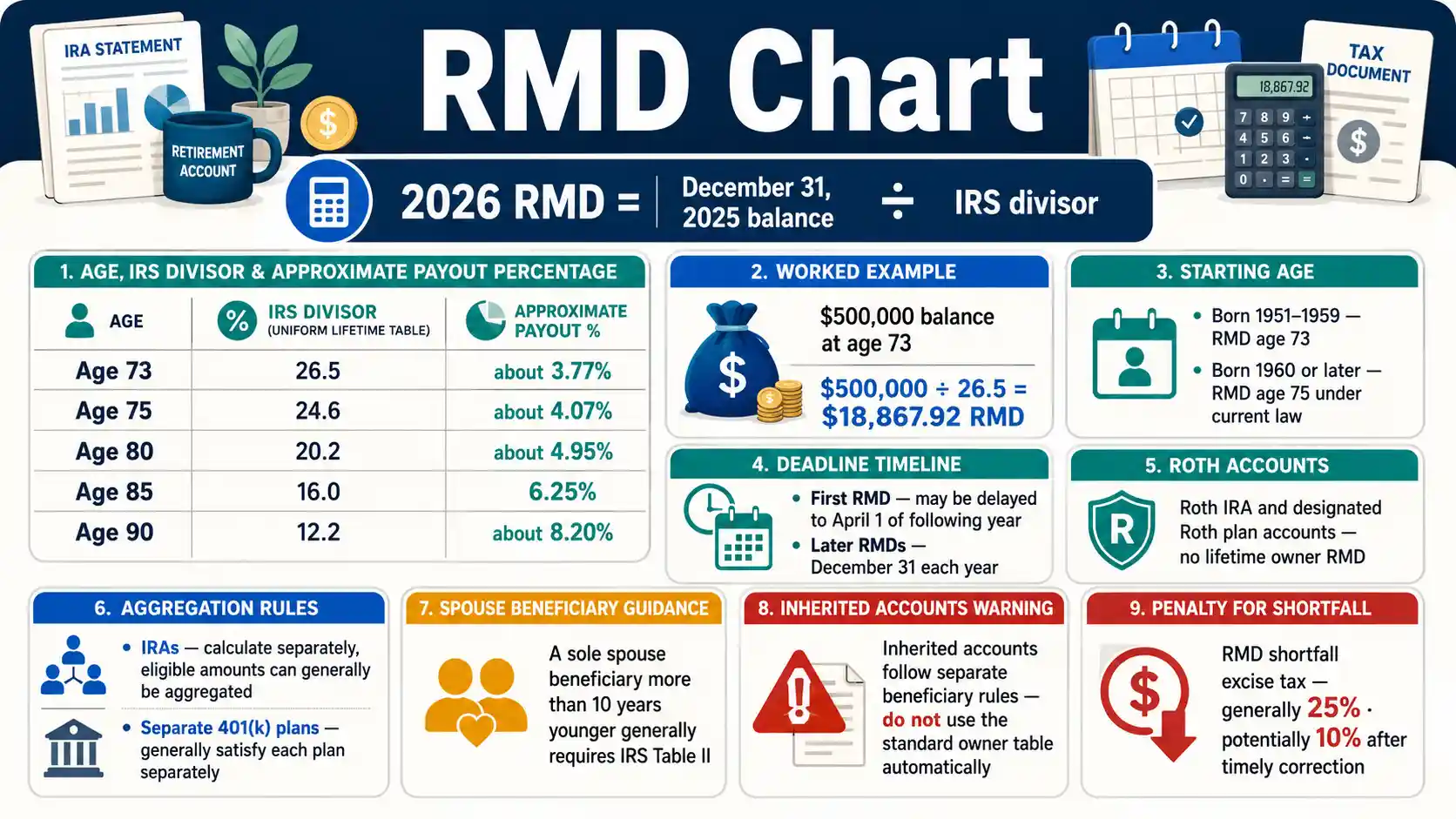
A required minimum distribution is the annual minimum that generally must leave certain tax-deferred retirement accounts after the owner reaches the applicable starting point. For a typical IRA owner using the Uniform Lifetime Table, the calculation is prior December 31 balance ÷ IRS life-expectancy divisor.
For 2026, an owner who is age 73 and uses Table III has a divisor of 26.5. A $500,000 adjusted December 31, 2025 balance therefore produces an illustrative 2026 RMD of about $18,867.92. IRS Publication 590-B provides the 2026 method and life-expectancy tables.
The age rule depends on birth cohort. The current SECURE 2.0 cohort generally uses age 73, while people born in 1960 or later move to age 75 under current law. IRS 2026 guidance confirms the age-73 and age-75 framework.
Current owner age
73
Current SECURE 2.0 cohort generally begins owner RMDs at age 73; a later cohort moves to age 75.
Age 73 divisor
26.5
Uniform Lifetime Table III divisor, equal to about 3.77% of the prior year-end balance.
$500k at age 73
$18,867.92
Illustrative 2026 owner RMD using $500,000 ÷ 26.5.
Regular annual deadline
December 31
After the special first-year deadline, subsequent RMDs generally must be completed by year-end.
How the RMD rules work in practice
The standard owner calculation uses the prior year-end balance, not the current account value on the day the withdrawal is made. Market gains or losses during the distribution year can therefore change the percentage of the current balance that the fixed dollar RMD represents.
The first IRA RMD can be postponed until April 1 of the following year, but the next RMD is still due by December 31 of that same year. Delaying can therefore create two RMDs in one tax year.
Roth IRA owners do not have lifetime RMDs. Designated Roth accounts in 401(k) and 403(b) plans also no longer have lifetime owner RMDs, although beneficiaries remain subject to post-death distribution rules.
An IRA owner must calculate each IRA RMD separately, but eligible IRA RMD amounts can generally be combined and withdrawn from one or more of those IRAs. Separate 401(k) plan RMDs generally cannot be combined this way.
RMDs are generally included in taxable income except for basis or another tax-free portion. The required amount itself is not eligible for rollover into another tax-deferred retirement account.
A spouse who is the sole beneficiary and more than 10 years younger changes the calculation. That owner generally uses the Joint and Last Survivor Table instead of the Uniform Lifetime Table shown in the calculator below.
Inherited IRAs require a separate analysis. Beneficiary type, whether the original owner died before or after the required beginning date, spouse elections, the 10-year rule, and life-expectancy rules can change both timing and amount. Do not use the owner calculator for an inherited account.
RMD Starting Age by Birth Date
The applicable RMD age changed under the SECURE Act and SECURE 2.0. The later age-75 rule applies to the cohort that reaches age 74 after 2032.
Swipe horizontally inside the table to view every column.
| Birth date | Applicable RMD age | General first RMD timing | Current relevance |
|---|---|---|---|
| Before July 1, 1949 | 70½ | Historical rule applied | Already past the original required beginning age |
| July 1, 1949–December 31, 1950 | 72 | Historical SECURE Act rule applied | Already past the original required beginning age |
| January 1, 1951–December 31, 1959 | 73 — Current age-73 cohort | Generally by April 1 after the year age 73 is reached | Current age-73 cohort |
| January 1, 1960 or later | 75 — Future age-75 cohort | Generally by April 1 after the year age 75 is reached | Future age-75 cohort under current law |
Owner rules only. Workplace plans can permit a later start based on retirement, except for certain owners.
- • Traditional, SEP, and SIMPLE IRA owners do not get a still-working delay.
- • The first-year April 1 delay can cause two taxable RMDs in one calendar year because the next annual RMD is still due by December 31.
Download or export
IRS Uniform Lifetime Table for RMDs
Use Table III for most account owners. The denominator is based on age attained during the distribution year. A spouse who is the sole beneficiary and more than 10 years younger generally requires Table II instead.
Swipe horizontally inside the table to view every column.
| Age | Divisor | Approx. % of prior balance | Age | Divisor | Approx. % of prior balance |
|---|---|---|---|---|---|
| 73 | 26.5 — Age-73 divisor | 3.77% | 97 | 7.8 | 12.82% |
| 74 | 25.5 | 3.92% | 98 | 7.3 | 13.70% |
| 75 | 24.6 — Age-75 divisor | 4.07% | 99 | 6.8 | 14.71% |
| 76 | 23.7 | 4.22% | 100 | 6.4 | 15.63% |
| 77 | 22.9 | 4.37% | 101 | 6.0 | 16.67% |
| 78 | 22.0 | 4.55% | 102 | 5.6 | 17.86% |
| 79 | 21.1 | 4.74% | 103 | 5.2 | 19.23% |
| 80 | 20.2 | 4.95% | 104 | 4.9 | 20.41% |
| 81 | 19.4 | 5.15% | 105 | 4.6 | 21.74% |
| 82 | 18.5 | 5.41% | 106 | 4.3 | 23.26% |
| 83 | 17.7 | 5.65% | 107 | 4.1 | 24.39% |
| 84 | 16.8 | 5.95% | 108 | 3.9 | 25.64% |
| 85 | 16.0 | 6.25% | 109 | 3.7 | 27.03% |
| 86 | 15.2 | 6.58% | 110 | 3.5 | 28.57% |
| 87 | 14.4 | 6.94% | 111 | 3.4 | 29.41% |
| 88 | 13.7 | 7.30% | 112 | 3.3 | 30.30% |
| 89 | 12.9 | 7.75% | 113 | 3.1 | 32.26% |
| 90 | 12.2 | 8.20% | 114 | 3.0 | 33.33% |
| 91 | 11.5 | 8.70% | 115 | 2.9 | 34.48% |
| 92 | 10.8 | 9.26% | 116 | 2.8 | 35.71% |
| 93 | 10.1 | 9.90% | 117 | 2.7 | 37.04% |
| 94 | 9.5 | 10.53% | 118 | 2.5 | 40.00% |
| 95 | 8.9 | 11.24% | 119 | 2.3 | 43.48% |
| 96 | 8.4 | 11.90% | 120+ | 2.0 | 50.00% |
Approximate percentage = 100 ÷ divisor. RMD = prior December 31 adjusted account balance ÷ applicable divisor.
- • The percentage column is a mathematical restatement of the divisor, not a withdrawal recommendation.
- • Beneficiaries generally use different rules and may use Table I rather than this owner table.
Download or export
RMD Examples by Age and Prior-Year Balance
Illustrative owner RMDs using the Uniform Lifetime Table. Each amount is the prior December 31 balance divided by the age-specific denominator.
Swipe horizontally inside the table to view every column.
| Age | Divisor | $100,000 balance | $500,000 balance | $1,000,000 balance |
|---|---|---|---|---|
| 73 | 26.5 | $3,773.58 | $18,867.92 — $500,000 age-73 example | $37,735.85 |
| 75 | 24.6 | $4,065.04 | $20,325.20 | $40,650.41 |
| 80 | 20.2 | $4,950.50 | $24,752.48 | $49,504.95 |
| 85 | 16.0 | $6,250.00 | $31,250.00 | $62,500.00 |
| 90 | 12.2 | $8,196.72 | $40,983.61 | $81,967.21 |
| 95 | 8.9 | $11,235.96 | $56,179.78 | $112,359.55 |
| 100 | 6.4 | $15,625.00 | $78,125.00 | $156,250.00 |
Illustrative U.S. dollars before tax withholding. Does not apply Table II or beneficiary rules.
- • A changing account balance means the dollar RMD must be recalculated each year from the new prior-year-end balance.
- • Withdrawals above the RMD are allowed, but excess amounts do not reduce a future-year RMD.
Download or export
Browser-only IRS Table III tool
Uniform Lifetime RMD Calculator
Estimate an owner RMD using the prior December 31 account balance and the IRS Uniform Lifetime divisor for the age reached during the distribution year.
Full calculated RMD
$18,867.92
$500,000.00 ÷ 26.5.
Remaining modeled RMD
$18,867.92
After subtracting entered distributions that count toward this year's RMD.
Uniform divisor
26.5
Equivalent to about 3.77% of the entered prior-year-end balance.
Monthly equivalent
$1,572.33
RMD ÷ 12 for budgeting only. The IRS does not require equal monthly withdrawals.
Formula: annual RMD = adjusted prior December 31 balance ÷ applicable IRS life-expectancy denominator.
Use a different method when required: this calculator does not apply Table II for an owner whose sole beneficiary spouse is more than 10 years younger, Table I for beneficiaries, inherited-account 10-year rules, annuity adjustments, or special 403(b) rules.
The calculation runs only in your browser. No retirement-account balance, age, or withdrawal amount is transmitted or stored.
RMD Deadlines and First-Year Timing
The first distribution year has a special April 1 deferral option. Using it does not postpone the second annual RMD, which remains due by December 31 of that same following calendar year.
Swipe horizontally inside the table to view every column.
| Situation | Deadline | Balance used | Planning consequence |
|---|---|---|---|
| First IRA RMD year | December 31 of the year applicable age is reached, or delay to April 1 of next year — First-year April 1 option | Prior December 31 balance | Delaying can bunch two RMDs into the following tax year |
| Second and later RMDs | December 31 each year — Regular December 31 deadline | Prior December 31 balance | Annual deadline continues even if first RMD was delayed |
| Workplace plan with allowed still-working delay | Generally April 1 after later of applicable age or retirement | Plan balance under applicable rules | 5% owners generally cannot use the retirement delay |
| Traditional / SEP / SIMPLE IRA while still working | Age-based IRA deadline still applies | Prior December 31 IRA balance | Employment does not postpone IRA owner RMDs |
| Owner dies after required beginning date | Any remaining owner RMD for year of death must still be completed | Calculated as if owner lived the full year | Beneficiary then follows post-death rules |
- • A different rule may apply to separately accounted pre-1987 403(b) amounts.
- • Plan documents and account status can affect workplace-plan timing.
Download or export
Which Retirement Accounts Have Owner RMDs?
Lifetime owner RMD treatment depends on account type. Beneficiary RMD rules can apply even when the original owner had no lifetime RMD requirement.
Swipe horizontally inside the table to view every column.
| Account type | Owner lifetime RMD? | Still-working delay? | Key point |
|---|---|---|---|
| Traditional IRA | Yes | No | Age-based owner RMD rules apply |
| SEP IRA | Yes | No | IRA-style RMD treatment |
| SIMPLE IRA | Yes | No | IRA-style RMD treatment |
| 401(k) / profit-sharing plan | Generally yes | Often possible until retirement if plan permits; not for certain 5% owners | Calculate plan RMD under applicable plan rules |
| 403(b) | Generally yes | Often possible until retirement if plan permits | Pre-1987 amounts can have a special rule if separately accounted |
| Governmental 457(b) | Generally yes | Workplace-plan timing rules apply | RMD generally must be satisfied from the plan account |
| Roth IRA | No while owner is alive — No lifetime Roth IRA owner RMD | Not applicable | Beneficiaries are subject to post-death distribution rules |
| Designated Roth 401(k) / 403(b) | No while owner is alive — No lifetime designated Roth plan owner RMD | Not applicable to owner RMD | SECURE 2.0 removed owner lifetime RMDs beginning in 2024 |
| Inherited traditional or Roth account | Beneficiary rules apply | No owner-style still-working exception | Rules depend on beneficiary type and owner death timing |
- • RMD rules are not the same as general withdrawal eligibility rules.
- • A qualified Roth distribution can be tax-free, but beneficiary distribution deadlines can still apply after death.
Download or export
RMD Aggregation Rules Across Multiple Accounts
Calculating each account separately does not always mean the withdrawal must come from that same account. The aggregation rule depends on account type.
Swipe horizontally inside the table to view every column.
| Accounts owned | Calculate each RMD separately? | Can aggregate withdrawals? | Practical rule |
|---|---|---|---|
| Multiple traditional / SEP / SIMPLE IRAs | Yes | Generally yes across eligible IRAs — IRA aggregation generally allowed | Total IRA RMD can generally be taken from one or more of the owner’s IRAs |
| Multiple 403(b) contracts | Yes | Generally yes across eligible 403(b) contracts | Total 403(b) amount can generally be taken from one or more 403(b) contracts |
| Multiple 401(k) plans | Yes | No across separate plans — 401(k) plan RMDs generally separate | Each plan RMD generally must be satisfied from that plan |
| 401(k) plus IRA | Yes | No across account categories | An IRA withdrawal cannot satisfy a separate 401(k) RMD |
| Governmental 457(b) plus another plan | Yes | Generally no cross-plan aggregation | Satisfy each plan’s RMD under its own rules |
| Inherited accounts | Yes under beneficiary rules | Special restrictions apply | Do not combine inherited-account obligations with your own IRA RMD without confirming the rule |
- • The account owner remains responsible for taking the correct total even if a custodian calculates an amount.
- • Aggregation mistakes can create an RMD shortfall even when total retirement withdrawals seem large enough.
Download or export
RMD Tax, Penalty and Inherited-Account Rules
RMD administration includes more than the divisor. Tax treatment, rollover restrictions, beneficiary status, and missed-distribution corrections can materially change the result.
Swipe horizontally inside the table to view every column.
| Rule or situation | General treatment | Why it matters | What to verify |
|---|---|---|---|
| Taxation | Generally ordinary taxable income except basis or other tax-free amounts | RMD can affect taxable income and other tax calculations | Basis, Roth status, withholding and state tax rules |
| Rollover | The year’s RMD amount is not eligible for rollover | Rolling an RMD back into a tax-deferred account can create an invalid rollover | Amount that must be distributed before rollover |
| Take more than the RMD | Allowed | Extra withdrawal can meet spending needs but does not prepay future RMDs | Tax and portfolio impact |
| Missed or short RMD | 25% excise tax on shortfall; 10% if timely corrected within two years — Excise tax for RMD shortfall | Shortfalls can be costly | Form 5329 and possible reasonable-error waiver |
| QCD from eligible IRA | A qualifying charitable distribution can count toward the RMD | Can satisfy distribution while directing funds to eligible charity | Age, account, charity, annual limit and timing requirements |
| 10-year beneficiary rule | Many designated beneficiaries must empty the inherited account by end of 10th year | Annual distribution requirements can also depend on death timing and beneficiary type | Whether owner died before or after required beginning date and whether beneficiary is eligible designated beneficiary |
| Spouse more than 10 years younger and sole beneficiary | Use Joint and Last Survivor Table II for owner RMD — Table II exception | Produces a different divisor from Uniform Lifetime Table III | Beneficiary designation and both spouses’ ages |
- • Inherited-account rules are substantially more complex than the owner RMD chart and should be checked against current IRS guidance.
- • A penalty waiver can be available for reasonable error when the shortfall is corrected and Form 5329 requirements are satisfied.
Download or export
Common RMD mistakes and special cases
Do not use the current balance by default
The standard annual calculation generally starts with the account balance at the end of the preceding calendar year. Certain transfers, rollovers, annuity purchases, or other situations can require adjustments.
Do not assume every account can be aggregated
Owned IRAs have a broad aggregation rule, while separate 401(k) plans generally require separate satisfaction. Taking enough from one account does not automatically cure another account's shortfall.
Do not use Table III for every situation
Table II can apply when a sole spouse beneficiary is more than 10 years younger. Beneficiaries can use Table I or a 5-year or 10-year framework depending on the facts.
Withholding does not change the gross RMD
Federal or state tax withholding can be taken from a distribution, but the gross distribution amount is what matters for satisfying the RMD. Tax liability depends on the recipient's full tax situation.
Inherited accounts, trusts, multiple beneficiaries, annuitized balances, QLACs, qualified charitable distributions, pre-1987 403(b) amounts, pensions, corrections, plan mergers, rollovers in transit, and changes in marital or beneficiary status can require rules beyond this chart. For a missed RMD, current IRS guidance states that the excise tax can be 25% of the shortfall and may fall to 10% when corrected within the specified two-year period; a reasonable-error waiver can also be available through Form 5329 procedures.
Frequently asked questions
What is an RMD?
A required minimum distribution is the minimum amount that generally must be withdrawn each year from certain tax-deferred retirement accounts after the applicable starting point.
What age do RMDs start now?
For the current SECURE 2.0 cohort born from 1951 through 1959, the applicable age is 73. Under current law, people born in 1960 or later have an applicable age of 75.
How is a 2026 RMD calculated?
For a typical owner using the Uniform Lifetime Table, divide the adjusted December 31, 2025 account balance by the IRS denominator for the age reached during 2026.
What is the age-73 RMD divisor?
The Uniform Lifetime Table denominator at age 73 is 26.5, which corresponds to about 3.77% of the prior year-end balance.
What is the age-75 RMD divisor?
The Uniform Lifetime Table denominator at age 75 is 24.6, which corresponds to about 4.07% of the prior year-end balance.
How much is the RMD on $500,000 at age 73?
Using the standard Uniform Lifetime divisor of 26.5, a $500,000 prior year-end balance produces an RMD of about $18,867.92.
When is the first RMD due?
An IRA owner can take the first RMD by December 31 of the applicable-age year or delay that first distribution until April 1 of the following year.
What happens if I delay my first RMD until April 1?
The next annual RMD is still due by December 31 of that same calendar year, so delaying the first RMD can put two taxable distributions into one year.
Do Roth IRAs have RMDs for the original owner?
No. Roth IRA owners do not have lifetime RMDs, although beneficiaries are subject to post-death distribution rules.
Do Roth 401(k) accounts have RMDs for the owner?
No. Beginning in 2024, designated Roth accounts in employer plans are not subject to lifetime owner RMDs.
Can I take all my IRA RMD from one IRA?
Generally yes after calculating each IRA RMD separately. Eligible IRA RMDs can generally be aggregated and withdrawn from one or more of the owner’s IRAs.
Can one 401(k) withdrawal satisfy another 401(k) RMD?
Generally no. RMDs from separate 401(k) or similar plan accounts generally must be satisfied separately from each plan.
Can an RMD be rolled over?
No. The amount that is required to be distributed for the year is not eligible for rollover into another tax-deferred retirement account.
What is the penalty for missing an RMD?
The IRS states that an RMD shortfall may be subject to a 25% excise tax, reduced to 10% when the shortfall is corrected within the specified two-year correction period.
Do inherited IRAs use the same RMD table?
Not usually. Beneficiaries can be subject to the Single Life table, 5-year or 10-year rules, spouse elections, and other rules based on beneficiary status and when the original owner died.
Sources
Internal Revenue Service — Retirement Plan and IRA Required Minimum Distributions FAQs
https://www.irs.gov/retirement-plans/retirement-plan-and-ira-required-minimum-distributions-faqs
Explains current owner RMD deadlines, account types, aggregation rules, taxation, rollover restrictions, and the excise tax for missed distributions.
Internal Revenue Service — Publication 590-B (2025), Distributions from Individual Retirement Arrangements
https://www.irs.gov/publications/p590b
Provides the 2026 RMD calculation method and Appendix B life-expectancy tables, including the Uniform Lifetime, Joint and Last Survivor, and Single Life tables.
Internal Revenue Service — RMD Comparison Chart — IRAs vs. Defined Contribution Plans
https://www.irs.gov/retirement-plans/rmd-comparison-chart-iras-vs-defined-contribution-plans
Compares first-distribution timing, still-working treatment, aggregation, and account-specific RMD obligations for IRAs and workplace defined-contribution plans.
Internal Revenue Service — Internal Revenue Bulletin 2026-06 — SECURE 2.0 RMD Changes
https://www.irs.gov/irb/2026-06_IRB
Confirms the applicable RMD age of 73 for the current SECURE 2.0 cohort, age 75 for the later cohort, and removal of lifetime RMDs from designated Roth plan accounts.