Body & Appearance · Skin
Skin Tone Chart for Fitzpatrick Types and Undertones
Compare Fitzpatrick sun-response types I–VI, separate visible skin tone from cosmetic undertone, match shades more consistently, and recognize skin changes across diverse complexions.
Skin tone cannot identify race, ethnicity, diagnosis, or safe procedure settings. No tone is immune to ultraviolet injury, pigment changes, or skin cancer. New, evolving, painful, bleeding, blistering, infected, or non-healing areas need appropriate medical assessment. Read the ChartsLoom Disclaimer.
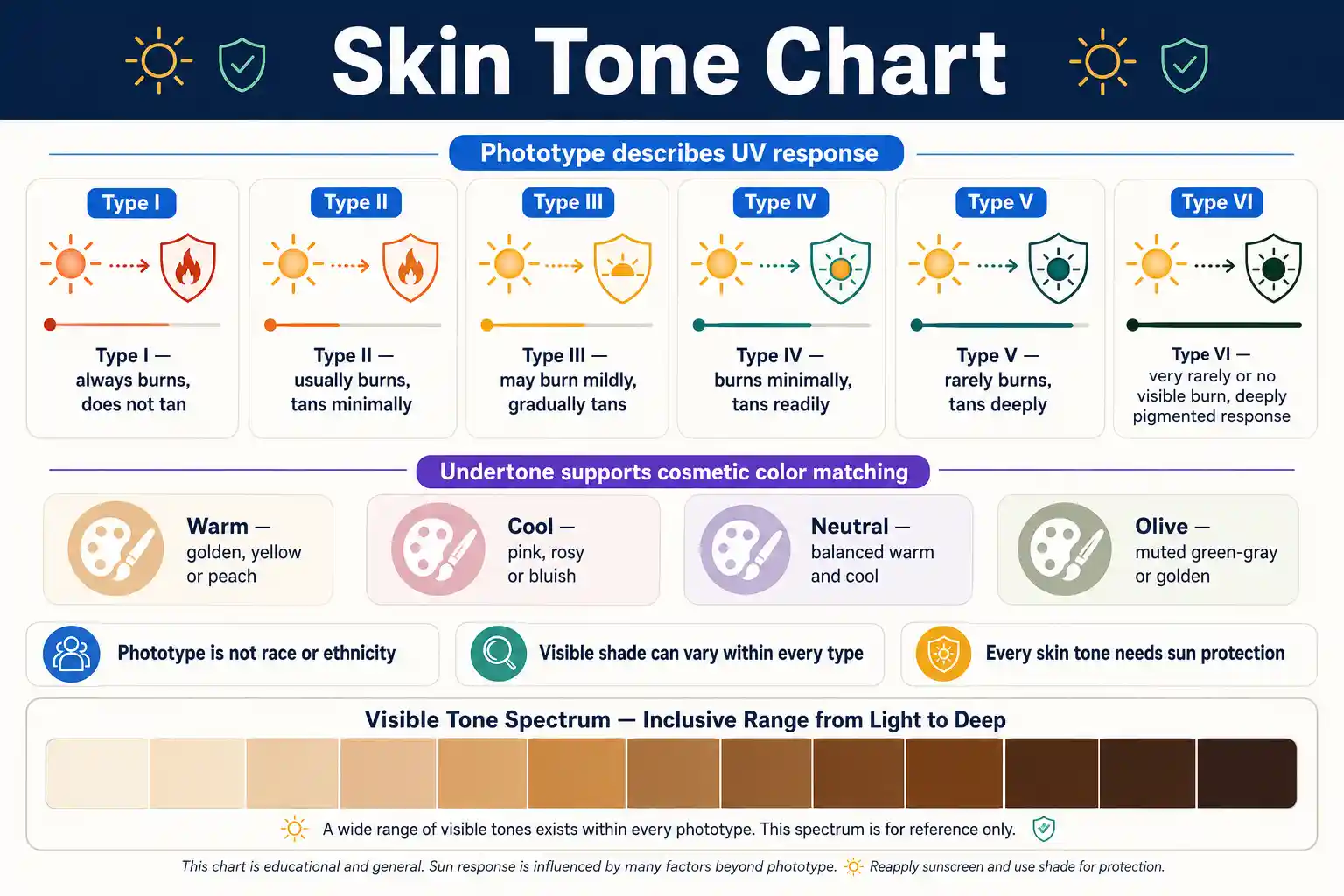
What does a skin tone chart show?
A useful skin tone chart separates three ideas: visible shade, cosmetic undertone, and Fitzpatrick phototype. Fitzpatrick types describe burning and tanning response; they do not define race, ethnicity, attractiveness, or exact skin color.
The original Fitzpatrick sun-reactive classification uses six types. Later research documents why the scale should not be treated as a substitute for visible color, race, or ethnicity. If burn and tan memories conflict, keep a range or mark the type uncertain.
Fitzpatrick scale
Types I–VI
Phototype is based on remembered burning and tanning response—not a visible shade swatch.
Cosmetic undertones
4 common labels
Warm, cool, neutral, and olive are useful conventions, but brand definitions can differ.
Sun protection
Every tone
More melanin does not remove UV damage, pigment-change, photoaging, or skin-cancer risk.
Best comparison
Personal baseline
Texture, warmth, swelling, symptoms, and change can matter when redness is difficult to see.
Skin Tone, Undertone and Phototype Terms
These terms answer different questions. Visible shade and cosmetic undertone describe appearance; Fitzpatrick phototype describes remembered response to ultraviolet exposure.
Swipe horizontally inside the table to view every column.
| Term | What it describes | How it is assessed | Do not use it as |
|---|---|---|---|
| Visible skin tone | Current light-to-deep surface color — Visible tone definition | Observation in neutral, indirect daylight or standardized imaging | A race, ethnicity, diagnosis, or UV-response category |
| Undertone | Cosmetic color impression beneath the surface shade — Undertone definition | Comparison across several neutral, warm, cool, or olive color cues | A medical diagnosis or sun-sensitivity measurement |
| Fitzpatrick phototype | Tendency to burn and tan after UV exposure — Phototype definition | Personal history of unprotected sun response | A foundation shade, race label, or exact skin color |
| Melanin | Pigments that contribute to skin, hair, and eye color | Laboratory or instrument-based measurement in research; not judged precisely by eye | Complete protection from UV damage |
| Complexion | Broad everyday description of facial skin appearance | Informal observation | A standardized scientific category |
| Tan | UV-triggered increase in pigmentation | Change from natural baseline after exposure | Proof that exposure was harmless or protective |
| Hyperpigmentation | An area darker than the person’s baseline | Pattern, onset, symptoms, exposures, and clinical examination | A natural undertone or cosmetic shade-depth label |
| Hypopigmentation or depigmentation | An area lighter than the person’s baseline | Pattern, progression, symptoms, and clinical examination | A Fitzpatrick type change |
Appearance terms are descriptive; Fitzpatrick I–VI is an ordinal sun-response classification.
- • Natural skin tone varies across the body and can change with season, UV exposure, hormones, inflammation, medicine, and illness.
- • A photograph can shift color because of lighting, white balance, exposure, camera processing, display settings, and makeup.
- • Race and ethnicity cannot be inferred reliably or respectfully from skin tone.
Download or export
Fitzpatrick Skin Type Chart I–VI
Fitzpatrick types classify how untanned skin usually reacts to ultraviolet exposure. The response pattern—not a color swatch or ancestry—defines the comparison.
Swipe horizontally inside the table to view every column.
| Type | Typical burn response | Typical tanning response | Interpretation limits |
|---|---|---|---|
| Type I — Type one | Always burns | Does not tan | A sun-response category; visible shade can vary |
| Type II | Usually burns | Tans minimally or with difficulty | Past exposure and recall can affect self-report |
| Type III — Type three | May burn mildly | Gradually tans to a light-brown response | Borderline patterns can overlap Type II or IV |
| Type IV | Burns minimally | Tans readily to a moderate-brown response | Does not mean UV exposure is harmless |
| Type V | Rarely burns | Tans deeply | Burning may be less visibly red and still cause pain or damage |
| Type VI — Type six | Very rarely or does not visibly burn | Deeply pigmented response | Does not eliminate UV damage or skin-cancer risk |
Type is written with Roman numerals I through VI.
- • The original scale is a sun-reactivity tool; it is not a comprehensive color scale.
- • Self-reported burning and tanning can be uncertain, especially when exposure history is limited or redness is hard to see.
- • A clinician may use additional history, examination, colorimetry, or test-dose methods when phototype affects a procedure.
Download or export
How to use a skin tone chart
Start with the decision you are trying to make. A foundation match, a sun-response history, and a changing rash require different observations and should not be collapsed into one color label.
1
Name the question
Decide whether you need visible shade, cosmetic undertone, UV response, or a medical assessment.
2
Use the right evidence
Use neutral light for shade, several swatches for undertone, and past burn-and-tan response for phototype.
3
Keep uncertainty
Choose mixed, uncertain, or adjacent types when the observations do not support one clear category.
4
Protect and observe
Use sun protection for every tone and assess new or changing findings against personal baseline.
Fitzpatrick phototype is based on ultraviolet response. It is not a race label, a precise visible-color scale, a measure of attractiveness, or permission to skip sun protection.
Skin Response Guide
Compare a remembered sun response and undertone
Use past burn-and-tan behavior for a cautious Fitzpatrick comparison. Cosmetic undertone is optional and kept separate. No image is uploaded, and selections stay in your browser.
Phototype comparison
Phototype uncertain
A consistent burn-and-tan history is needed. Keep the actual observations rather than assigning a Roman numeral.
Burn response
Uncertain or conflicting memories
The history does not support one repeatable burn pattern.
Tan response
Uncertain or little exposure history
The history does not support one repeatable tanning pattern.
Cosmetic undertone
Undertone not assessed
Cosmetic undertone is optional and does not affect the Fitzpatrick comparison.
Use emergency services for a sudden rash with breathing difficulty, throat symptoms, severe facial swelling, collapse, or another life-threatening reaction. Do not wait for a specific color change.
How to Estimate Fitzpatrick Phototype
Use a consistent memory of untanned skin after unprotected sun exposure. Avoid deliberately exposing skin to UV radiation to test a type.
Swipe horizontally inside the table to view every column.
| Question | Most useful observation | Why it matters | Common mistake |
|---|---|---|---|
| Which skin area? | Recall an area that was not already tanned | Pre-existing tan can change the next response | Judging only the darkest or most exposed area |
| What exposure? | A meaningful past exposure without deliberate testing | Very brief or heavily protected exposure may reveal little | Seeking new unprotected exposure for classification |
| Did it burn? | Pain, tenderness, warmth, swelling, or later peeling—not redness alone — Burn symptoms | Burning can be present when color change is subtle | Assuming no visible red color means no burn |
| How often did it burn? | Consistent history: always, usually, sometimes, minimally, rarely | Frequency helps separate adjacent types | Using one unusual childhood event |
| Did it tan? | No tan, minimal tan, gradual tan, ready tan, or deep tan | Tanning response complements burn history | Treating a tan as evidence of skin health |
| When was the response checked? | Symptoms and color change over the following hours and days | Sunburn may not be immediate | Judging only during exposure |
| Do memories conflict? | Choose uncertain or a range between adjacent types — Uncertain result | Real responses do not always fit one box | Forcing a single type from mixed evidence |
| Is a procedure planned? | Ask the treating clinician for an in-person assessment | Laser, light, and peel safety needs more than an online category — Procedure safety | Selecting device settings from a self-test |
Estimate from past response only; no intentional UV test is recommended.
- • Photosensitivity from medicines or medical conditions can change burn response and may make historical type less useful.
- • A current tan, self-tanner, makeup, lighting, and camera color do not establish phototype.
- • When uncertain, record the actual burn-and-tan history instead of relying only on a Roman numeral.
Download or export
Undertone is a cosmetic comparison, not a medical test
Warm, cool, neutral, and olive labels help organize color matching, but brands define them differently. Compare multiple nearby swatches at the jawline in neutral light and check the product after it dries. Vein color and jewelry preference can be clues, but neither is reliable enough to decide an undertone alone.
Warm, Cool, Neutral and Olive Undertone Chart
Undertone is a cosmetic color-matching convention, not a medical classification. Use several comparisons in neutral light because one cue can be misleading.
Swipe horizontally inside the table to view every column.
| Undertone label | Common color impression | Useful comparison | Important limitation |
|---|---|---|---|
| Warm — Warm undertone | Golden, yellow, or peach impression | Several warm and neutral swatches near the jawline | Warm surface tanning can mask a different baseline impression |
| Cool — Cool undertone | Pink, rosy, red, or bluish impression | Several cool and neutral swatches near the jawline | Visible redness from irritation is not necessarily undertone |
| Neutral | Balanced warm and cool impression | Neutral swatches that do not turn strongly orange, pink, or gray | Many people sit between commercial categories |
| Olive | Green, gray-green, or muted golden cast | Muted or olive-labeled swatches beside neutral options | Olive can occur at any shade depth and is not identical to warm |
| Mixed or seasonal | Different cues across face, neck, chest, or seasons | Match the intended area and current baseline | One label may not fit every product or season |
| Uncertain | No repeatable pattern across comparisons | Use a small set of close swatches and check after they dry | Vein color or jewelry preference alone is not a reliable test — Uncertain undertone |
Undertone labels are qualitative cosmetic categories without universal diagnostic criteria.
- • Commercial brands define undertone labels differently, so the same person may match different labels across products.
- • Vein appearance depends on skin depth, lighting, vessel depth, and surrounding color; treat it as one weak clue only.
- • Jewelry preference reflects taste and metal finish as well as color harmony.
Download or export
Skin Shade and Foundation Matching Steps
A repeatable shade match uses neutral lighting, the intended wear area, multiple nearby swatches, and enough time for the product to dry.
Swipe horizontally inside the table to view every column.
| Step | What to do | What it prevents | Helpful record |
|---|---|---|---|
| Start with bare skin | Remove tinted products from the test area | Existing pigment altering the comparison | Products removed and skin-care layer used |
| Use neutral light | Stand in indirect daylight or high-quality neutral indoor light — Neutral lighting | Warm, cool, green, or dim lighting bias | Lighting and location |
| Match the wear area | Compare jawline, neck, or body area the product must blend with | Matching only a darker forehead or lighter inner wrist | Area tested |
| Select close depths | Choose one likely shade plus a slightly lighter and deeper option | Anchoring on the first plausible shade | Shade names or numbers |
| Compare undertones | Include adjacent warm, cool, neutral, or olive options | Confusing depth mismatch with undertone mismatch | Brand’s undertone labels |
| Use narrow swatches | Place separate stripes without blending them together | Losing side-by-side comparison | Swatch order |
| Let it dry | Wait the product’s normal set time before judging — Dry-down check | Missing oxidation, darkening, or finish change | Wet and dry observations |
| Check face and neck | View from conversational distance as well as close up | A perfect spot match that creates a visible edge | Best blend boundary |
| Patch-test new products | Follow product directions and stop if irritation develops — Patch test | Treating color matching as an allergy or irritation test | Product, date, and skin reaction |
Shade names and numbers are brand-specific and cannot be converted universally.
- • Face, neck, chest, and hands often differ because of UV exposure, blood flow, irritation, or natural variation.
- • Self-tanner, recent sun exposure, active rash, peeling, or inflammation can make a baseline match temporary.
- • A color match does not prove that a product is non-irritating, non-comedogenic, or appropriate for a skin condition.
Download or export
Every skin tone benefits from sun protection
The American Academy of Dermatology sunscreen guidance recommends broad-spectrum, water-resistant SPF 30 or higher. More melanin can reduce visible burning and lower some risk, but it does not block all ultraviolet damage. Shade, covering clothing, hats, sunglasses, and correct reapplication remain important.
Sun Protection Guidance for Every Skin Tone
More melanin can reduce visible burning and lower—but not remove—some UV-related risks. Sun protection remains relevant across all skin tones and phototypes.
Swipe horizontally inside the table to view every column.
| Protection step | Practical guidance | Applies to | Key limitation |
|---|---|---|---|
| Broad-spectrum sunscreen | Choose UVA and UVB protection | Every skin tone — All skin tones | No sunscreen blocks all UV radiation |
| SPF level | AAD recommends SPF 30 or higher — AAD SPF guidance | Every skin tone | Higher SPF does not allow unlimited exposure |
| Water resistance | Choose 40- or 80-minute water resistance for swimming or sweating | Outdoor and water activity | No sunscreen is waterproof |
| Application timing | Apply as directed before exposure | Exposed skin not covered by clothing | Missed areas reduce protection |
| Reapplication | At least every two hours and after swimming, sweating, or towel drying as labeled — Reapplication | Ongoing outdoor exposure | A morning application does not last all day |
| Clothing and shade | Use shade, hats, sunglasses, and covering clothing | Every skin tone | Sunscreen is only one part of protection |
| Tinted sunscreen | A matching tint with iron oxide can add visible-light protection for dark spots | People managing hyperpigmentation or white cast | Tint does not replace broad-spectrum SPF |
| Infants under 6 months | Prioritize shade and protective clothing; ask a clinician about sunscreen use | Young infants | Adult product routines should not be assumed |
SPF measures protection against sunburn-producing UVB under standardized test conditions.
- • A tan is a sign of UV response and does not make future exposure safe.
- • Skin that rarely burns can still develop UV damage, pigment changes, photoaging, and skin cancer.
- • Photosensitizing medicines and medical conditions may require individualized sun precautions.
Download or export
How Skin Findings Can Look Across Skin Tones
Inflammation and disease can change color, texture, temperature, swelling, and sensation. Compare with the person’s baseline instead of searching only for “redness.”
Swipe horizontally inside the table to view every column.
| Finding | Possible appearance variation | Also check | Reason to get care |
|---|---|---|---|
| Inflammation or rash | Pink or red; violet, purple, brown, gray, or darker than baseline | Texture, warmth, swelling, itch, pain, and spread — Assess beyond redness | Rapid spread, severe pain, illness, or uncertain cause |
| Sunburn | Redness may be obvious or subtle; skin can darken, feel hot, tender, swollen, or peel | Pain, warmth, blistering, fever, and exposure history | Extensive blistering, severe symptoms, or infant burn |
| Infection around a rash | Red, purple, brown, or darker surrounding skin | Warmth, pus, crust, odor, pain, fever, and red/dark streaking | Spreading change, fever, severe pain, or feeling unwell — Possible infection |
| Bruise | Red or purple early; blue, brown, green, yellow, gray, or very dark as it changes | Tenderness, swelling, injury history, and unexplained recurrence | Large unexplained bruises, severe pain, or bleeding |
| Dry or scaly area | White or ashy scale may contrast more strongly on deeper tones | Cracks, itch, pain, product use, and distribution | Persistent, widespread, infected, or treatment-resistant area |
| Acne inflammation | Pink, red, purple, brown, or skin-colored bumps | Tenderness, depth, scarring, and lingering dark marks | Painful nodules, scarring, or significant distress |
| Post-inflammatory change | Darker or lighter patch after rash, injury, acne, or procedure | Whether the original inflammation is still active | New, worsening, widespread, or unexplained pigment loss or gain |
| Pale or gray appearance | May be easier to notice in lips, gums, palms, soles, or comparison with baseline | Breathing, alertness, circulation, and sudden onset | Sudden change with weakness, fainting, or breathing difficulty |
| Changing lesion | Tan, brown, black, pink, red, blue, white, gray, or mixed colors | Asymmetry, border, growth, bleeding, pain, itch, and evolution | New, evolving, non-healing, or unlike other spots — Changing lesion |
Color words are examples, not diagnostic criteria.
- • Lighting and camera processing can hide or exaggerate color change; direct examination is more informative.
- • Texture, warmth, swelling, pain, itch, speed of spread, and systemic symptoms may be more reliable than color alone.
- • Do not delay care because a rash or infection does not look bright red.
Download or export
Dark Spots, Light Spots and Pigment Changes
A pigment change is a comparison with personal baseline. Its distribution, trigger, timing, symptoms, and progression matter more than an undertone label.
Swipe horizontally inside the table to view every column.
| Pattern | Possible context | Useful observation | Avoid this mistake |
|---|---|---|---|
| Dark mark after acne or rash | Post-inflammatory hyperpigmentation — Post-inflammatory hyperpigmentation | Original trigger, picking, irritation, UV exposure, and fading trend | Using harsh products that create more inflammation |
| Light mark after inflammation | Post-inflammatory hypopigmentation | Whether color is returning and whether the rash is controlled | Assuming every light area is vitiligo |
| Symmetric facial patches | Melasma or another pigment condition | Hormonal context, sun and visible-light exposure, medicines, and pattern | Self-diagnosing from color alone |
| Sharply defined depigmented patches | Vitiligo is one possibility | New areas, progression, hair color change, and family history | Treating without confirming the cause |
| Darkening after a product | Irritant or allergic inflammation with residual pigment | New ingredients, burning, itch, scaling, and timing | Continuing a product because the rash is not bright red |
| Change after a procedure | Inflammation, burn, bruising, or pigment alteration | Procedure type, settings, onset, pain, blistering, and progression | Repeating treatment before review — Procedure complication |
| New generalized color change | Medicine, hormone, metabolic, circulation, or systemic context | Eyes, mucosa, symptoms, medicine list, and timing | Calling it a seasonal undertone shift |
| Persistent unexplained spot | Benign or concerning lesion; examination may be needed | Evolution, symptoms, surface change, bleeding, and healing | Trying to bleach or cover a changing lesion — Persistent lesion |
Pigment changes are described relative to the person’s natural baseline.
- • Darker skin tones may develop more noticeable or longer-lasting post-inflammatory dark marks.
- • Treating the underlying inflammation and avoiding irritation are central to preventing new marks.
- • New, spreading, painful, blistering, bleeding, or non-healing changes need medical assessment.
Download or export
Skin checks must include every tone and body area
The AAD guide to finding skin cancer in darker skin tones emphasizes persistent sores, changing areas, palms, soles, and nail changes. Check the whole body and compare with personal baseline. A lesion can be concerning even if it is not bright red, large, or located on sun-exposed skin.
Skin Self-Check and Care Timing Chart
Every skin tone can develop skin cancer. Check the whole body and act on new, changing, non-healing, painful, or bleeding areas rather than relying on phototype alone.
Swipe horizontally inside the table to view every column.
| Situation | What to look for | Suggested action | Important detail |
|---|---|---|---|
| ABCDE change | Asymmetry, irregular border, varied color, diameter concern, or evolution | Arrange prompt medical assessment — ABCDE assessment | Evolution or looking unlike other spots can be especially important |
| New or changing growth | Growth, color, shape, surface, itch, pain, or bleeding changes | Arrange medical assessment | Skin cancer can occur in any skin tone |
| Sore that does not heal | Repeated crusting, bleeding, breakdown, or return | Arrange prompt medical assessment | Do not repeatedly cover or treat without review |
| Palm, sole, or nail change | New spot, vertical nail band, widening color, nail lifting, or pigment around nail — Palm sole or nail change | Arrange dermatology assessment | These locations deserve attention in every tone |
| Rapidly spreading rash | Fast expansion, widespread involvement, or significant swelling | Urgent medical care | Color may be red, purple, brown, gray, or darker than baseline |
| Breathing trouble or facial swelling with rash | Sudden rash plus trouble breathing, throat symptoms, or swelling | Emergency services now — Emergency reaction | Possible severe allergic reaction |
| Painful or blistering rash | Severe pain, blisters, raw skin, or eyes, mouth, lips, or genitals involved | Urgent medical assessment | Medicine reactions and infections are among possible causes |
| Possible skin infection | Increasing warmth, pain, swelling, pus, crust, odor, fever, or streaking | Prompt or urgent care based on severity | Do not wait for bright redness |
| Stable familiar mark | No change in size, shape, color, surface, or symptoms | Continue routine observation | Photographs can help compare but do not diagnose |
| Head-to-toe self-check | Scalp, back, underarms, nails, palms, soles, between toes, and hidden areas | Use mirrors or help for hard-to-see areas | Compare with the person’s own baseline and other spots |
Care timing is based on change and symptoms, not Fitzpatrick type.
- • A spot can be concerning even when it is small or does not match every ABCDE feature.
- • Darker natural skin lowers some UV-related risk but does not eliminate skin cancer.
- • Use local emergency services for breathing difficulty, collapse, severe swelling, or another life-threatening reaction.
Download or export
Frequently asked questions
What is the Fitzpatrick skin type chart?
The Fitzpatrick chart groups skin into six phototypes according to how untanned skin usually burns and tans after ultraviolet exposure. It was designed as a sun-reactivity classification, not as a precise visible-color scale, race label, foundation guide, or measure of skin health.
What are Fitzpatrick skin types I through VI?
Type I typically always burns and does not tan; Type II usually burns and tans minimally; Type III may burn mildly and gradually tans; Type IV burns minimally and tans readily; Type V rarely burns and tans deeply; Type VI very rarely or does not visibly burn and is deeply pigmented.
How do I find my Fitzpatrick skin type?
Use your consistent history of burning and tanning on previously untanned skin, including pain, tenderness, warmth, swelling, or peeling—not redness alone. Do not deliberately expose skin to UV radiation to test a type, and choose uncertain when your memories conflict.
Is Fitzpatrick skin type the same as skin color?
No. Fitzpatrick type describes UV response, while visible skin tone describes appearance. People with a similar visible tone can report different burn-and-tan patterns, and people in one phototype can have varied appearances. Neither should be used to infer race or ethnicity.
Can Fitzpatrick type determine laser or peel settings?
No online self-classification should determine procedure settings. Laser, light, peel, and energy-based procedure safety depends on the device, wavelength, dose, skin condition, recent tanning, medicines, operator training, and an in-person assessment that may go beyond Fitzpatrick type.
What is a skin undertone?
Undertone is a cosmetic description of the color impression beneath the visible surface shade. Common commercial labels are warm, cool, neutral, and olive. These labels have no universal clinical test, and the same person may match different terms across brands.
How can I tell if my undertone is warm, cool, neutral, or olive?
Compare several nearby swatches at the jawline in neutral indirect daylight and view them after drying. Warm tends golden or peach, cool tends pink or bluish, neutral appears balanced, and olive appears muted green-gray or golden. Use uncertain if cues are mixed.
Is the vein test accurate for skin undertone?
Vein color is only a weak cosmetic clue because lighting, vessel depth, skin depth, surrounding color, and individual anatomy affect what you see. Jewelry preference is also subjective. A side-by-side product swatch in neutral light is more useful than either clue alone.
Can skin undertone change?
The underlying color impression may seem fairly stable, but tanning, irritation, acne, dryness, hormones, circulation, self-tanner, makeup, lighting, and seasonal exposure can change surface appearance. Match the current intended wear area rather than relying on an old label.
Do darker skin tones need sunscreen?
Yes. More melanin can reduce visible burning and lower some UV-related risk, but it does not block all UV damage or eliminate skin cancer, photoaging, or pigment changes. The AAD recommends broad-spectrum, water-resistant SPF 30 or higher for exposed skin.
Can dark skin get sunburned?
Yes. Burning may be less visibly red on deeply pigmented skin, so also check for tenderness, warmth, swelling, tightness, pain, blistering, peeling, or a change from baseline. Rarely burning is not the same as being immune to ultraviolet damage.
Why can a rash look different on darker skin?
Inflammation can appear pink or red, but it may also look violet, purple, brown, gray, or darker than surrounding skin. Texture, warmth, swelling, pain, itch, spread, fever, and change from personal baseline help identify a problem when redness is subtle.
What causes dark spots after acne or a rash?
Inflammation can trigger post-inflammatory hyperpigmentation, leaving a darker mark after acne, injury, irritation, or a rash. Picking and irritating products can worsen it. Persistent, spreading, painful, bleeding, or unexplained changes should be assessed before treatment.
Can people with darker skin tones get skin cancer?
Yes. Anyone can get skin cancer. Check the whole body, including palms, soles, nails, between toes, scalp, mouth, and other hidden areas. Seek assessment for a new or changing growth, a sore that does not heal, or a spot that bleeds, hurts, or looks unlike others.
When should a skin change need urgent care?
Use emergency services for a sudden rash with trouble breathing, throat symptoms, severe facial swelling, collapse, or another life-threatening reaction. Rapid spread, severe pain, blistering, fever, infection signs, or involvement of the eyes, mouth, lips, or genitals needs urgent assessment.
Sources
Phototype definitions and limitations, sun protection, pigment changes, inclusive skin assessment, warning signs, and self-check guidance were checked against these publications and health organizations.
PubMed, U.S. National Library of Medicine — The Validity and Practicality of Sun-Reactive Skin Types I Through VI
Indexes Thomas Fitzpatrick’s 1988 paper describing six sun-reactive phototypes based on burning and tanning response.
https://pubmed.ncbi.nlm.nih.gov/3377516/
PubMed, U.S. National Library of Medicine — Racial Limitations of Fitzpatrick Skin Type
Reviews limitations of using Fitzpatrick type as a proxy for visible skin color, race, or ethnicity and supports separating these concepts.
https://pubmed.ncbi.nlm.nih.gov/32186531/
American Academy of Dermatology — Sunscreen FAQs
Recommends broad-spectrum, water-resistant SPF 30 or higher and explains the additional visible-light role of a matching tinted sunscreen for dark spots.
https://www.aad.org/media/stats-sunscreen
U.S. Food and Drug Administration — Sunscreen: How to Help Protect Your Skin from the Sun
Explains broad-spectrum sunscreen, sun-protective clothing, midday exposure reduction, and reapplication at least every two hours and after swimming or sweating.
https://www.fda.gov/drugs/understanding-over-counter-medicines/sunscreen-how-help-protect-your-skin-sun
Centers for Disease Control and Prevention — Skin Cancer Risk Factors
States that anyone can get skin cancer and lists lighter natural skin, burning tendency, UV exposure, moles, family history, and age among risk factors.
https://www.cdc.gov/skin-cancer/risk-factors/index.html
Centers for Disease Control and Prevention — Symptoms of Skin Cancer
Identifies a new growth, a sore that does not heal, or a changing mole or skin spot as reasons to seek medical assessment.
https://www.cdc.gov/skin-cancer/symptoms/index.html
American Academy of Dermatology — Finding Skin Cancer in Darker Skin Tones
Shows how skin cancer may appear in darker skin and emphasizes checking palms, soles, nails, and persistent or changing areas.
https://www.aad.org/public/diseases/skin-cancer/find/skin-of-color
American Academy of Dermatology — What to Look For: ABCDEs of Melanoma
Explains asymmetry, border, color variation, diameter, and evolving change while noting that a concerning spot may not meet every letter.
https://www.aad.org/public/diseases/skin-cancer/find/at-risk/abcdes
American Academy of Dermatology — Rash 101 in Adults: When to Seek Medical Treatment
Lists rapidly spreading, painful, blistering, infected, widespread, and illness-associated rashes that need medical care and describes inflammation in varied colors.
https://www.aad.org/public/everyday-care/itchy-skin/rash/rash-101
American Academy of Dermatology — How to Fade Dark Spots in Darker Skin Tones
Explains that treating the cause of hyperpigmentation and avoiding irritating products can help prevent new dark spots.
https://www.aad.org/public/everyday-care/skin-care-secrets/routine/fade-dark-spots
American Academy of Dermatology — Find Skin Cancer: How to Perform a Skin Self-Exam
Provides a head-to-toe self-exam method that includes the scalp, nails, palms, soles, between toes, back, and other hard-to-see areas.
https://www.aad.org/public/diseases/skin-cancer/find/check-skin