Health & Medical · Digestive Health
Stool Color Chart for Meanings, Causes and Warning Signs
Compare brown, green, yellow, pale, black, red, maroon, and orange stool with form, food and medicine effects, infant patterns, bleeding clues, testing, and care timing.
Call local emergency services for heavy bleeding, large clots, vomiting blood, coffee-ground-like vomit, or black or red stool with fainting, confusion, severe weakness, or breathing difficulty. A color chart cannot measure blood loss or diagnose the cause. Read the ChartsLoom Disclaimer.
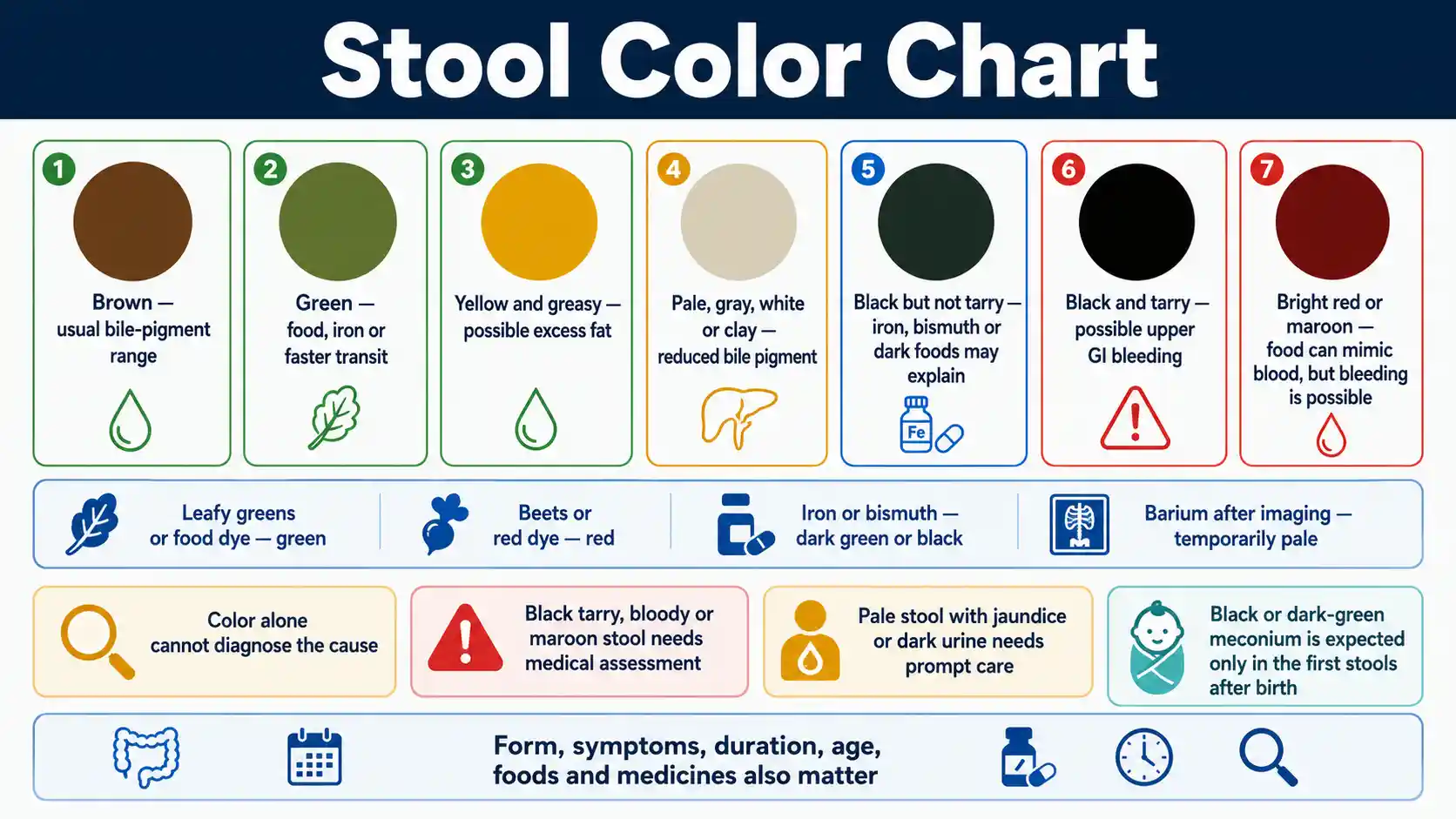
What does stool color mean?
Brown is the usual stool-color range, and green can also be typical. Food, medicines, bile, transit time, bleeding, and fat absorption can change the appearance.
The Mayo Clinic stool-color guide explains that bile normally changes from yellow-green toward brown during digestion. Black tarry, clearly bloody, or persistently pale or clay-colored stool is different from ordinary shade variation and needs medical context.
Usual range
Brown; sometimes green
Bile pigments, foods, medicines, and transit time create a broad normal-looking range.
Best context
Color + form + symptoms
Texture, visible blood, duration, pain, fever, hydration, and exposures refine meaning.
Urgent patterns
Tarry, bloody or maroon
Possible gastrointestinal bleeding needs medical assessment, especially with instability.
Infant warning
White, red or later black
Pale or chalky, bloody, or black stool after meconium needs prompt pediatric guidance.
Stool Color Meanings at a Glance
Color is an observation, not a diagnosis. Food, medicines, bile, transit time, bleeding, and absorption can all change appearance; texture and symptoms determine urgency.
Swipe horizontally inside the table to view every column.
| Observed color | Common context | What else to check | Care direction |
|---|---|---|---|
| Light to dark brown — Common expected color | Usual bile-pigment range | Form, frequency, comfort, and personal baseline | Usually expected when no concerning symptoms are present |
| Green | Leafy foods or dye; iron; bile moving through quickly during diarrhea | Recent foods, supplements, loose stool, fever, and hydration | Often temporary; assess persistent diarrhea or illness |
| Yellow-brown | Can fall within normal brown variation | Whether the stool is formed versus greasy, floating, or foul-smelling | Color alone is usually less useful than the full pattern |
| Yellow, greasy, foul-smelling | Excess fat in stool or another absorption problem is possible | Floating, oiliness, diarrhea, weight loss, travel, and duration | Arrange medical review if persistent or recurrent |
| Pale, gray, white, clay, or putty-colored | Too little bile pigment may be reaching the stool | Jaundice, dark urine, itching, pain, medicines, and persistence | Contact a clinician promptly, especially with jaundice or dark urine — Prompt assessment |
| Black but not tarry | Iron, bismuth, activated charcoal, black licorice, or dark foods may explain it | Exact exposure, stickiness, odor, weakness, dizziness, and recurrence | Do not assume an exposure explains tarry or symptomatic stool |
| Black, tarry, sticky, or unusually foul-smelling | Digested blood from upper gastrointestinal bleeding is possible | Vomiting blood, coffee-ground vomit, dizziness, fainting, weakness, or pain | Seek urgent medical assessment — Urgent assessment |
| Bright red | Food or dye can mimic blood; fresh bleeding is also possible | Blood on paper, streaks, blood mixed in, clots, pain, and amount | Visible or suspected blood should be medically assessed |
| Dark red or maroon | Bleeding higher in the colon or brisk gastrointestinal bleeding is possible | Amount, clots, weakness, lightheadedness, pain, and blood thinners | Urgent assessment is appropriate |
| Orange | Orange foods, dyes, and some medicines can change color | Whether stool is otherwise brown, pale, greasy, or associated with jaundice | Track exposures; seek advice if persistent or with other warning signs |
Use ordinary descriptive color words; lighting, toilet water, and phone cameras can alter perceived color.
- • All shades of brown and some green stools can occur in healthy digestion.
- • A familiar food or medicine can explain color without proving that bleeding or another condition is absent.
- • Severe symptoms outweigh the color category.
Download or export
How to read a stool color chart safely
Treat color as one part of a bowel-movement description. Texture, location of visible blood, duration, age, medicines, diet, hydration, pain, jaundice, and other symptoms make the observation clinically useful.
1
Name the closest color
Use brown, green, yellow, pale or clay, black, red, maroon, or orange.
2
Describe the appearance
Add formed, watery, greasy, tarry, sticky, streaked, mixed with blood, or mucus.
3
Check recent exposures
Record foods, dyes, iron, bismuth, charcoal, imaging contrast, and medicine changes.
4
Let symptoms set urgency
Bleeding, faintness, vomiting blood, jaundice, severe pain, or dehydration outweigh color.
The Bristol Stool Chart describes form, while a stool color chart describes pigment and visible material. Use both observations separately.
Foods and medicines can imitate warning colors
Beets and red dye can look like blood. Iron, bismuth, charcoal, and dark foods can look black. Green vegetables and dyes can produce green stool. Record the exposure, but do not use it to dismiss tarry texture, blood, jaundice, weakness, dizziness, or pain.
Foods, Supplements and Medicines That Can Change Stool Color
Recent exposures can create convincing color changes. Record the product and timing, but do not use a possible mimic to dismiss tarry stool, visible blood, jaundice, or severe symptoms.
Swipe horizontally inside the table to view every column.
| Exposure | Possible appearance | Useful distinction | Safety note |
|---|---|---|---|
| Leafy green vegetables | Green or dark green | Often follows a clear dietary change | Persistent watery stool still needs diarrhea context |
| Green, blue, or purple food dye | Green, blue-green, or very dark stool | Check drinks, frosting, candy, and frozen treats | Color can blend with brown and look nearly black |
| Beets, cranberries, tomato products, or red dye | Red, pink, or maroon-appearing stool | Compare timing and whether color is uniform or looks like blood | Uncertain red stool should be treated as possible blood — Possible blood mimic |
| Carrots, squash, sweet potato, or orange dye | Orange or yellow-orange | Usually follows strongly pigmented foods | Pale gray-white stool is a different finding |
| Blueberries, black licorice, or very dark foods | Dark brown to black | Usually lacks the tarry, sticky, foul-smelling quality of melena | Symptoms or tarry texture need urgent assessment — Melena distinction |
| Iron supplement | Dark green or black | Expected labeling may mention stool darkening | Do not stop prescribed iron without speaking with the prescriber |
| Bismuth subsalicylate | Black stool and sometimes a dark tongue | A known temporary medicine effect is common | Do not assume bismuth explains tarry stool with weakness or dizziness |
| Activated charcoal | Black | Exposure is usually obvious and time-linked | Charcoal use can complicate visual interpretation |
| Barium after an imaging study | Pale or whitish | Ask how long the expected post-test change should last | Persistent pale stool outside the expected window needs review |
| A new or changed medicine | Varies by product | Check the official label or pharmacist rather than guessing | Do not start, stop, or change a medicine based only on this chart |
Record the exact food, supplement, medicine, dose timing, and number of affected bowel movements.
- • A dietary explanation is more convincing when the color resolves after the exposure passes and no warning symptoms occur.
- • Blood can be mixed through stool, coat it, streak the surface, appear on paper, or darken after digestion.
- • A clinician can order tests when appearance alone cannot distinguish food pigment from blood.
Download or export
Stool Color Context Guide
Build a clearer stool-change summary
Combine color with form, visible blood, age, exposures, duration, and symptoms. The result is a communication note with safety reminders—not a diagnosis or treatment plan.
Safety reminder
No selected warning sign
A brief brown, green, orange, or exposure-linked change without concerning symptoms can often be observed. Seek advice if it persists, recurs, worsens, or no longer fits the selected context.
Generated summary
Stool color and symptom summary
Age context: Adult or older child
Closest color: Brown
Form or appearance: Formed or soft
Visible blood: No visible blood
Recent exposure: No known food, supplement, or medicine explanation
Duration: One bowel movement
Other selected symptom: No warning symptom selected
Additional context: Not specified
Safety reminder: No selected warning sign.
Interpretation note: Appearance cannot confirm blood, bleeding location, bile blockage, infection, or malabsorption.
Do not wait for another bowel movement when emergency signs appear. Call local emergency services for heavy or ongoing bleeding, large clots, vomiting blood, coffee-ground-like vomit, fainting, confusion, severe weakness, or breathing difficulty. Nothing entered here is stored or transmitted.
Newborn and infant stool uses a different baseline
Meconium is black or dark green, sticky, and expected only in the first stools after birth. Milk feeding then produces yellow, tan, brown, or green stool. White or chalky stool, visible blood, or black tarry stool after meconium needs prompt pediatric advice.
Newborn and Infant Stool Color Guide
Newborn stool changes quickly after birth. Feeding method and solids affect color and texture, while white or chalky stool, visible blood, or black stool after meconium require clinician guidance.
Swipe horizontally inside the table to view every column.
| Stage or color | Common appearance | Typical context | When to contact a clinician |
|---|---|---|---|
| Meconium — Early newborn stool | Black or very dark green, thick, sticky, and tar-like | The first stools after birth | Ask the newborn-care team if meconium timing or passage is concerning |
| Transitional stool | Green-brown to yellow-green and becoming looser | Appears as milk feeding replaces meconium | Discuss feeding difficulty, few wet diapers, vomiting, or lethargy |
| Breastfed milk stool | Mustard-yellow, loose, mushy, or seedy | Common after milk supply is established | Watery stool plus illness or dehydration signs needs assessment |
| Formula-fed stool | Yellow, tan, brown, or green; often pastier | Color and consistency vary by formula and infant | Hard pellets, blood, persistent vomiting, or poor feeding need advice |
| Green | Ranges from yellow-green to dark green | Can occur with either breast milk or formula | Use feeding, growth, hydration, and illness—not green color alone |
| After starting solids | Broader brown, green, orange, or food-related colors | Food particles and pigments may be visible | Suspected blood or persistent unusual color still needs review |
| White, gray, pale, or chalky | Little or no brown pigment | Not an expected feeding-method color | Contact the baby’s clinician promptly, especially with jaundice or dark urine — Prompt infant assessment |
| Red or visibly bloody | Streaks, spots, mixed blood, or red stool | Food can mimic red after solids, but blood must be considered | Contact the baby’s clinician promptly; urgent symptoms need emergency care |
| Black after the meconium period | Very dark, sticky, or tarry | Iron may darken stool, but digested blood is possible | Obtain prompt medical guidance rather than assuming it is normal — Prompt infant assessment |
Infant color should be interpreted with age in days, feeding method, wet diapers, feeding quality, growth, and behavior.
- • Meconium is a specific early-newborn context; later black tarry stool is interpreted differently.
- • A photo in neutral light and, when feasible, the diaper itself can help a clinician evaluate color.
- • Young infants can become dehydrated quickly during vomiting or diarrhea.
Download or export
Stool Color With Symptoms and Pattern Clues
The same color means different things in different contexts. Combine appearance with pain, fever, hydration, urine color, bleeding signs, weight change, and duration.
Swipe horizontally inside the table to view every column.
| Pattern | Possible context | Key questions | Action |
|---|---|---|---|
| Green plus short-lived loose stool | Rapid transit, food, dye, medicine, or infection | How frequent, how long, and are fluids staying down? | Monitor hydration; seek care for severe or persistent symptoms |
| Yellow, greasy, floating, foul-smelling stool | Fat malabsorption or an intestinal infection is possible | Is it recurrent with weight loss, gas, travel, or pain? | Arrange clinical assessment if persistent or recurrent |
| Pale stool plus jaundice or dark urine | Reduced bile flow or liver/biliary disease is possible | Are the eyes or skin yellow; is there itching, fever, or pain? | Seek prompt medical assessment — Prompt assessment |
| Black tarry stool plus dizziness or weakness | Significant upper GI bleeding is possible | Is there fainting, shortness of breath, pain, or vomiting blood? | Seek emergency medical care — Emergency assessment |
| Bright red blood on paper after a hard stool | An anal fissure or hemorrhoid is possible | How much blood, is pain present, and does it recur? | Contact a clinician; heavier bleeding or severe symptoms is urgent |
| Blood mixed through diarrhea plus fever or pain | Infectious or inflammatory bowel disease is possible | Travel, exposures, immune status, frequency, and hydration? | Obtain prompt medical assessment |
| Maroon stool or clots | Lower or brisk gastrointestinal bleeding is possible | Amount, medicines, faintness, shortness of breath, and recurrence? | Urgent or emergency assessment is appropriate |
| Mucus with a bowel-habit change | Irritation, infection, inflammation, or another condition is possible | Is mucus increasing, bloody, painful, or persistent? | Discuss recurrent or symptomatic mucus with a clinician |
| Brown stool with severe pain, fever, or dehydration | A serious problem can occur without an alarming color | Can fluids be kept down; is urine reduced; is pain severe? | Use the symptoms—not brown color—to decide urgency — Symptoms override color |
Pattern = color + form + visible material + duration + associated symptoms + age and medical context.
- • A reassuring color never cancels severe pain, dehydration, fainting, confusion, or repeated vomiting.
- • Blood thinners, anti-inflammatory medicines, liver disease, prior GI bleeding, and recent procedures can change urgency.
- • Pregnant, older, immunocompromised, and medically complex people may need earlier assessment.
Download or export
Red, maroon, and black tarry stool can reflect bleeding
The NIDDK gastrointestinal-bleeding guidance lists black or tarry stool and dark or bright red blood among possible acute-bleeding signs. Fainting, dizziness, fatigue, shortness of breath, abdominal pain, vomiting blood, or coffee-ground-like vomit increase urgency.
Visible Blood and Black Stool Pattern Guide
Appearance can suggest—but cannot prove—the source of bleeding. Food, medicines, lighting, and transit can mislead, so visible or suspected blood deserves medical context.
Swipe horizontally inside the table to view every column.
| Appearance | Clinical term or context | Possible source pattern | Safety interpretation |
|---|---|---|---|
| Bright red on toilet paper | Rectal bleeding | Anus or rectum, including fissure or hemorrhoid, is possible | Report recurrent bleeding; amount and symptoms matter |
| Bright red streak on stool surface | Fresh visible blood | A low rectal or anal source is possible | Seek medical advice even when the amount looks small |
| Bright or dark red mixed through stool | Hematochezia or visible GI bleeding | Colon or another GI source is possible | Prompt assessment is appropriate |
| Dark red or maroon stool | Partly digested or brisk bleeding pattern | Small bowel or colon source is possible | Urgent assessment is appropriate — Urgent bleeding pattern |
| Black, tarry, sticky, foul-smelling stool | Melena pattern | Upper GI bleeding is common in this pattern | Seek urgent medical assessment — Melena warning |
| Black formed stool after iron or bismuth | Medication-related darkening is possible | Non-bleeding exposure may explain color | Symptoms or tarry quality still require assessment |
| Blood too small to see | Occult blood | Bleeding may be detectable only with testing | A normal-looking stool cannot exclude microscopic blood |
| Red stool after strongly pigmented food | Food mimic is possible | Color may not be blood | If uncertain, persistent, or symptomatic, seek medical advice |
Describe location, amount, mixing, clots, texture, odor, number of episodes, and symptoms rather than relying on the color name alone.
- • Bleeding location cannot be confirmed from appearance alone.
- • Call emergency services for bleeding with fainting, confusion, severe weakness, breathing difficulty, or signs of shock.
- • Do not stop a blood thinner or prescribed anti-inflammatory medicine without urgent advice from the prescriber or emergency team.
Download or export
Stool Color, Form and Other Visible Features
Color and form answer different questions. A stool color chart should be paired with consistency, frequency, urgency, floating, oiliness, mucus, and the person’s usual pattern.
Swipe horizontally inside the table to view every column.
| Feature | What it describes | Why it matters | What it cannot show alone |
|---|---|---|---|
| Color | Pigment from bile, food, medicine, blood, or other material | Highlights possible bleeding, bile-flow, diet, or transit clues | Cannot diagnose the cause — Color limitation |
| Hard pellets or separate lumps | Very firm stool form | Often accompanies constipation or slow transit | Brown color does not make painful constipation harmless |
| Formed, smooth, or softly cracked stool | Common formed patterns | May fit an individual healthy baseline | Does not exclude microscopic blood or disease |
| Soft blobs or mushy stool | Loose form | Can reflect diet, medicines, infection, or faster transit | Green or yellow color does not identify the cause |
| Watery stool | Liquid diarrhea | Frequency and fluid loss can cause dehydration — Dehydration context | Color does not measure dehydration severity |
| Greasy, oily, floating, foul-smelling stool | Possible excess fat or gas | A recurrent pattern may suggest malabsorption | Floating alone is not a diagnosis |
| Mucus | Jellylike intestinal secretion | Increasing, bloody, painful, or recurrent mucus adds context | A small amount can occur without disease |
| Visible food pieces | Undigested or rapidly passed food material | Often reflects fibrous foods or rapid transit | Does not by itself show poor nutrient absorption |
| Very narrow stool | Change in diameter or shape | A persistent new bowel-habit change deserves discussion | A single episode cannot identify blockage or cancer |
Track color and form separately, then add frequency, urgency, pain, bleeding, fever, weight change, diet, and medicines.
- • The Bristol Stool Chart classifies form, not color.
- • Toilet-bowl water, cleaning products, and lighting can alter appearance.
- • Avoid using photographs alone to diagnose bleeding, infection, or malabsorption.
Download or export
Persistent pale or clay-colored stool needs review
MedlinePlus guidance on pale or clay-colored stool explains that bile salts contribute to brown color. Pale, gray, clay, putty, or white stool can occur when bile production or flow is reduced. Prompt assessment matters when it accompanies yellow skin or eyes, dark urine, itching, fever, or pain.
How to Track a Stool Color Change
A short factual record can make a medical discussion more useful. Do not delay urgent care to complete a diary or obtain a photograph.
Swipe horizontally inside the table to view every column.
| Record | Useful detail | Example | Why it helps |
|---|---|---|---|
| Date and time | Each affected bowel movement | Friday 7:30 a.m.; second episode today | Shows duration and recurrence |
| Closest color | Brown, green, yellow, pale, black, red, maroon, or orange | Black rather than dark brown | Creates consistent language |
| Texture and form | Formed, loose, watery, greasy, sticky, or tarry | Black, sticky, difficult to flush — Tarry description | Separates ordinary darkening from a melena-like pattern |
| Where color appears | Uniform, surface streak, mixed in, on paper, or in water | Bright red streak on surface | Adds bleeding-pattern context |
| Other material | Mucus, clots, oil, pus, or visible food | Jellylike mucus with loose stool | Identifies features color alone misses |
| Symptoms | Pain, fever, vomiting, dizziness, jaundice, dark urine, weakness, or dehydration | Pale stool with dark urine | Symptoms can determine urgency — Urgency context |
| Foods and products | Pigmented foods, supplements, medicines, contrast, and timing | Iron started three days ago | Identifies plausible mimics or triggers |
| Medical context | Age, pregnancy, recent travel, surgery, illness, GI history, and blood thinners | Prior ulcer and daily anticoagulant | Changes risk and evaluation |
| Photo or sample | Neutral light; avoid editing color; follow collection instructions | Unfiltered photo before flushing | Can support—but never replace—clinical assessment |
Use a brief record for one to several days unless a clinician requests longer tracking.
- • Do not handle stool directly; wash hands and follow any specimen instructions.
- • A phone camera may shift white balance and is not a color-calibrated diagnostic tool.
- • Seek care immediately when warning signs appear rather than waiting for another bowel movement.
Download or export
Clinical assessment can identify what color cannot
Clinicians combine the history, medicines, examination, and vital signs with selected stool tests, blood tests, imaging, endoscopy, or colonoscopy. Appearance may suggest a direction, but it cannot confirm blood, locate bleeding, diagnose blocked bile flow, or identify an infection.
How Clinicians Assess Abnormal Stool Color
The evaluation depends on the suspected problem. A clinician may need history and examination only, or may use stool, blood, imaging, endoscopic, or infection tests.
Swipe horizontally inside the table to view every column.
| Assessment | What it can address | Common context | Limit |
|---|---|---|---|
| History and medication review | Foods, products, timing, prior bleeding, liver disease, travel, and family history | Any unexplained color change | Recall and visual description can be imperfect |
| Physical examination and vital signs | Tenderness, hydration, jaundice, circulation, and illness severity | Bleeding, diarrhea, pain, or pale stool | A normal exam does not explain every recurrent change |
| Fecal occult blood test | Blood not visible to the eye | Selected bleeding or screening contexts | Not a home diagnosis for visible bleeding — Testing limitation |
| Blood count and related blood tests | Anemia and possible blood-loss severity | Suspected GI bleeding | Cannot locate the bleeding source |
| Liver and bile-related blood tests | Patterns that may support liver or biliary evaluation | Persistent pale stool, jaundice, or dark urine | Abnormal results require clinical interpretation |
| Stool infection testing | Selected bacteria, parasites, toxins, or inflammatory findings | Bloody, persistent, severe, or exposure-linked diarrhea | Not every short-lived diarrhea episode needs testing |
| Endoscopy or colonoscopy | Direct view, biopsy, and sometimes treatment — Direct evaluation | Suspected upper or lower GI bleeding or persistent symptoms | Requires clinical indication and preparation |
| Imaging or angiography | Biliary anatomy, inflammation, active bleeding, or another structural issue | Selected pale-stool, pain, or bleeding presentations | The appropriate test depends on the suspected cause |
Testing is selected from symptoms, examination, age, medicines, history, duration, and the suspected source.
- • At-home appearance cannot confirm blood, bile obstruction, infection, or fat malabsorption.
- • Screening stool tests are not substitutes for evaluating visible blood or black tarry stool.
- • Save medicine and supplement names for the visit; do not change prescribed therapy without advice.
Download or export
When a Stool Color Change Needs Medical Care
Care timing is symptom-based. Local services differ; use emergency services for severe bleeding or instability and contact a clinician promptly for persistent abnormal colors.
Swipe horizontally inside the table to view every column.
| Situation | Suggested timing | Why | Do now |
|---|---|---|---|
| Large amount of red blood, clots, or ongoing bleeding | Emergency now — Emergency | Substantial gastrointestinal blood loss is possible | Call local emergency services |
| Black tarry stool with fainting, severe weakness, confusion, or breathing difficulty | Emergency now — Emergency | Significant upper GI bleeding or shock is possible | Call local emergency services; do not drive yourself |
| Vomiting blood or coffee-ground-like material | Emergency now | Acute upper GI bleeding is possible | Call local emergency services |
| Dark red or maroon stool | Urgent assessment | Gastrointestinal bleeding is possible | Use urgent or emergency care based on amount and symptoms |
| Black, tarry, sticky stool without a clear benign explanation | Urgent assessment | Melena is possible even before other symptoms appear | Contact urgent medical services |
| Pale, clay, white, or gray stool with jaundice or dark urine | Prompt same-day assessment — Same-day assessment | Reduced bile flow or liver/biliary disease is possible | Contact a clinician or urgent-care service |
| Any suspected blood in an infant or child | Prompt medical advice | Age, amount, illness, feeding, and hydration change urgency | Contact the child’s clinician; use emergency care for severe symptoms |
| Bloody diarrhea, severe abdominal or rectal pain, high fever, or dehydration | Prompt or urgent assessment | Infection, inflammation, bleeding, or fluid loss may be serious | Seek medical care and monitor hydration |
| One green or food-related color change with no warning symptoms | Observe briefly | Diet, dye, iron, or faster transit may explain it | Record exposure and seek advice if it persists or recurs |
| Persistent unusual color, greasy stool, mucus, weight loss, or bowel-habit change | Schedule clinical assessment | A recurring pattern needs more context than a color chart provides | Bring a symptom, food, and medicine record |
Emergency = immediate local emergency help; prompt/urgent = same day or as directed by local services.
- • This chart cannot determine the amount of blood loss or rule out internal bleeding.
- • Lower thresholds for care may apply during pregnancy, infancy, older age, immune suppression, or serious chronic disease.
- • If you are unsure whether stool is black tarry, bloody, or pale/clay, contact a healthcare professional.
Download or export
Frequently asked questions
What stool colors are usually considered normal?
Light to dark brown is the usual range, and green can also occur in healthy digestion. Food, dye, iron, medicines, and transit time can shift color. Form, symptoms, duration, and personal baseline still matter.
Why is stool normally brown?
Bile begins as a yellow-green digestive fluid. As it moves through the intestine, enzymes and intestinal processes alter its pigments, contributing to the familiar brown range.
Does green stool mean an infection?
No. Green stool can follow leafy foods, food dye, iron, or rapid movement through the intestine. Infection is only one possibility and is judged from diarrhea, fever, pain, exposures, hydration, and duration.
When is yellow stool concerning?
Yellow-brown can be normal. A persistent yellow stool that is greasy, oily, floating, unusually foul-smelling, or accompanied by weight loss or diarrhea deserves medical assessment because excess fat or another absorption problem may be present.
What does pale, clay, gray, or white stool mean?
It may mean too little bile pigment is reaching the stool. Contact a clinician if the change persists, and seek prompt assessment when pale stool occurs with yellow skin or eyes, dark urine, itching, pain, or fever.
Can iron supplements make stool black?
Yes. Iron commonly darkens stool to dark green or black. However, black stool that is tarry, sticky, foul-smelling, recurrent, or accompanied by weakness, dizziness, pain, or vomiting blood still needs urgent assessment.
Can bismuth medicine make stool black?
Yes. Bismuth can temporarily darken stool and the tongue. A known medicine effect should not be used to dismiss a tarry texture, significant symptoms, or uncertainty about bleeding.
Can beets or red food dye look like blood in stool?
Yes. Beets, cranberries, tomato products, and red dye can create red or maroon-looking stool. If the color is uncertain, persistent, mixed with clots, or accompanied by pain, weakness, dizziness, or other symptoms, seek medical advice.
What is melena?
Melena is black, tarry stool caused by digested blood, usually from the upper gastrointestinal tract. It may be sticky and unusually foul-smelling. Urgent medical assessment is appropriate.
Is bright red blood always from hemorrhoids?
No. Hemorrhoids and anal fissures are common causes, but infection, inflammation, polyps, cancer, diverticular bleeding, and other problems can also cause red blood. Appearance alone cannot confirm the source.
What baby stool colors require a call to the clinician?
White, gray, pale, or chalky stool; visible red blood; and black stool after the meconium period need prompt guidance. Feeding difficulty, vomiting, lethargy, jaundice, dark urine, fewer wet diapers, or dehydration increase urgency.
Is black newborn meconium normal?
Black or dark green, thick, sticky meconium is expected in the first stools after birth. Later black tarry stool is a different context and should not automatically be labeled meconium.
Does mucus change stool color?
Mucus can look clear, whitish, or jellylike around stool. A small amount may occur normally, but increasing, recurrent, bloody, painful, or diarrhea-associated mucus should be discussed with a clinician.
Can a photo identify whether stool contains blood?
No. Photos can support a description, but lighting, camera processing, toilet water, and food pigments affect appearance. Clinicians may use stool testing and other evaluation when blood is uncertain.
When is a stool color change an emergency?
Call local emergency services for heavy or ongoing bleeding, large clots, vomiting blood, coffee-ground-like vomit, or black or red stool with fainting, confusion, severe weakness, breathing difficulty, or signs of shock.
Sources
These digestive-health, bleeding, bile-flow, infant-stool, infection, testing, and emergency-care resources support the chart interpretations and care guidance.
Mayo Clinic — Stool Color: When to Worry
https://www.mayoclinic.org/diseases-conditions/diarrhea/expert-answers/stool-color/faq-20058080
Explains how bile, foods, medicines, and digestive transit influence stool color and identifies bright red, black, and light-colored stools that may need assessment.
National Institute of Diabetes and Digestive and Kidney Diseases — Symptoms and Causes of GI Bleeding
https://www.niddk.nih.gov/health-information/digestive-diseases/gastrointestinal-bleeding/symptoms-causes
Lists black or tarry stool, dark or bright red blood, vomiting blood, lightheadedness, fainting, fatigue, abdominal pain, and shortness of breath as possible GI-bleeding findings.
National Institute of Diabetes and Digestive and Kidney Diseases — Diagnosis of GI Bleeding
https://www.niddk.nih.gov/health-information/digestive-diseases/gastrointestinal-bleeding/diagnosis
Describes history, examination, stool and blood tests, endoscopy, capsule endoscopy, imaging, and angiography used to locate and assess gastrointestinal bleeding.
MedlinePlus — Black or Tarry Stools
https://medlineplus.gov/ency/article/003130.htm
Distinguishes black, tarry, foul-smelling melena from dark stool caused by iron, bismuth, activated charcoal, black licorice, blueberries, and other exposures.
MedlinePlus — Stools — Pale or Clay-Colored
https://medlineplus.gov/ency/article/003129.htm
Explains that bile salts contribute to normal brown color and that persistent pale, clay, or putty-colored stool can occur with reduced bile production or blocked bile flow.
MedlinePlus — Rectal Bleeding
https://medlineplus.gov/ency/article/007741.htm
Explains bright red rectal bleeding, darker digested blood, food mimics, common anorectal causes, and why visible bleeding requires clinical context.
Mayo Clinic — Baby Poop: What to Expect
https://www.mayoclinic.org/healthy-lifestyle/infant-and-toddler-health/expert-answers/baby-poop/faq-20057971
Describes meconium, transitional stool, breastfed and formula-fed stool, green stool, solid-food changes, and normal variation in infant bowel patterns.
Mayo Clinic — Mucus in Stool: A Concern?
https://www.mayoclinic.org/diseases-conditions/inflammatory-bowel-disease/expert-answers/mucus-in-stool/faq-20058262
Notes that a small amount of mucus may be normal but increasing, recurrent, bloody, painful, or diarrhea-associated mucus deserves medical discussion.
Centers for Disease Control and Prevention — Symptoms of Giardia Infection
https://www.cdc.gov/giardia/signs-symptoms/index.html
Lists diarrhea, gas, abdominal symptoms, dehydration, and smelly, greasy stool that may float among possible Giardia findings.
Centers for Disease Control and Prevention — Symptoms of Salmonella Infection
https://www.cdc.gov/salmonella/signs-symptoms/index.html
Advises medical contact for bloody stool, prolonged vomiting or diarrhea, high fever, and dehydration signs during suspected enteric infection.
National Health Service — Jaundice
https://www.nhs.uk/conditions/jaundice/
Connects yellow skin or eyes with possible serious disease and notes that dark urine and paler stool can accompany jaundice.