Health & Medical · Skin and Body Art Safety
Tattoo Pain Chart by Body Area, Factors and Safety
Compare broad discomfort expectations from outer arms and thighs to ribs, joints, hands, and feet; then add technique, duration, preparation, healing, and warning signs.
Call local emergency services for trouble breathing, chest tightness, widespread hives, intense swelling, collapse, or another rapidly worsening whole-body reaction. Seek prompt medical care for worsening pain, spreading warmth or color change, pus, open sores, fever, or chills. Read the ChartsLoom Disclaimer.
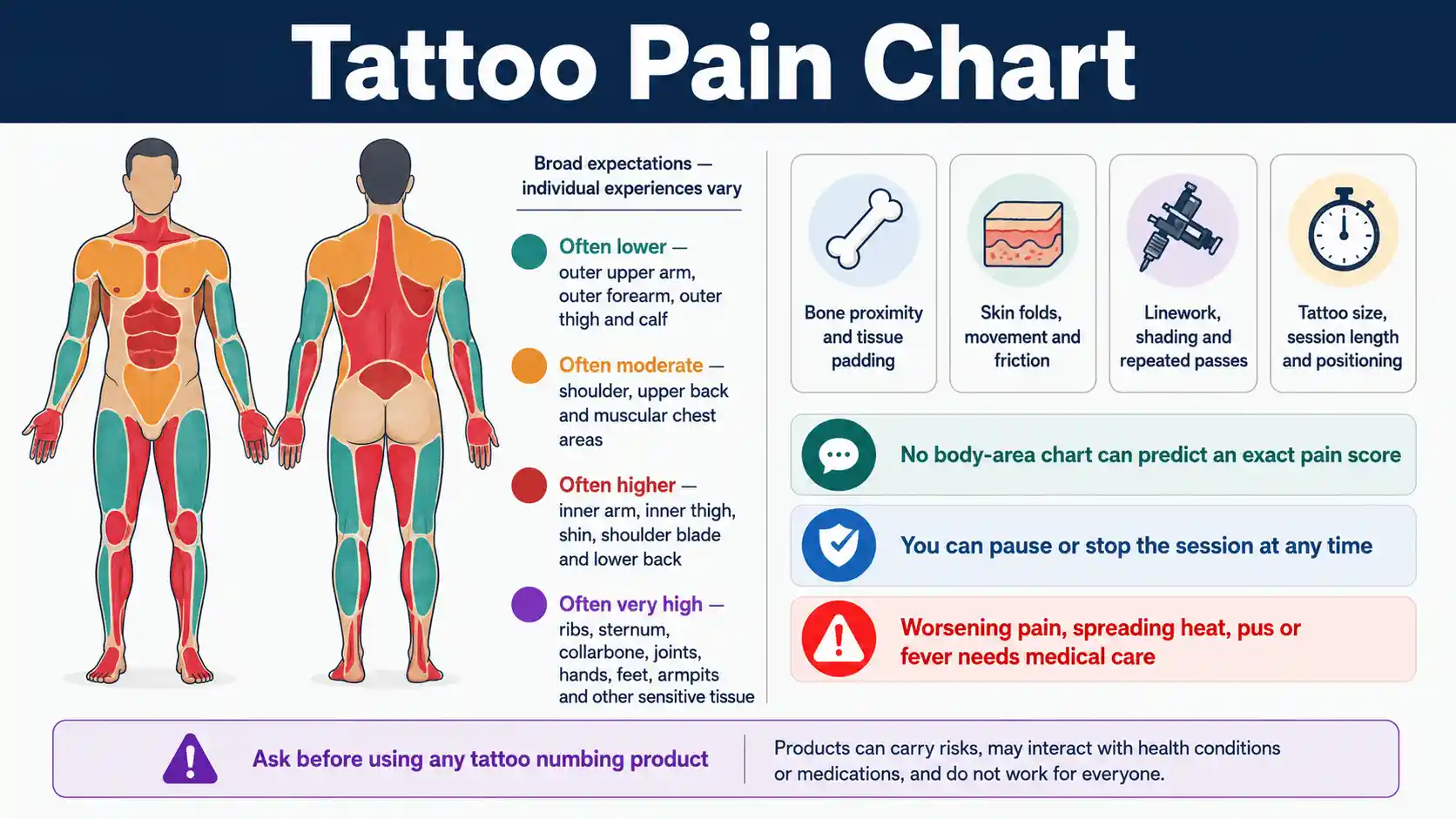
Where do tattoos hurt the most and least?
Outer upper arms, outer thighs, and calves often feel lower to moderate, while ribs, sternum, joints, hands, feet, armpits, and other thin or sensitive areas often feel higher. These are broad expectations, not guaranteed pain scores.
Clinical tattooing descriptions from Cleveland Clinic compare the procedure with repeated poking or scratching plus machine vibration. Exact tissue, design, technique, session length, position, stress, and personal pain history can change how any placement feels.
Placement
Broad expectation only
Outer muscular areas often rank lower, while bone, joints, folds, ribs, hands, and feet often rank higher.
Tissue
Padding, bone and motion
Skin mobility, sensitive anatomy, breathing motion, friction, and position can change sensation.
Session
Technique + duration
Linework, shading, dense color, repeated passes, fatigue, and time in one position all matter.
Safety trend
Improving versus worsening
Worsening pain, spreading warmth, pus, fever, hives, or systemic symptoms outweigh any placement label.
Tattoo Pain by Body Area
These are broad planning categories, not validated medical scores. A small tattoo can cross several tissue types, and individual experiences vary widely.
Swipe horizontally inside the table to view every column.
| Body area | Broad expectation | Why it may feel this way | Planning note |
|---|---|---|---|
| Outer upper arm | Often lower to moderate — Often lower relative discomfort | Usually has more muscle and padding than bony or inner-arm areas | Edges near the shoulder, elbow, or inner arm can feel different |
| Outer forearm | Often lower to moderate | Relatively stable surface with some tissue over bone | Wrist and elbow ends may be sharper or more vibration-heavy |
| Outer thigh | Often lower to moderate | Large muscular area with useful padding | Inner thigh and areas near the knee or hip are different |
| Calf | Often lower to moderate | Muscle can cushion much of the area | Shin, ankle, and back-of-knee borders may feel stronger |
| Upper shoulder or deltoid | Often moderate | Muscle covers part of the shoulder, but position and bone proximity vary | Shoulder blade and collarbone are separate higher-sensitivity zones |
| Upper back | Often moderate | Broad area with muscle in places | Spine and shoulder-blade edges can feel more intense |
| Lower back | Often moderate to higher | Sensation varies between muscle, mobile skin, and areas near the spine or pelvis | Long prone sessions can add positioning discomfort |
| Chest over muscle | Often moderate to higher | Breathing movement and variable padding affect sensation | Sternum, collarbone, and nipple or breast tissue need separate discussion |
| Inner upper arm | Often higher | Softer, mobile skin and sensitive tissue can increase discomfort | Armpit and elbow ditch are commonly more sensitive borders |
| Inner thigh | Often higher | Soft, mobile, friction-prone tissue can be sensitive | Groin proximity raises privacy, positioning, and aftercare considerations |
| Shin | Often higher | Little padding over the tibia can make vibration feel prominent | Calf experience does not predict shin experience |
| Shoulder blade | Often higher | Thin coverage over bone can transmit vibration | Muscular areas beside the blade may feel different |
| Knee or elbow | Often higher to very high — Often higher relative discomfort | Bone, joint contours, and tough or mobile skin complicate the sensation | Bent-versus-straight positioning and repeated passes matter |
| Knee ditch or elbow ditch | Often higher to very high | Thin, flexible skin in a fold can be sensitive and swell | Movement and friction can also complicate healing |
| Ribs or side torso | Often higher to very high | Limited padding, bone proximity, breathing motion, and large movement with each breath | Size and session length strongly change the experience |
| Sternum or collarbone | Often higher to very high | Thin tissue over prominent bone can create sharp or vibrating sensations | Designs extending onto chest muscle may vary across the same piece |
| Ankle or top of foot | Often higher to very high | Thin tissue, prominent bone, tendons, and limited padding | Shoes, swelling, and walking affect aftercare planning |
| Hand, fingers, wrist, or palm | Often higher to very high | Many small structures, limited padding, movement, and frequent use | Palm and fingers also have distinct durability and healing challenges |
| Armpit, groin, nipple, or genital skin | Often very high | Highly sensitive, mobile, or specialized tissue with friction and moisture | Requires an experienced professional, explicit consent, privacy, and detailed aftercare — Specialized planning required |
| Head, face, neck, scalp, or behind ear | Often higher to very high | Thin tissue, dense sensation, vibration, sound, and difficult positioning may contribute | Anatomy and risk vary greatly within this group |
Broad expectation uses lower, moderate, higher, and very high—not a promised 1–10 pain score.
- • No body-location chart can predict an individual person’s pain.
- • Bone proximity, padding, skin mobility, nerve sensitivity, breathing motion, friction, position, technique, and duration all interact.
- • There is no evidence-based need for separate “male” and “female” tattoo pain maps; personal anatomy and context are more useful.
Download or export
How to use a tattoo pain chart
Start with placement, then add the actual design and session. Use the result to ask better questions—not to prove toughness, guarantee comfort, or decide whether worsening pain is medically harmless.
1
Locate the exact borders
A design may cross muscle, bone, a joint, a skin fold, or several sensitivity zones.
2
Add session demands
Size, linework, shading, color packing, repeated passes, position, and duration matter.
3
Use personal context
Past pain, health, skin condition, sleep, stress, medicines, and consent shape planning.
4
Track the healing trend
Improving soreness differs from worsening pain, spreading warmth, pus, fever, or hives.
“Lower” and “higher” are comparative planning labels. They are not clinical pain grades, and one person’s experience cannot predict another person’s result.
Factors That Change Tattoo Discomfort
Placement is only one input. The same person can experience different sensations within one tattoo as the artist changes location, needle grouping, color packing, or repeated passes.
Swipe horizontally inside the table to view every column.
| Factor | Possible effect | Why it matters | Useful planning question |
|---|---|---|---|
| Bone proximity | Can feel sharper or more vibration-heavy | Less tissue separates the working skin from bone | Does the design cross a rib, shin, joint, spine, sternum, or collarbone? |
| Padding and muscle | May soften some sensations | More tissue can cushion vibration, although it never guarantees low pain | Is the whole design on the padded area or only part of it? |
| Skin mobility or fold | Can increase sensitivity and technical difficulty | Thin, stretching, creased, or friction-prone skin moves differently | Will the tattoo enter an elbow ditch, knee ditch, armpit, or inner limb? |
| Tattoo size and duration | Discomfort may build over time | Longer exposure, positioning, swelling, and fatigue can reduce tolerance | Would the artist recommend more than one session? |
| Linework, shading, and color packing | May feel different | Needle configurations, speed, pressure, saturation, and repeated passes vary | What techniques and density does the design require? |
| Artist technique and equipment | Changes sensation and skin trauma | Machine setup, hand pressure, speed, and experience differ | How does the artist approach this placement and style? |
| Cover-up or rework | May require dense or repeated work | Existing pigment and design constraints can increase passes or area | Is a consultation needed before estimating session scope? |
| Body position | Can add muscle, joint, neck, or back discomfort | Remaining still may become harder than the needle sensation | How will the body be supported and when can breaks occur? |
| Sleep, anxiety, illness, and stress | Can lower coping capacity | Pain perception and tolerance change with physical and emotional state | Is rescheduling safer if you are ill or unable to consent comfortably? |
| Personal pain history | Often more useful than internet rankings | Prior procedures, tattoos, chronic pain, trauma, and expectations affect experience | What has helped you communicate and pause safely before? |
Effects are directional possibilities, not a formula that can calculate pain.
- • A larger “easy placement” tattoo can be harder than a brief tattoo in a sensitive location.
- • The tattoo artist can estimate technical time, but cannot guarantee how the client will experience pain.
- • Pain tolerance should never be used as a test of toughness or worth.
Download or export
Tattoo Sensations During a Session
People use different words for tattoo discomfort. Describing the quality, location, trend, and associated symptoms is more useful than forcing every sensation into one number.
Swipe horizontally inside the table to view every column.
| Description | Possible session context | What to do during tattooing | Safety distinction |
|---|---|---|---|
| Repeated scratching or poking | Common description of needle contact | Use agreed communication and steady breathing | Expected discomfort should remain manageable enough to communicate |
| Vibration or buzzing | Often noticeable near bone or in the head and neck | Tell the artist if the position or sensation is hard to tolerate | Vibration alone does not measure tissue damage |
| Sharp or stinging | May occur with linework, sensitive borders, or fresh areas | Ask for a pause if it is escalating or causing movement | Sudden severe pain deserves immediate communication |
| Hot or burning | Can occur during repeated passes or dense work | Report the location and whether it eases when the needle stops | Severe burning or systemic symptoms are not a toughness challenge |
| Dull ache or soreness | Can build with time, swelling, or prolonged positioning | Change support or take an agreed break when safe | A positioning injury can occur separately from skin discomfort |
| Radiating or electric-like sensation | May be felt when work is near a sensitive structure | Tell the artist immediately and stop for assessment | Do not continue through numbness, weakness, or persistent electric pain |
| Lightheaded, sweaty, nauseated, or faint | Stress, pain, prolonged position, or another cause may contribute | Stop the procedure and alert the artist immediately — Stop the procedure | Fainting and systemic symptoms require safety assessment |
| Numbness or loss of control | Not a normal goal of tattooing | Stop and seek appropriate assessment | Do not use numbing as a reason to ignore injury signals |
| Trouble breathing, widespread hives, chest tightness, or intense swelling | Possible serious allergic reaction or emergency | Stop and seek emergency medical care | This is not ordinary tattoo pain — Emergency reaction |
Describe sensation + exact location + onset + whether it stops when tattooing pauses + any whole-body symptoms.
- • Clients can withdraw consent or request a pause at any time.
- • Continuing while dizzy, faint, unable to communicate, or involuntarily moving can make the procedure less safe.
- • A planned break should follow the artist’s contamination-control process.
Download or export
Tattoo Placement and Safety Planner
Build a safer tattoo planning note
Combine placement, tissue, session scope, technique, skin status, product plans, and healing symptoms. The result supports a conversation with an artist or clinician; it does not calculate a pain score or clear you for tattooing.
Planning and safety result
Standard planning conversation
The selected area and session appear comparatively straightforward, but pain remains unpredictable. Confirm exact placement, hygiene, technique, breaks, aftercare, and the right to stop before the session begins.
Generated summary
Tattoo placement and safety planning summary
Broad placement expectation: Often lower expectation: outer arm, outer thigh, or calf
Estimated session scope: Small or brief session
Technique: Mostly linework
Tissue or border context: Mostly padded or muscular tissue
Skin status: Skin looks healthy and intact
Numbing-product plan: No numbing product planned
Current healing or reaction pattern: Planning only; no tattoo symptoms
Additional context: Not specified
Planning result: Standard planning conversation.
Interpretation note: This guide cannot predict a 1–10 pain score, approve a product, diagnose a reaction, or replace consent, professional hygiene, aftercare, or medical assessment.
Whole-body allergic symptoms are an emergency. Call local emergency services for trouble breathing, chest tightness, widespread hives, intense swelling, collapse, or severe dizziness. Seek prompt medical care for worsening pain, spreading heat or redness, pus, open sores, fever, or chills. Nothing entered here is stored or transmitted.
Prepare for consent, hygiene and positioning
A safer plan verifies local requirements, studio hygiene, healthy intact skin, relevant medicines and medical history, placement boundaries, estimated time, breaks, aftercare, and the right to stop. Do not tattoo active rash, infection, open skin, sunburn, or an unevaluated changing lesion.
Tattoo Appointment Preparation Checklist
Preparation should support informed consent, infection prevention, positioning, and communication. It should not involve changing prescribed medicine or using unapproved numbing products on your own.
Swipe horizontally inside the table to view every column.
| Before the appointment | Why it matters | Safer approach | Avoid |
|---|---|---|---|
| Verify local requirements and studio oversight | Tattoo regulation varies by location | Check the relevant public-health or licensing authority | Assuming social-media popularity proves safe practice |
| Review hygiene and single-use practices | Tattooing breaks the skin and can transmit infection | Ask how needles, ink caps, surfaces, gloves, and equipment are handled | Proceeding when infection-control answers are unclear |
| Disclose relevant health and skin history | Allergy, keloid, eczema, psoriasis, immune problems, diabetes, medicines, and bleeding risk can matter | Ask a clinician when your health context creates uncertainty | Hiding medical information from the artist or clinician |
| Do not tattoo inflamed, sunburned, infected, cut, or rash-covered skin | Damaged skin can increase complications and distort the result | Reschedule and obtain assessment when needed | Tattooing through active lesions or an unexplained mole — Do not tattoo damaged skin |
| Discuss design, placement, duration, and breaks | A realistic session plan improves consent and positioning | Ask whether the design crosses higher-sensitivity tissue | Treating an online pain score as a time estimate |
| Arrive able to give informed consent | Intoxication or impairment undermines consent and aftercare understanding | Follow local rules and the studio’s safety policy | Alcohol, recreational drugs, or sedating substances to “push through” |
| Plan clothing, transport, food, and hydration | Access, comfort, faintness risk, and post-session movement matter | Follow the artist’s written appointment instructions | Fasting, extreme caffeine, or improvising against medical restrictions |
| Ask before using any numbing product | Products can affect skin, interact with medicines, and be absorbed systemically | Check with an appropriate clinician and the artist | High-concentration, heavily applied, wrapped, or broken-skin use — Topical anesthetic warning |
| Plan aftercare supplies and schedule | Fresh tattooed skin needs clean handling and reduced friction | Obtain written, product-specific instructions from the professional | Relying on conflicting social-media aftercare routines |
Local law, studio policy, medical history, and product instructions take priority over a generic checklist.
- • Never stop anticoagulants, antiplatelet medicines, diabetes medicines, or any prescription solely for a tattoo appointment without prescriber guidance.
- • A history of keloids or a skin disease flare deserves clinician discussion before tattooing.
- • Do not tattoo over a changing mole or lesion that has not been medically evaluated.
Download or export
Tattoo numbing products require a safety check
The FDA warning on certain topical pain products explains that high lidocaine concentrations and heavy, large-area, prolonged, covered, irritated-skin, or broken-skin application can increase absorption and cause serious injury. Ask an appropriate clinician and the artist before using any product; never treat numbness as proof that tissue is safe.
Comfort and Communication During Tattooing
The goal is not zero sensation. It is a consent-based session in which the client and artist can communicate, pause, preserve hygiene, and stop when needed.
Swipe horizontally inside the table to view every column.
| Strategy | Potential benefit | How to use it | Boundary |
|---|---|---|---|
| Agree on a stop or pause signal | Makes communication possible when talking is difficult | Choose the signal before setup begins | The artist must be able to see or hear it |
| Use supported positioning | Reduces muscle guarding and pressure discomfort | Ask for pillows or safe adjustments before sterile work starts | Do not make sudden movements during needle contact |
| Take planned breaks | Can reduce fatigue, stiffness, and escalating distress | Coordinate timing with the artist | Breaks must preserve contamination control |
| Use slow, steady breathing | Can reduce breath-holding and panic escalation | Keep breathing natural rather than forcing extreme techniques | Breathing does not make severe symptoms safe |
| Use conversation, music, or another distraction | May shift attention without removing sensation | Choose something that still allows artist communication | Do not use headphones so loudly that instructions are missed |
| Report changing sensation early | Allows position, technique, or session plan to be reassessed | Name the location and quality clearly | Do not wait until you are faint or moving involuntarily |
| Split extensive work into sessions | Limits prolonged skin trauma, fatigue, and positioning | Follow the artist’s technical and healing plan | More sessions do not eliminate infection or reaction risk |
| Stop if consent or safety changes | Protects the client and artist | Pause for dizziness, faintness, uncontrolled movement, severe pain, or illness | Finishing the design is never more important than immediate safety — Safety before completion |
| Keep the field clean | Reduces contamination risk | Avoid touching the tattoo or work area unless instructed | Phones, clothing, hands, and personal items can contaminate surfaces |
Comfort strategies support coping; they do not diagnose pain or make unsafe symptoms harmless.
- • The client can change their mind or stop the procedure.
- • The artist should explain how unscheduled movement affects safety.
- • Pain bragging, shaming, or pressure to continue undermines informed consent.
Download or export
Healing soreness should trend toward improvement
The American Academy of Dermatology tattoo-reaction guide notes that early soreness, redness, swelling, clear fluid, itching, flaking, and scabbing can occur. Infection becomes more concerning when pain, color change, heat, or swelling worsens or spreads, or when pus, open sores, fever, or chills develop.
Expected Tattoo Healing Versus Warning Pain
Fresh tattooed skin is an open wound. Early soreness can be expected, but the trend should generally improve rather than spread, intensify, or develop pus or systemic symptoms.
Swipe horizontally inside the table to view every column.
| Observation | More consistent with expected healing | More concerning pattern | Action |
|---|---|---|---|
| Soreness or tenderness | Local soreness that gradually eases | Pain that continues, becomes severe, or worsens instead of subsiding — Worsening pain warning | Contact a clinician promptly for worsening pain |
| Redness or color change around skin | Limited early change that diminishes | Expanding, darkening, increasingly hot, or streaking change | Seek prompt medical assessment |
| Swelling | Mild localized swelling that improves | Increasing, tense, widespread, or function-limiting swelling | Obtain prompt assessment; emergency care for airway or facial swelling |
| Clear fluid | A small amount can occur early | Cloudy, yellow, green, foul-smelling, or increasing drainage | Seek medical assessment for possible infection |
| Itching and flaking | Can occur as skin heals | Intense, persistent, spreading, blistering, or color-specific rash | Discuss possible allergy or skin reaction with a clinician |
| Scabbing | Light scabbing may form | Thick worsening crust, open sores, pus, or tissue breakdown | Seek clinical assessment |
| Warmth | Mild local warmth shortly after tattooing may occur | Increasing heat with pain, swelling, drainage, or fever | Contact a clinician promptly |
| Fever, chills, or feeling ill | Not an expected local-healing feature | Fever, chills, shivering, weakness, or swollen lymph nodes | Seek prompt medical care |
| Hives, chest tightness, dizziness, or breathing difficulty | Not expected | Possible serious allergic reaction | Call local emergency services — Emergency reaction |
| Pain after initial improvement | Brief variation can happen with movement or friction | New or increasing pain after the area had been improving | Assess for infection, trauma, or another complication |
Track the direction of change: improving, unchanged, or worsening; also note spread, heat, discharge, fever, and whole-body symptoms.
- • Skin redness may appear red, purple, brown, gray, or darker than surrounding skin depending on skin tone.
- • A normal-looking tattoo does not rule out faintness, allergic symptoms, or a bloodborne infection.
- • Photographs in similar lighting can help show whether redness or swelling is spreading.
Download or export
Tattoo Infection, Allergy and Skin-Reaction Clues
Tattoo reactions can begin immediately or appear much later. Pain location, timing, color specificity, spread, drainage, fever, and whole-body symptoms help clinicians assess the pattern.
Swipe horizontally inside the table to view every column.
| Pattern | Possible context | Clues to record | Care direction |
|---|---|---|---|
| Worsening pain with spreading warmth or redness | Bacterial infection is possible | Onset, spread, drainage, fever, chills, and medical conditions | Seek prompt medical care |
| Pus, foul odor, open sores, or increasing discharge | Infection is possible | Color, amount, odor, tissue breakdown, and fever | Seek prompt medical care |
| Painful bumps limited to tattooed skin | Infection, follicular reaction, or another eruption is possible | Ink color, shaving, products, timing, and spread | Arrange clinician or dermatologist assessment |
| Itchy, raised, scaly, blistered, or swollen area in one ink color | Ink allergy or inflammatory reaction is possible | Specific pigment color, sun exposure, timing, and other symptoms | Seek dermatology advice; emergency care for systemic reaction |
| Persistent nodule or lump | Granuloma, scar, keloid, foreign-body reaction, or another lesion is possible | Growth, pain, drainage, color, and duration | Arrange dermatology assessment |
| Raised scar extending beyond the original injury | Keloid is possible | Prior keloids, growth, itch, pain, and location | Discuss with a dermatologist |
| New or changing mole or lesion within tattoo | Tattoo pigment can obscure skin-cancer warning signs | Change in size, shape, color, bleeding, or healing | Obtain prompt dermatology assessment — Changing lesion assessment |
| Tattoo burns or stings during MRI | Rare MRI-related heating reaction is possible | Exact tattoo location and sensation | Alert MRI staff immediately; do not simply endure it |
| Trouble breathing, chest tightness, racing heart, dizziness, hives, or intense swelling | Serious allergic reaction or another emergency is possible | Time of onset and exposures if safely available | Call local emergency services — Emergency symptoms |
A clinician may need examination, culture, biopsy, allergy assessment, blood tests, or other testing; appearance alone cannot identify the cause.
- • Do not self-treat suspected infection with leftover antibiotics.
- • Allergic reactions can occur weeks, years, or decades after tattooing.
- • Tell MRI staff about tattoos and permanent makeup before scanning.
Download or export
Follow aftercare for the actual dressing and tattoo
Hand hygiene, dressing timing, cleaning, skin products, clothing, water exposure, and activity instructions can vary by dressing and procedure. Use the written instructions supplied for the tattoo, and seek medical assessment instead of altering aftercare when pain or inflammation is worsening.
Tattoo Aftercare and Comfort Guide
Follow the written aftercare supplied for the specific dressing, inked area, and local standard. Generic advice cannot replace product instructions or medical care.
Swipe horizontally inside the table to view every column.
| Aftercare step | Purpose | Practical note | Caution |
|---|---|---|---|
| Wash hands before touching the tattoo | Reduces transfer of germs | Use clean hands every time dressing or skin is handled | Unwashed hands are a major contamination route |
| Follow the dressing schedule provided | Protects the fresh wound while avoiding inappropriate occlusion | Different dressings have different wear and removal instructions | Do not improvise prolonged wrapping |
| Clean gently as instructed | Removes residue without unnecessary trauma | Use the artist’s written method and clean materials | Do not scrub, pick, or use harsh products |
| Use only advised skin products | Supports comfort while limiting irritation | Choose product amount and timing from professional instructions | Fragrance and unapproved products can irritate skin |
| Reduce friction and contamination | Protects the surface while it closes | Plan loose clean clothing and clean bedding | Avoid tight rubbing fabric and unnecessary touching |
| Avoid soaking or swimming until appropriate | Reduces prolonged moisture and microbial exposure | Ask when showers, baths, pools, hot tubs, and open water are safe | Water exposure rules depend on healing and dressing |
| Protect healed tattooed skin from sun | Reduces UV damage and fading | Use shade, clothing, and broad-spectrum water-resistant SPF 30+ on healed skin | Do not apply sunscreen to an open wound unless specifically advised |
| Track improvement | Makes worsening pain, spread, or discharge easier to identify | Note pain trend, warmth, swelling, drainage, fever, and photos | Do not wait for a scheduled touch-up when infection signs appear |
| Seek help for a reaction | Early assessment can limit harm | Contact a clinician or dermatologist for worsening or persistent symptoms | The tattoo artist cannot diagnose or prescribe treatment — Medical assessment |
Written instructions for the actual dressing and procedure take priority; seek medical care when symptoms are concerning.
- • Do not pick scabs or intentionally reopen tattooed skin.
- • Do not use antibiotic cream unless a clinician recommends it for a diagnosed problem.
- • Long-term sun protection supports both skin health and tattoo appearance.
Download or export
When Tattoo Pain or a Reaction Needs Care
Urgency depends on the full pattern, not a pain score. Whole-body symptoms, breathing difficulty, fainting, spreading infection signs, and rapidly worsening pain outweigh placement expectations.
Swipe horizontally inside the table to view every column.
| Timing | Pattern | Suggested action | Why |
|---|---|---|---|
| During the session | Pain is manageable and communication remains clear | Continue only with ongoing consent and hygiene | Expected discomfort alone is not an emergency |
| During the session | Pain becomes severe, electric, radiating, or causes uncontrolled movement | Stop and reassess immediately | Continuing may increase injury risk |
| During the session | Lightheadedness, nausea, sweating, confusion, or fainting | Stop, alert the artist, and obtain appropriate assessment | Systemic symptoms require safety attention |
| Any time | Trouble breathing, chest tightness, widespread hives, intense swelling, or collapse | Call local emergency services — Emergency care | Possible severe allergic reaction or another emergency |
| After tattooing | Localized soreness, mild redness, or swelling is gradually improving | Follow written aftercare and monitor | Improving local symptoms can fit expected healing |
| After tattooing | Pain, redness, swelling, or warmth is increasing or spreading | Contact a clinician promptly | Infection or another complication is possible |
| After tattooing | Pus, foul-smelling drainage, open sores, fever, or chills | Seek prompt medical care — Prompt infection care | These are infection warning signs |
| Days to years later | Persistent color-specific itch, bumps, scales, blisters, or swelling | Arrange clinician or dermatologist assessment | Delayed ink allergy or inflammatory reaction is possible |
| Any time | New or changing lesion, nonhealing area, unexplained bleeding, or growing lump in tattooed skin | Arrange prompt dermatology assessment | Pigment can make skin changes harder to evaluate |
| During MRI | Tattooed skin heats, burns, stings, or tingles | Tell MRI staff immediately | Rare tattoo-related heating can occur |
If you are unsure whether symptoms are urgent, use local medical advice or emergency services rather than an online chart.
- • Pain should not be judged against a placement ranking when infection or allergic symptoms are present.
- • People with diabetes, immune suppression, circulation problems, extensive skin disease, or other medical complexity may need earlier advice.
- • Report product or ink problems through the appropriate health authority when advised.
Download or export
Frequently asked questions
What are the least painful places for a tattoo?
Outer upper arms, outer forearms, outer thighs, and calves are often described as lower to moderate discomfort because they commonly have more muscle or padding. This is only a broad expectation. Design size, exact borders, technique, session length, positioning, and personal sensitivity can change the experience.
What are the most painful tattoo locations?
Ribs, sternum, collarbone, joints and joint folds, ankles, feet, hands, armpits, groin, nipple or genital skin, and parts of the head or neck are often described as higher discomfort. These areas may combine thin tissue, bone proximity, mobility, friction, or sensitive anatomy, but no chart can predict an individual score.
Is there a medically validated tattoo pain scale by body part?
No widely accepted clinical scale can assign a reliable tattoo pain number to each body part. Online maps summarize common reports and anatomy-based expectations. Pain remains subjective and changes with the person, placement boundaries, technique, session duration, and context.
Do women and men need different tattoo pain charts?
A sex-separated pain map is usually less useful than the person’s actual anatomy, tissue padding, skin mobility, health, prior pain experience, design, and precise placement. Individual variation is too large for a gender label to predict tattoo pain reliably.
What does getting a tattoo feel like?
People commonly describe repeated scratching, poking, stinging, vibration, heat, or a building ache. The sensation can change within one design as work moves from padded tissue toward bone, a fold, or previously worked skin.
Does tattoo pain get worse during a long session?
It can. Repeated work, swelling, fatigue, stress, and holding one position may reduce comfort over time. Ask the artist whether the design is better divided into sessions and agree on safe breaks before tattooing begins.
Does linework hurt more than shading or color?
There is no universal winner. Linework can feel sharp or stinging, while shading and color packing can feel hot, scratchy, or increasingly sore because they may cover larger areas or require repeated passes. Technique and the client’s experience determine which feels stronger.
Can I use numbing cream before a tattoo?
Do not apply a numbing product without checking the product, the tattoo artist’s process, and appropriate medical advice. The FDA has warned about certain high-concentration lidocaine products marketed for tattooing, especially when applied heavily, over large or broken areas, for long periods, or under a wrap.
Should I stop blood thinners or pain medicine before a tattoo?
Never stop or change a prescribed medicine solely for a tattoo without the prescriber’s guidance. Tell the artist about relevant medicines and medical conditions, and ask the clinician who manages the medicine whether an elective tattoo is appropriate.
How long should a new tattoo stay sore?
Some soreness for several days can occur, and timing varies with placement, size, technique, and healing. The direction matters more than a fixed deadline: discomfort should generally improve. Pain that persists, intensifies, returns after improvement, or accompanies spreading warmth, redness, pus, fever, or chills needs medical assessment.
How can I tell normal tattoo soreness from infection?
Limited soreness, redness, swelling, clear fluid, itching, flaking, and light scabbing can occur during healing. Infection is more concerning when pain worsens instead of easing, redness or warmth spreads, swelling increases, pus or foul drainage appears, open sores form, or fever and chills develop.
Can tattoo ink cause an allergic reaction later?
Yes. An ink reaction can appear immediately or weeks, years, or decades later. It may affect one ink color and cause persistent itch, swelling, bumps, scales, blisters, crusting, or drainage. Serious symptoms such as breathing difficulty, chest tightness, hives, dizziness, or intense swelling require emergency care.
Is it safe to tattoo over a mole, rash, scar, or sunburn?
Do not tattoo active rash, infection, open skin, or sunburn. A changing mole or unexplained lesion should be examined before it is covered, because pigment can make later skin changes harder to see. People prone to keloids should discuss scarring risk with a dermatologist.
Can a tattoo burn during an MRI?
Rare heating or burning reactions have been reported. Tell MRI staff about tattoos and permanent makeup before scanning, and immediately report warmth, stinging, tingling, or burning at a tattooed area during the scan.
When is tattoo pain an emergency?
Call local emergency services for trouble breathing, chest tightness, widespread hives, intense facial or throat swelling, collapse, severe confusion, or another rapidly developing whole-body reaction. Stop the tattoo immediately for fainting, uncontrolled movement, severe radiating or electric pain, or symptoms that prevent clear communication.
Sources
These dermatology, medication-safety, infection-control, clinical tattooing, aftercare, MRI, and facility-safety resources support the planning and warning guidance.
U.S. Food and Drug Administration — Tattoos and Permanent Make-up
https://www.fda.gov/consumers/womens-health-topics/tattoos-and-permanent-make
Summarizes tattooing, infection, allergic-reaction, scarring, MRI, ink, and removal risks and advises consumers to check local safety oversight.
U.S. Food and Drug Administration — Warning About Certain Topical Pain Relief Products
https://www.fda.gov/news-events/press-announcements/fda-warns-consumers-avoid-certain-topical-pain-relief-products-due-potential-dangerous-health
Warns that high-concentration lidocaine products marketed around tattooing can cause serious harm, especially over large, irritated, broken, prolonged, or covered skin areas.
American Academy of Dermatology — Tattoos: Skin Reactions and What to Do
https://www.aad.org/public/everyday-care/skin-care-basics/tattoos/tattoo-skin-reactions
Distinguishes expected early soreness, redness, swelling, clear fluid, itching, flaking, and scabbing from infection, allergy, keloid, MRI, and other tattoo reactions.
American Academy of Dermatology — Caring for Tattooed Skin
https://www.aad.org/public/everyday-care/skin-care-basics/tattoos/caring-for-tattooed-skin
Provides dermatologist guidance on moisturizing dry tattooed skin, protecting healed tattoos from ultraviolet light, and seeking evaluation for skin reactions.
American Academy of Dermatology — Do Tattoos Cause Skin Cancer?
https://www.aad.org/public/diseases/skin-cancer/find/do-tattoos-cause-skin-cancer
Explains that evidence on tattoo-related cancer risk is still developing and emphasizes that tattoo pigment can make skin changes harder to notice.
UK Health Security Agency — Tattooing and Body Piercing: Infection Prevention and Control
https://www.gov.uk/guidance/tattooing-and-body-piercing-infection-prevention-and-control
Describes infection and bloodborne-virus risks when tattooing is not performed with appropriate infection-prevention and control practices.
Torbay Council — Tattoo Aftercare
https://www.torbay.gov.uk/business/licensing/skin-piercing-acupuncture-and-tattooing/tattoo-aftercare/
Explains hand hygiene, covering and cleaning guidance, expected tenderness, and infection signs such as increasing redness, swelling, burning, pain, and discharge.
Cleveland Clinic — Nipple and Areola Reconstruction: Tattoo Options
https://my.clevelandclinic.org/health/treatments/nipple-reconstruction
Describes medical tattooing as a poking or scratching sensation with vibration and notes that the skin can remain sore for several days.
Dudley Group NHS Foundation Trust — Medical Tattooing Aftercare Advice
https://www.dgft.nhs.uk/pil/medical-tattooing-aftercare-advice/
Provides clinical aftercare advice and identifies inflamed, moist, red, or hot tattooed skin as a possible infection requiring medical contact.
East and North Hertfordshire NHS Trust — Patient Information — Magnetic Resonance Imaging
https://www.enherts-tr.nhs.uk/wp-content/uploads/2019/10/Magnetic-Resonance-Imaging-MRI-v2-11.2019.pdf
Explains the slight risk that tattooed skin can heat during MRI and instructs patients to tell radiography staff about tattoos and report warmth immediately.
South Carolina Department of Public Health — Standards for Licensing Tattoo Facilities
https://dph.sc.gov/sites/scdph/files/Library/Regulations/R.60-111.pdf
Provides a public-health example of facility rules addressing impaired consent and avoiding tattooing on rashes, boils, keloids, sunburn, open lesions, and other unsuitable skin.