Finance & Money
2026 Tax Bracket Chart
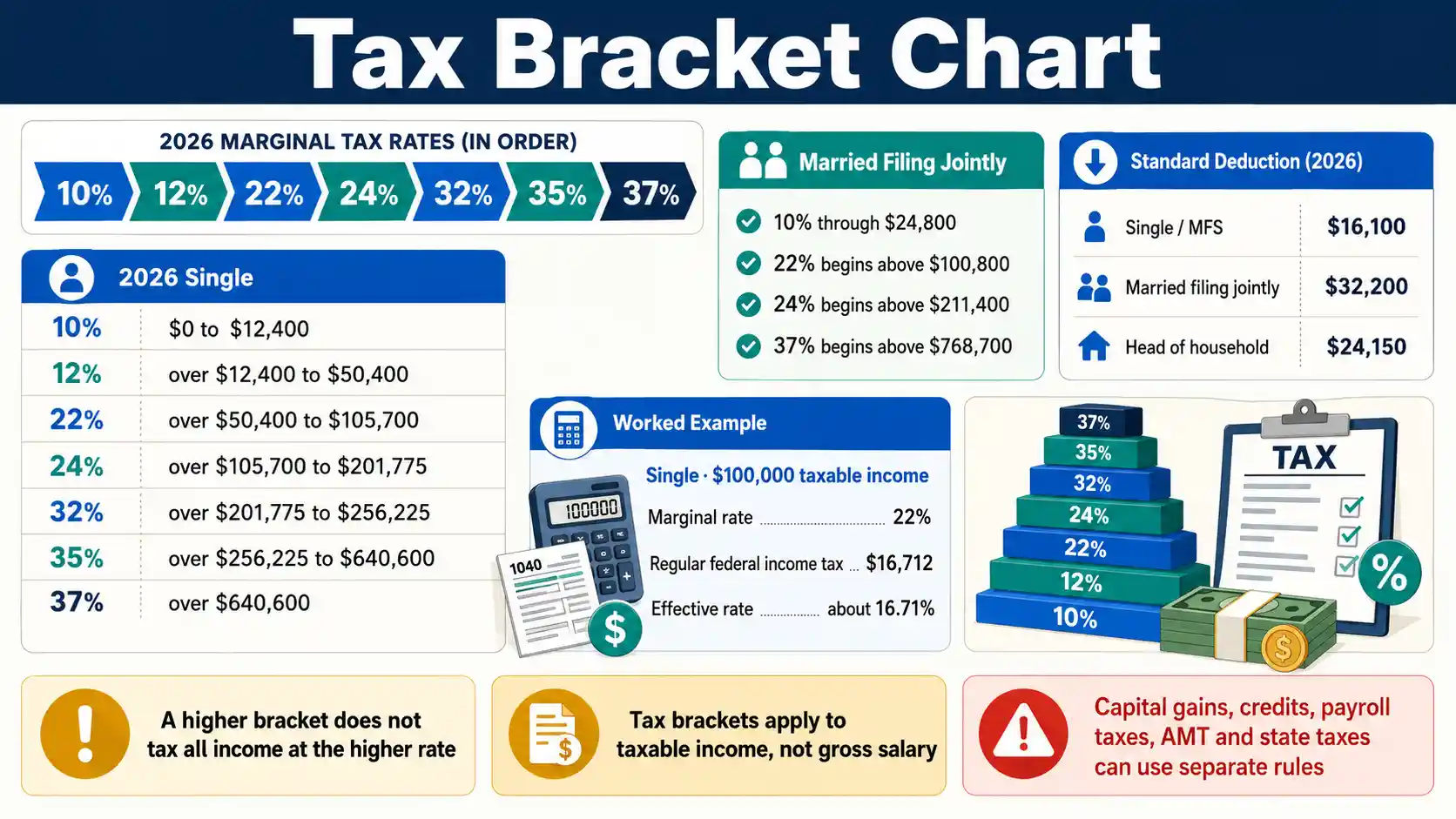
The 2026 federal individual income-tax rates are 10%, 12%, 22%, 24%, 32%, 35%, and 37%. The brackets apply to taxable income in layers, so reaching a 22% or 24% marginal bracket does not make every dollar of taxable income subject to that rate.
For a single filer, the 22% bracket begins above $50,400 of 2026 taxable income, while the 37% bracket begins above $640,600. Married couples filing jointly enter the 22% bracket above $100,800 and the 37% bracket above $768,700. IRS published the 2026 inflation-adjusted brackets and standard deductions.
Tax brackets use taxable income, not gross salary. For 2026, the basic standard deduction is $16,100 for single or married filing separately, $32,200 for married filing jointly or qualifying surviving spouse, and $24,150 for head of household.
2026 federal rates
10%–37%
Seven regular marginal individual income-tax rates remain in effect for 2026.
Single standard deduction
$16,100
Basic 2026 amount before eligible age/blind additions or other separate deductions.
Married filing jointly
$32,200
Basic 2026 standard deduction for joint filers and qualifying surviving spouses.
Marginal system
Taxed in layers
Moving into a higher bracket does not make all taxable income subject to that higher rate.
How a marginal tax bracket actually works
A single filer with $100,000 of ordinary taxable income is in the 22% marginal bracket, but the regular federal income tax is $16,712, an effective rate of about 16.71% on that taxable income.
The first $12,400 of that taxable income is taxed at 10%, the next layer through $50,400 is taxed at 12%, and only the taxable-income layer above $50,400 is taxed at 22%.
Taxable income is usually lower than gross income because adjustments and deductions can reduce the amount that enters the rate schedule. Credits work later and reduce tax rather than taxable income.
Filing status changes bracket widths and thresholds. It is determined by tax-law eligibility, not by choosing whichever column produces the smallest calculation.
Long-term capital gains and qualified dividends can use separate rate rules, so the ordinary bracket calculator should not be used as the sole tax calculation for an investment gain.
Federal income-tax brackets also exclude Social Security tax, Medicare tax, self-employment tax, state and local taxes, AMT and other specialized taxes.
2026 deductions include important special rules
The basic standard deduction is only one piece of taxable-income calculation. Eligible taxpayers who are age 65 or blind can receive an additional standard deduction amount. Separately, eligible people age 65 or older may claim an enhanced senior deduction of up to $6,000 per person for 2025 through 2028, subject to income phaseouts and filing requirements. IRS summarizes the enhanced senior deduction and its phaseout thresholds.
2026 Federal Tax Brackets — Single
Ordinary taxable income for a single filer. Taxable income is after applicable deductions and adjustments, not gross salary.
Swipe horizontally inside the table to view every column.
| Marginal rate | Taxable income over | Taxable income up to | Tax on income at top of bracket |
|---|---|---|---|
| 10% | $0 | $12,400 | $1,240.00 |
| 12% | $12,400 | $50,400 | $5,800.00 |
| 22% — 22% marginal bracket | $50,400 | $105,700 | $17,966.00 |
| 24% | $105,700 | $201,775 | $41,024.00 |
| 32% | $201,775 | $256,225 | $58,448.00 |
| 35% | $256,225 | $640,600 | $192,979.25 |
| 37% | $640,600 | No upper limit | $192,979.25 + 37% of amount over $640,600 |
Tax year 2026 ordinary federal taxable income.
- • Each rate applies only to the taxable-income layer inside that bracket.
- • Capital gains, qualified dividends, AMT, NIIT, payroll taxes, credits, and state taxes can follow different rules.
Download or export
2026 Federal Tax Brackets — Married Filing Jointly
Ordinary taxable income for married couples filing jointly and qualifying surviving spouses.
Swipe horizontally inside the table to view every column.
| Marginal rate | Taxable income over | Taxable income up to | Tax on income at top of bracket |
|---|---|---|---|
| 10% | $0 | $24,800 | $2,480.00 |
| 12% | $24,800 | $100,800 | $11,600.00 |
| 22% | $100,800 | $211,400 | $35,932.00 |
| 24% | $211,400 — 24% bracket begins above $211,400 taxable income | $403,550 | $82,048.00 |
| 32% | $403,550 | $512,450 | $116,896.00 |
| 35% | $512,450 | $768,700 | $206,583.50 |
| 37% | $768,700 | No upper limit | $206,583.50 + 37% of amount over $768,700 |
Tax year 2026 ordinary federal taxable income.
- • Joint filing combines spouses on one return; tax results can differ from simply adding two single-filer calculations.
- • Qualifying surviving spouse uses the same rate schedule as married filing jointly.
Download or export
2026 Federal Tax Brackets — Head of Household
Ordinary taxable income for taxpayers who qualify to file as head of household.
Swipe horizontally inside the table to view every column.
| Marginal rate | Taxable income over | Taxable income up to | Tax on income at top of bracket |
|---|---|---|---|
| 10% | $0 | $17,700 | $1,770.00 |
| 12% | $17,700 | $67,450 — Top of the 12% head-of-household bracket | $7,740.00 |
| 22% | $67,450 | $105,700 | $16,155.00 |
| 24% | $105,700 | $201,750 | $39,207.00 |
| 32% | $201,750 | $256,200 | $56,631.00 |
| 35% | $256,200 | $640,600 | $191,171.00 |
| 37% | $640,600 | No upper limit | $191,171.00 + 37% of amount over $640,600 |
Tax year 2026 ordinary federal taxable income.
- • Head-of-household status has eligibility rules; it is not available simply because a taxpayer is unmarried.
- • The rate schedule differs from both single and married filing jointly.
Download or export
2026 Federal Tax Brackets — Married Filing Separately
Ordinary taxable income for married taxpayers filing separate federal returns.
Swipe horizontally inside the table to view every column.
| Marginal rate | Taxable income over | Taxable income up to | Tax on income at top of bracket |
|---|---|---|---|
| 10% | $0 | $12,400 | $1,240.00 |
| 12% | $12,400 | $50,400 | $5,800.00 |
| 22% | $50,400 | $105,700 | $17,966.00 |
| 24% | $105,700 | $201,775 | $41,024.00 |
| 32% | $201,775 | $256,225 | $58,448.00 |
| 35% | $256,225 | $384,350 | $103,291.75 |
| 37% | $384,350 — 37% bracket begins at a lower threshold than for single filers | No upper limit | $103,291.75 + 37% of amount over $384,350 |
Tax year 2026 ordinary federal taxable income.
- • Married filing separately can change deduction, credit, and phaseout rules beyond the bracket schedule.
- • If one spouse itemizes, the other spouse generally cannot take the standard deduction.
Download or export
2026 Standard Deduction and Senior Additions
The basic standard deduction reduces income before the regular tax brackets are applied. Additional age/blind amounts and the enhanced senior deduction have separate rules.
Swipe horizontally inside the table to view every column.
| Filing situation | 2026 amount | Who can use it | Important note |
|---|---|---|---|
| Single | $16,100 basic standard deduction — 2026 single basic standard deduction | Eligible single filers | Age/blind addition is generally $2,050 per qualifying condition |
| Head of household | $24,150 basic standard deduction | Eligible head-of-household filers | Age/blind addition is generally $2,050 per qualifying condition |
| Married filing jointly / qualifying surviving spouse | $32,200 basic standard deduction | Eligible joint or surviving-spouse filers | Age/blind addition is generally $1,650 per qualifying condition |
| Married filing separately | $16,100 basic standard deduction | Eligible separate filers | Age/blind addition is generally $1,650 per qualifying condition |
| Enhanced senior deduction | Up to $6,000 per eligible person — Temporary enhanced senior deduction | Age 65+; 2025–2028 rules | Phases out above $75,000 MAGI, or $150,000 for joint filers; married taxpayers must file jointly to claim it |
Tax year 2026 deductions; eligibility rules and phaseouts apply.
- • The enhanced senior deduction is separate from the existing additional standard deduction for age 65 or blindness.
- • Itemizers may still qualify for the enhanced senior deduction if its requirements are met.
Download or export
Browser-only federal tax tool
2026 Federal Tax Bracket Calculator
Enter ordinary taxable income after deductions, not gross salary. The calculator applies the 2026 regular federal rate schedule for the selected filing status.
Regular income tax
$16,712.00
Before credits and other federal taxes.
Marginal rate
22%
Rate applied to the last taxable-income layer.
Effective rate
16.71%
Regular calculated tax divided by taxable income.
Entered payments vs tax
$1,288.00 above
Not a refund estimate because credits, other taxes and return adjustments are excluded.
Status: Single. The current marginal bracket begins above $50,400.00 and runs through $105,700.00.
Excluded: long-term capital-gain and qualified-dividend rate rules, refundable and nonrefundable credits, AMT, NIIT, Additional Medicare Tax, self-employment tax, Social Security and Medicare payroll tax, state/local tax, and special deductions.
The calculation runs only in your browser. No income, filing-status or withholding entry is transmitted or stored.
Marginal Rate vs. Effective Tax Rate Examples
Examples use 2026 single-filer ordinary taxable income. They exclude credits, special capital-gain rates, AMT, NIIT, payroll taxes, and state or local taxes.
Swipe horizontally inside the table to view every column.
| Taxable income | Marginal bracket | Regular income tax | Effective rate |
|---|---|---|---|
| $25,000 | 12% | $2,752.00 | 11.01% |
| $50,000 | 12% | $5,752.00 | 11.50% |
| $75,000 | 22% | $11,212.00 | 14.95% |
| $100,000 | 22% — $100,000 taxable income is in the 22% marginal bracket | $16,712.00 | 16.71% — Effective rate is lower than the marginal rate |
| $150,000 | 24% | $28,598.00 | 19.07% |
| $250,000 | 32% | $56,456.00 | 22.58% |
| $500,000 | 35% | $143,769.25 | 28.75% |
Regular federal income tax on ordinary taxable income.
- • The marginal rate applies to the last taxable-income layer, not the full amount.
- • Effective rate equals calculated regular income tax divided by taxable income.
Download or export
Same Taxable Income Across Filing Statuses
The same taxable-income amount can produce different regular income tax because filing statuses use different bracket thresholds.
Swipe horizontally inside the table to view every column.
| Taxable income | Single | Married filing jointly | Head of household | Married filing separately |
|---|---|---|---|---|
| $50,000 | $5,752.00 | $5,504.00 | $5,646.00 | $5,752.00 |
| $100,000 | $16,712.00 | $11,504.00 — Joint-return tax at $100,000 taxable income | $14,901.00 | $16,712.00 |
| $200,000 | $40,598.00 | $33,424.00 | $38,787.00 | $40,598.00 |
| $500,000 | $143,769.25 | $112,912.00 | $141,961.00 | $146,082.25 |
Regular federal income tax on identical ordinary taxable income; this is not a comparison of gross household income.
- • Filing-status eligibility depends on family and marital circumstances, not on which schedule gives the lowest tax.
- • Credits, deductions and special rules can change the final return result beyond these regular rate schedules.
Download or export
Common tax-bracket mistakes and limitations
Do not apply your marginal rate to all income
Only the taxable-income layer inside the highest bracket is taxed at the marginal rate. Lower layers keep their lower rates.
Do not confuse gross income with taxable income
Salary, business income, retirement distributions and other income can be adjusted by deductions and special rules before the regular bracket schedule is applied.
Do not use ordinary brackets for every type of income
Qualified dividends and long-term capital gains can use preferential tax rates. AMT, NIIT and other taxes can add separate calculations.
A bracket calculator cannot predict a refund
Refunds depend on final tax liability compared with withholding and payments, after credits, deductions, additional taxes and all return information are included.
Self-employment income, qualified business income, capital gains, qualified dividends, tips, overtime deductions, car-loan interest deductions, senior deductions, dependent rules, itemized deductions, AMT, NIIT, Additional Medicare Tax, foreign income, tax credits and state taxes can make an actual return materially different from the simplified ordinary-income examples here.
Frequently asked questions
What are the federal tax rates for 2026?
The regular federal individual income-tax rates for 2026 are 10%, 12%, 22%, 24%, 32%, 35%, and 37%.
What is the 22% tax bracket for a single filer in 2026?
For a single filer, the 22% bracket applies to ordinary taxable income over $50,400 and up to $105,700 in 2026.
What is the top federal tax rate in 2026?
The top regular individual rate is 37%. It begins above $640,600 of taxable income for single filers and above $768,700 for married couples filing jointly.
Does entering a higher tax bracket tax all my income at that rate?
No. Federal tax brackets are marginal, so the higher rate applies only to the taxable-income layer inside that bracket.
What is the standard deduction for a single filer in 2026?
The 2026 basic standard deduction is $16,100 for single filers and married individuals filing separately.
What is the 2026 standard deduction for married filing jointly?
The 2026 basic standard deduction is $32,200 for married couples filing jointly and qualifying surviving spouses.
What is the 2026 head-of-household standard deduction?
The 2026 basic standard deduction for head of household is $24,150.
What is the additional standard deduction for age 65 or blindness in 2026?
The additional amount is generally $2,050 per qualifying age/blind condition for single or head-of-household filers and $1,650 for married filers or qualifying surviving spouses.
Is there an extra senior tax deduction in 2026?
Yes. Eligible taxpayers age 65 or older may claim an enhanced deduction of up to $6,000 per person under rules effective from 2025 through 2028, subject to income phaseouts and filing requirements.
What is the difference between marginal and effective tax rate?
Marginal rate is the rate on the next or last layer of taxable income. Effective rate is total calculated tax divided by taxable income.
How much federal tax is due on $100,000 of taxable income for a single filer in 2026?
Using the regular 2026 single-filer rate schedule, $100,000 of ordinary taxable income produces $16,712 of federal income tax before credits and other taxes.
Is taxable income the same as gross salary?
No. Taxable income generally comes after adjustments and deductions, while gross salary is earnings before those reductions.
Do these brackets include Social Security and Medicare payroll taxes?
No. The individual income-tax brackets do not include Social Security tax, Medicare tax, self-employment tax, Additional Medicare Tax, or other payroll-related taxes.
Are capital gains taxed using these ordinary brackets?
Not always. Long-term capital gains and qualified dividends can use separate preferential rate rules, while short-term capital gains are generally taxed as ordinary income.
Can a tax-bracket calculator predict my refund?
Not by itself. A refund depends on final tax liability, withholding, estimated payments, credits, deductions, other taxes, and the facts reported on the return.
Sources
Internal Revenue Service — Tax Year 2026 Inflation Adjustments
https://www.irs.gov/newsroom/irs-releases-tax-inflation-adjustments-for-tax-year-2026-including-amendments-from-the-one-big-beautiful-bill
Lists the 2026 federal individual income-tax brackets and basic standard deduction amounts.
Internal Revenue Service — Publication 505 (2026), Tax Withholding and Estimated Tax
https://www.irs.gov/publications/p505
Provides the 2026 tax rate schedules, standard deduction worksheet, age/blind additions, and other estimated-tax guidance.
Internal Revenue Service — Federal Income Tax Rates and Brackets
https://www.irs.gov/filing/federal-income-tax-rates-and-brackets
Explains marginal tax brackets and that moving into a higher bracket does not subject all taxable income to the higher rate.
Internal Revenue Service — Working Families Tax Cuts — Individuals and Workers
https://www.irs.gov/newsroom/working-families-tax-cuts-individuals-and-workers
Explains the enhanced senior deduction, including the $6,000 amount per eligible person for 2025 through 2028 and income phaseout thresholds.