Health & Medical · Prescription Medication
Tirzepatide Dosage Chart for Mounjaro and Zepbound
Compare initiation, escalation, maintenance, maximum, missed-dose, presentation, and monitoring guidance from current U.S. labels.
Call local emergency services for trouble breathing, facial or throat swelling, collapse, seizure, unconsciousness, or another life-threatening reaction. Contact a poison center or urgent medical service after an extra dose, wrong concentration, or measurement error. This page explains labels; it does not prescribe tirzepatide. Read the ChartsLoom Disclaimer.
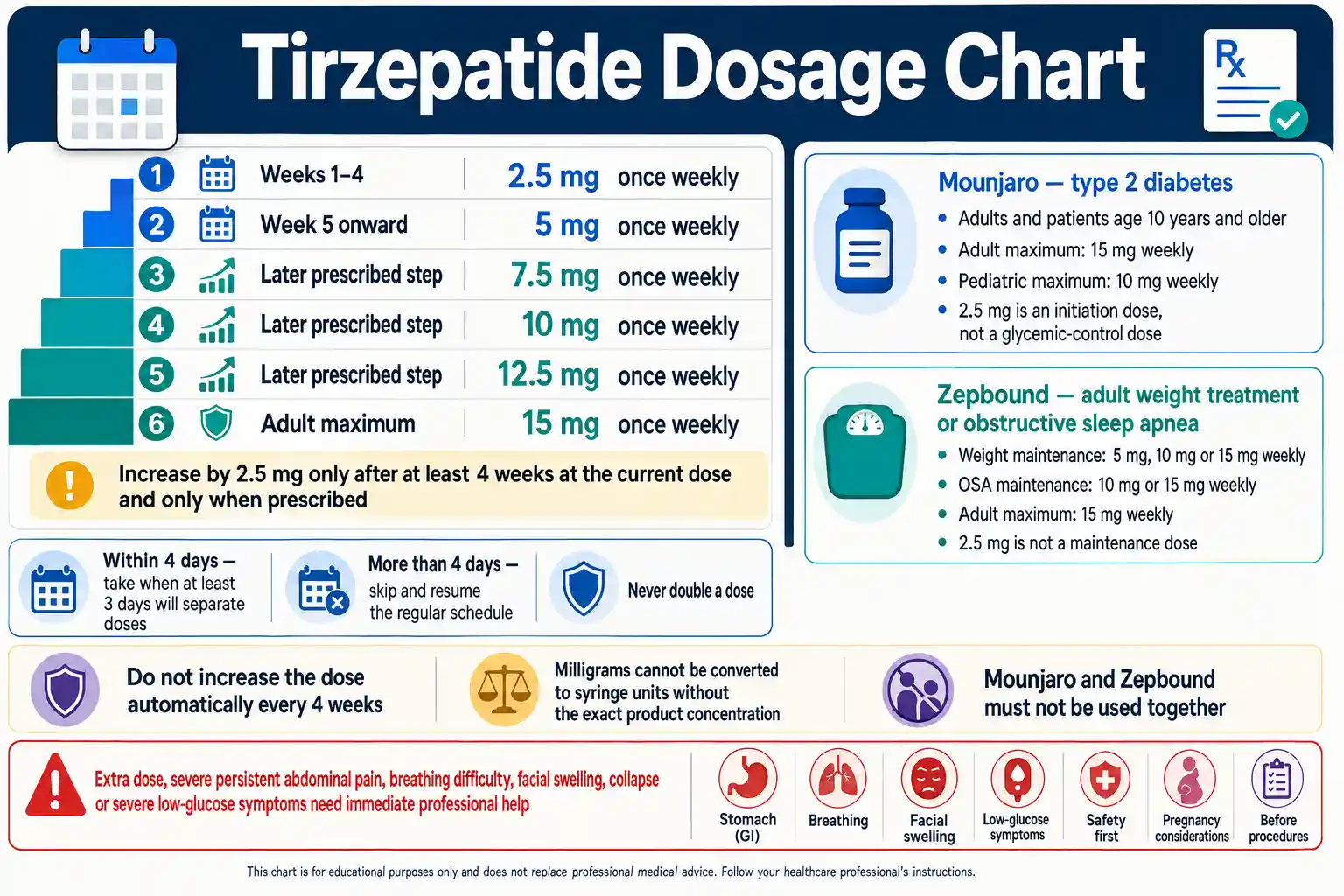
What is the standard tirzepatide dose schedule?
Tirzepatide usually starts at 2.5 mg once weekly for four weeks, then increases to 5 mg once weekly. Later increases use 2.5 mg steps only after at least four weeks on the current dose and only when the prescriber decides the change is appropriate.
Current U.S. labels for Mounjaro and Zepbound use the same initiation sequence. Their approved uses and some maintenance limits are different.
Starting sequence
2.5 mg for 4 weeks
Both brands then move to 5 mg once weekly; later increases require at least four weeks.
Dose steps
Increase by 2.5 mg
A prescriber decides whether another step is needed based on indication, response, and tolerance.
Brand context
Mounjaro ≠ Zepbound
They contain tirzepatide but carry different indications and maintenance-dose guidance.
Maximum
Not a treatment goal
Adults may reach 15 mg; pediatric Mounjaro has a 10 mg maximum and Zepbound is not established in children.
FDA-Labeled Tirzepatide Dose Escalation
Both U.S. brands start at 2.5 mg once weekly and move to 5 mg after four weeks. Later increases are optional prescriber decisions based on indication, response, and tolerability.
Swipe horizontally inside the table to view every column.
| Stage | Weekly dose | Earliest labeled timing | Meaning |
|---|---|---|---|
| Treatment initiation | 2.5 mg once weekly — Initiation dose | Weeks 1–4 | Starting dose used to improve gastrointestinal tolerability |
| First increase | 5 mg once weekly | Beginning at week 5 | First dose after the four-week initiation period |
| Possible later step | 7.5 mg once weekly | After at least 4 weeks at 5 mg | Intermediate escalation dose when prescribed |
| Possible later step | 10 mg once weekly | After at least 4 weeks at 7.5 mg | Maintenance option for both brands in selected patients |
| Possible later step | 12.5 mg once weekly | After at least 4 weeks at 10 mg | Intermediate escalation dose when prescribed |
| Possible later step | 15 mg once weekly — Adult maximum dose | After at least 4 weeks at 12.5 mg | Adult maximum and a maintenance option for selected indications |
Dose is milligrams of tirzepatide injected subcutaneously once weekly.
- • Do not move up automatically every four weeks; a prescriber decides whether and when another increase is appropriate.
- • The 2.5 mg dose is an initiation dose. It is not intended for glycemic control with Mounjaro and is not an approved Zepbound maintenance dose.
- • Pediatric Mounjaro and adult Zepbound maintenance limits differ from the adult Mounjaro maximum.
Download or export
How to read a tirzepatide dosage chart
Start with the exact prescription label. Then match the brand, age, indication, current dose, weeks at that dose, and tolerability. Use the chart to understand a prescribed plan, not to choose or change a dose.
1
Identify the product
Mounjaro and Zepbound contain tirzepatide but have different labeled indications.
2
Match age and indication
Adult diabetes, pediatric diabetes, weight treatment, and OSA do not share every limit.
3
Check time and tolerance
Later 2.5 mg increases require at least four weeks and a prescriber’s decision.
4
Apply safety first
A dosing error, severe reaction, pregnancy, or procedure can change the next action.
A labeled maximum is a ceiling, not a goal. Treatment may remain at a lower maintenance dose or pause escalation when response, adverse effects, or clinical circumstances require.
Mounjaro and Zepbound are not interchangeable instructions
Mounjaro
Mounjaro is labeled with diet and exercise to improve glycemic control in adults and pediatric patients 10 years and older with type 2 diabetes. The adult maximum is 15 mg weekly; the pediatric maximum is 10 mg weekly.
Zepbound
Zepbound is labeled for adult weight reduction and long-term maintenance, and for moderate to severe obstructive sleep apnea in adults with obesity. Its adult maximum is 15 mg weekly, but maintenance options depend on the indication.
Do not use Mounjaro and Zepbound together. Do not add another GLP-1 medicine to Zepbound unless a qualified prescriber has reviewed and changed the treatment plan.
Mounjaro Dosage for Type 2 Diabetes
Mounjaro is FDA-approved with diet and exercise to improve glycemic control in adults and children 10 years and older with type 2 diabetes. The maximum differs by age group.
Swipe horizontally inside the table to view every column.
| Patient or stage | Labeled dose | Timing or limit | Key point |
|---|---|---|---|
| Adults — starting dose | 2.5 mg once weekly | First 4 weeks | For treatment initiation; not intended for glycemic control |
| Adults — first treatment dose | 5 mg once weekly | After 4 weeks at 2.5 mg | Continue or adjust later according to response and tolerability |
| Adults — further escalation | Increase by 2.5 mg | Only after at least 4 weeks at the current dose | Used when additional glycemic control is needed and the dose is tolerated |
| Adults — maximum | 15 mg once weekly — Adult maximum | Maximum labeled adult dose | A maximum is not a treatment target for every patient |
| Age 10+ — starting dose | 2.5 mg once weekly | First 4 weeks | Pediatric use requires a pediatric diabetes prescriber and caregiver training |
| Age 10+ — first treatment dose | 5 mg once weekly | After 4 weeks at 2.5 mg | Response, adverse effects, glucose, and other medicines guide follow-up |
| Age 10+ — further escalation | Increase by 2.5 mg | Only after at least 4 weeks at the current dose | Pediatric KwikPen self-administration is not recommended in the U.S. label |
| Age 10+ — maximum | 10 mg once weekly — Pediatric maximum | Maximum labeled pediatric dose | Do not apply the 15 mg adult maximum to pediatric patients |
| Under age 10 | No established labeled dose — No established dose | Safety and effectiveness not established | Do not derive a child dose from body weight or an adult chart |
U.S. Mounjaro labeling; local approvals and presentations can differ.
- • Mounjaro is not dosed by body weight.
- • Insulin or sulfonylurea doses may need clinician-directed adjustment because hypoglycemia risk can increase.
- • Mounjaro and Zepbound contain the same active ingredient but have different labeled indications.
Download or export
Zepbound Maintenance Dose by Indication
Zepbound uses the same initiation sequence for its adult indications, but the labeled maintenance options differ for weight reduction and obstructive sleep apnea.
Swipe horizontally inside the table to view every column.
| Indication or stage | Labeled dose | Who it applies to | Interpretation |
|---|---|---|---|
| All Zepbound indications — start | 2.5 mg once weekly for 4 weeks — Not maintenance | Adults with a labeled indication | Initiation only; not an approved maintenance dose |
| All Zepbound indications — first increase | 5 mg once weekly | After the 4-week start | Further escalation depends on response and tolerability |
| Weight reduction and long-term maintenance | 5 mg once weekly | Adults with obesity or qualifying overweight | One of three recommended maintenance options |
| Weight reduction and long-term maintenance | 10 mg once weekly | Adults with obesity or qualifying overweight | Reached through labeled 2.5 mg steps when prescribed |
| Weight reduction and long-term maintenance | 15 mg once weekly | Adults with obesity or qualifying overweight | Highest recommended maintenance option |
| Moderate to severe OSA with obesity | 10 mg or 15 mg once weekly — OSA maintenance range | Adults with the labeled OSA indication | Recommended maintenance range for OSA |
| All indications — maximum | 15 mg once weekly | Adults | Do not exceed the labeled weekly maximum |
| Children and adolescents | No established labeled Zepbound dose — Pediatric use not established | Under age 18 | Safety and effectiveness are not established in the current U.S. label |
OSA means obstructive sleep apnea. Zepbound is used with reduced-calorie diet and increased physical activity.
- • A clinician selects the maintenance dose by balancing treatment response and tolerability.
- • If a maintenance dose is not tolerated, the label directs clinicians to consider a lower maintenance dose.
- • Do not combine Zepbound with another tirzepatide product or any GLP-1 receptor agonist.
Download or export
Tirzepatide Prescription Discussion Guide
Check a prescribed dose against label context
Match the product, indication, age, prescribed dose, time at that dose, missed-dose timing, symptoms, and special circumstances. The result highlights questions and urgent situations without choosing a dose.
Label and safety result
Dose matches a possible labeled stage
The selected dose can occur in the labeled schedule for this context, but the chart cannot confirm that it is right for one person. Continue only the written prescription and ask before any increase, restart, product switch, or concentration conversion.
Generated summary
Tirzepatide prescription discussion summary
Product: Mounjaro
Indication and age group: Adult type 2 diabetes
Current prescribed dose: Not started
Time at current dose: Not started
Weekly timing: On schedule; no missed dose
Symptoms: No current concerning symptoms
Special context: None of these
Additional note: Not specified
Guide result: Dose matches a possible labeled stage.
Safety note: This guide does not prescribe, authorize escalation, convert concentrations, diagnose symptoms, or replace the prescription label, pharmacist, prescriber, poison center, or emergency care.
A dosing error or severe symptom overrides routine schedule guidance. Call local emergency services for breathing difficulty, facial or throat swelling, collapse, seizure, or unconsciousness. Contact a poison center or urgent medical service after an extra dose, wrong concentration, or measurement error. Nothing entered here is stored or transmitted.
Four days and three days answer different timing questions
The 96-hour rule tells whether a missed dose can still be taken. The 72-hour rule keeps two doses far enough apart when changing the weekly day. Neither rule makes a double dose, uncertain dose, or overdose safe.
Missed Dose and Weekly Timing Rules
The FDA-labeled missed-dose and schedule-change rules are the same for Mounjaro and Zepbound. They do not replace individualized advice after an overdose, long interruption, or severe reaction.
Swipe horizontally inside the table to view every column.
| Situation | Label-based action | Timing rule | Do not |
|---|---|---|---|
| Dose missed by 4 days or less | Take the missed dose as soon as possible | Within 96 hours of the scheduled time — Within 96 hours | Take it if doing so would place doses less than 72 hours apart |
| Dose missed by more than 4 days | Skip the missed dose | Take the next dose on the regular day | Double the next dose — Never double |
| Changing the weekly dose day | Choose a new day only when needed | Keep at least 72 hours between doses | Use the rule to dose more often than weekly |
| Unsure when the last dose was taken | Check records and contact the prescriber or pharmacist | Resolve timing before injecting | Guess or repeat a possibly completed dose |
| Vomited after an injection | Contact the prescriber if symptoms are significant | Injected medicine is not redosed like an oral tablet | Automatically inject another dose |
| Took an extra dose or too much | Call a poison center or urgent medical service for case-specific advice — Possible overdose | Seek emergency help for severe symptoms | Wait for the next appointment if symptoms are worsening |
| Long treatment interruption | Ask the prescriber how to restart | Tolerance may have changed | Resume a high prior dose without instructions |
| Dose held for illness or a procedure | Follow the treating team’s restart plan | Coordinate with the prescriber and procedure team | Create a personal stop-and-restart schedule from the chart |
96 hours = 4 days. The minimum interval for changing weekly dose day is 72 hours = 3 days.
- • Use the exact scheduled date and injection record rather than memory alone.
- • A severe reaction or possible overdose takes priority over routine missed-dose instructions.
- • Local poison-center numbers vary; call local emergency services for collapse, breathing difficulty, or another life-threatening symptom.
Download or export
Milligrams, volume and syringe units are not interchangeable
Approved single-dose pens and vials commonly contain a dose in 0.5 mL, while current four-dose vials or KwikPens list a dose in 0.6 mL. A compounded vial may use a different concentration. The prescription, package label, and device instructions must agree before injection.
FDA warns that unapproved compounded GLP-1 products can involve quality, labeling, concentration, and titration problems. Review the FDA concerns about unapproved GLP-1 products and ask the dispensing pharmacist to demonstrate the exact measurement.
Tirzepatide Dose, Strength and Presentation
Approved presentations deliver a prescribed milligram dose. Device type and liquid volume can differ, so a milligram dose must never be converted to syringe “units” without product-specific professional instruction.
Swipe horizontally inside the table to view every column.
| Dose per injection | Single-dose pen or vial | Multi-dose vial or KwikPen dose | Safety point |
|---|---|---|---|
| 2.5 mg | 2.5 mg/0.5 mL | 2.5 mg/0.6 mL per labeled dose | Confirm the exact device and Instructions for Use |
| 5 mg | 5 mg/0.5 mL | 5 mg/0.6 mL per labeled dose | The same milligram dose can appear in a different volume |
| 7.5 mg | 7.5 mg/0.5 mL | 7.5 mg/0.6 mL per labeled dose | Do not use volume alone to identify the dose |
| 10 mg | 10 mg/0.5 mL | 10 mg/0.6 mL per labeled dose | Check product, concentration, and prescribed dose together |
| 12.5 mg | 12.5 mg/0.5 mL | 12.5 mg/0.6 mL per labeled dose | This is an escalation step, not a universal maintenance dose |
| 15 mg — Adult maximum strength | 15 mg/0.5 mL | 15 mg/0.6 mL per labeled dose | Adult maximum; not the pediatric Mounjaro maximum |
| Compounded or unfamiliar vial | Concentration may differ | Volume cannot be inferred from brand charts | Ask the dispensing pharmacist to show the exact measurement — Do not convert without instruction |
Current U.S. labels list single-dose and four-dose presentations. Availability varies by product, market, and time.
- • Never share a multi-dose pen between patients, even if the needle is changed.
- • Use a new needle and syringe for each vial injection and follow the presentation-specific Instructions for Use.
- • Do not transfer medicine between devices, split a fixed-dose pen, or use leftover liquid unless the approved instructions explicitly direct it.
Download or export
Checks Before Starting or Increasing Tirzepatide
A prescriber reviews indication, contraindications, medicines, pregnancy plans, gastrointestinal history, glucose risk, and procedure timing before treatment and dose changes.
Swipe horizontally inside the table to view every column.
| Check | Why it matters | Discuss before dosing | Key distinction |
|---|---|---|---|
| Personal or family history of MTC or MEN 2 | Both brands have a boxed warning and are contraindicated | Tell the prescriber before the first dose — Contraindication | Common thyroid disease is not the same history; the clinician must assess it |
| Previous serious tirzepatide allergy | Anaphylaxis and angioedema have been reported | Do not use after a known serious hypersensitivity reaction | Mild injection-site irritation is different from whole-body allergy |
| Pregnancy or pregnancy planning | Weight loss is not recommended in pregnancy and fetal risk is possible | Contact the prescriber promptly if pregnancy occurs | Do not stop diabetes treatment without a replacement plan |
| Oral hormonal contraception | Delayed gastric emptying may reduce oral contraceptive effectiveness | Use a non-oral method or add a barrier for 4 weeks after starting and after each escalation — Contraception timing | Non-oral hormonal methods are not expected to be affected in the same way |
| Severe gastroparesis or major gastrointestinal disease | Severe gastrointestinal reactions can occur | Review symptoms and history before treatment or escalation | Slower gastric emptying can also affect oral medicines |
| Pancreatitis or gallbladder history | Pancreatitis and acute gallbladder disease are warnings | Report history and new abdominal symptoms | Persistent severe pain is not routine nausea |
| Kidney disease or dehydration risk | Vomiting or diarrhea can cause volume depletion and kidney injury | Plan hydration and monitoring with the clinician | No routine renal dose adjustment does not remove dehydration risk |
| Insulin or sulfonylurea use | Combination can increase hypoglycemia risk | Ask who will adjust glucose-lowering medicines | Never reduce prescribed insulin on your own |
| Diabetic retinopathy | Rapid glucose improvement can temporarily worsen retinopathy | Arrange eye follow-up when indicated | New vision change needs prompt clinical contact |
| Planned anesthesia or deep sedation | Delayed gastric emptying can leave residual stomach contents | Tell the procedure and anesthesia teams that tirzepatide is used — Tell procedure team | Do not invent a holding interval from general internet advice |
| Age and brand-specific approval | Mounjaro and Zepbound pediatric labeling differs | Confirm brand, age, and indication | A weight-based pediatric calculation is not appropriate |
MTC = medullary thyroid carcinoma. MEN 2 = Multiple Endocrine Neoplasia syndrome type 2.
- • No dosage adjustment is routinely recommended for renal or hepatic impairment in U.S. labeling, but clinical monitoring still matters.
- • Bring a complete medicine and supplement list because tirzepatide delays gastric emptying and can affect oral-drug absorption.
- • Never use tirzepatide with another tirzepatide product; Zepbound also should not be coadministered with a GLP-1 receptor agonist.
Download or export
Common Effects During Tirzepatide Escalation
Gastrointestinal effects are common and often cluster during dose escalation. Frequency and severity vary; persistent or severe symptoms require individualized advice.
Swipe horizontally inside the table to view every column.
| Effect | Common context | Practical discussion point | Escalation concern |
|---|---|---|---|
| Nausea | Often more noticeable after starting or increasing | Discuss meal size, hydration, and dose tolerance with the prescriber | Persistent inability to eat or drink |
| Diarrhea | Can occur during treatment and escalation | Track frequency and fluid intake | Dehydration, weakness, or reduced urination |
| Vomiting | May occur, especially during escalation | Contact the care team if repeated | Inability to keep fluids down or severe abdominal pain — Dehydration or pancreatitis concern |
| Constipation | Common with both brands | Track bowel pattern and follow clinician advice | Severe constipation, distension, vomiting, or inability to pass stool or gas — Possible obstruction concern |
| Abdominal pain | Can be a common gastrointestinal effect | Describe location, severity, duration, and radiation | Persistent severe pain, especially toward the back |
| Decreased appetite | Expected pharmacologic effect for many patients | Monitor nutrition and hydration | Unable to meet basic intake or rapid clinical decline |
| Indigestion, reflux, belching or bloating | Delayed gastric emptying can contribute | Review foods, timing, and oral medicines with the clinician | Severe or progressive symptoms |
| Injection-site reaction | Redness, itching, bruising, or discomfort can occur | Rotate sites and follow device instructions | Spreading swelling, hives, or breathing symptoms |
| Fatigue or dizziness | May accompany reduced intake, dehydration, or low glucose | Check context and glucose when appropriate | Fainting, confusion, or persistent weakness |
| Hair loss | Reported with Zepbound weight-reduction treatment | Discuss nutrition, weight-loss pace, and other causes | Rapid or patchy loss with other symptoms |
This chart describes patterns; it cannot grade an individual adverse reaction.
- • Do not increase the dose while significant adverse effects are unresolved unless the prescriber specifically directs it.
- • Nausea, vomiting, and diarrhea in trials were often most frequent during escalation and decreased over time, but severe symptoms are not something to push through.
- • Report suspected adverse reactions through the clinician and the relevant national reporting system.
Download or export
Tirzepatide Warning Signs and Care Timing
Symptoms, severity, and trend matter more than the numeric dose. Emergency symptoms and possible overdose require immediate action rather than an online dose comparison.
Swipe horizontally inside the table to view every column.
| Pattern | Possible concern | Recommended timing | Examples |
|---|---|---|---|
| Trouble breathing, facial or throat swelling, widespread hives, collapse | Serious hypersensitivity or another emergency | Call local emergency services now — Emergency | Rapid swelling, wheeze, chest tightness, fainting |
| Severe persistent abdominal pain, sometimes radiating to the back | Acute pancreatitis | Urgent medical assessment | Pain with or without nausea and vomiting |
| Right-upper abdominal pain, fever, jaundice or clay-colored stool | Gallbladder or bile-duct problem | Prompt medical assessment | Pain after meals, yellow skin or eyes, dark urine |
| Repeated vomiting or diarrhea with low urine, faintness or confusion | Severe dehydration or acute kidney injury | Urgent assessment | Unable to keep fluids down, marked weakness |
| Severe constipation, swollen abdomen, vomiting, no stool or gas | Possible intestinal obstruction or severe gastrointestinal reaction | Urgent assessment | Progressive distension or colicky pain |
| Shaking, sweating, confusion, seizure or unconsciousness | Severe hypoglycemia, especially with insulin or sulfonylurea | Use the prescribed emergency plan and call for help | Glucose below the person’s action threshold or inability to self-treat |
| Sudden or worsening vision change | Diabetic retinopathy complication or another eye problem | Prompt eye or medical assessment | Blurred vision, floaters, dark areas, loss of vision |
| Neck mass, persistent hoarseness, trouble swallowing or breathing | Thyroid tumor symptoms requiring evaluation | Contact a clinician promptly | New lump or persistent voice change |
| Extra dose, unknown concentration, or suspected measurement error | Potential overdose | Call poison-control or urgent medical service now — Possible overdose | Wrong pen, wrong vial volume, repeated injection |
Care routes vary by country. Use local emergency, poison-center, and urgent-care services.
- • Do not use a reassuring glucose, weight, or dose number to dismiss severe symptoms.
- • A clinician may advise stopping or changing medicine; do not create that plan from this table.
- • Bring the product package, concentration, prescribed dose, injection time, and other medicines when seeking help after a dosing error.
Download or export
Tirzepatide Monitoring and Follow-Up
Monitoring connects the prescribed dose with treatment response, tolerability, other medicines, and safety. Not every person needs every test at the same interval.
Swipe horizontally inside the table to view every column.
| Item | What to record or review | Why it matters | Who interprets it |
|---|---|---|---|
| Dose history | Brand, dose in mg, date, injection site, presentation — Core dose record | Prevents duplicate doses and clarifies escalation timing | Patient, pharmacist and prescriber |
| Tolerance | Nausea, vomiting, diarrhea, constipation, pain, intake | Determines whether escalation is reasonable | Prescriber |
| Glucose pattern | Readings, lows, symptoms, insulin or sulfonylurea use | Identifies hypoglycemia and treatment response | Diabetes care team |
| A1C | Laboratory trend at the clinician’s interval | Measures longer-term glycemic response | Prescriber |
| Weight and waist trend | Consistent measurements over time | Shows trajectory without overreacting to daily fluctuation | Patient and prescriber |
| Hydration and kidney context | Fluid loss, urine output, dizziness, kidney history | Severe gastrointestinal loss can cause kidney injury | Prescriber; laboratory testing when indicated |
| Vision | New blur, floaters, dark areas or rapid change | Rapid glucose improvement can affect retinopathy | Eye-care and diabetes teams |
| Pregnancy and contraception | Pregnancy status, plans, oral hormonal method, escalation dates | Changes risk and contraceptive planning | Prescriber and reproductive-health clinician |
| Procedure planning | Upcoming anesthesia, sedation, endoscopy or surgery | Delayed gastric emptying affects aspiration risk — Procedure safety | Prescriber, proceduralist and anesthesia team |
| Device technique | Correct product, dose, site rotation, needle or syringe use | Reduces administration errors and contamination | Pharmacist, clinician or trained educator |
| Medication list | Insulin, sulfonylureas, oral medicines and other GLP-1 drugs | Interactions and duplicate therapy can change risk | Prescriber and pharmacist |
A1C reflects average glucose exposure over roughly the prior two to three months.
- • Use trends and symptoms together; a single weight, glucose, or adverse-effect entry rarely tells the whole story.
- • Keep the prescription label and device instructions with the record when presentation or concentration changes.
- • Monitoring supports prescriber decisions; it does not authorize self-escalation.
Download or export
Tirzepatide dosage FAQs
What is the usual starting dose of tirzepatide?
The FDA-labeled starting dose for both Mounjaro and Zepbound is 2.5 mg injected under the skin once weekly for four weeks. It is an initiation dose used to improve tolerability, not a signal to increase automatically.
When does tirzepatide increase from 2.5 mg to 5 mg?
The labels direct an increase to 5 mg once weekly after four weeks at 2.5 mg. A prescriber should still confirm the plan, especially if significant adverse effects, illness, or an interruption occurred.
How quickly can a tirzepatide dose be increased after 5 mg?
Later increases use 2.5 mg steps only after at least four weeks on the current dose. Whether to increase depends on the brand, indication, response, tolerability, age, and prescriber’s judgment.
What is the maximum Mounjaro dose?
The maximum labeled Mounjaro dose is 15 mg once weekly for adults and 10 mg once weekly for pediatric patients 10 years and older. The highest dose is not necessary or appropriate for every patient.
What are the Zepbound maintenance doses for weight loss?
For adult weight reduction and long-term maintenance, the recommended Zepbound maintenance doses are 5 mg, 10 mg, or 15 mg once weekly. The prescriber selects a dose by response and tolerability.
What is the Zepbound maintenance dose for obstructive sleep apnea?
For adults with obesity and moderate to severe obstructive sleep apnea, the labeled maintenance dose is 10 mg or 15 mg once weekly after gradual escalation.
Is 2.5 mg a maintenance dose of tirzepatide?
No. Mounjaro labels 2.5 mg as treatment initiation and not for glycemic control, while Zepbound states that 2.5 mg is not an approved maintenance dose.
What should I do if I miss a tirzepatide dose?
If four days or less have passed, the label says to take it as soon as possible when the 72-hour spacing rule can still be met. If more than four days have passed, skip it and take the next dose on the regular day. Never double a dose.
Can I change my weekly injection day?
The weekly day can be changed if at least 72 hours separate the two doses. This rule does not permit taking tirzepatide more often than once weekly.
Are Mounjaro and Zepbound the same medication?
Both contain tirzepatide, but they have different FDA-approved indications and some different maintenance guidance. They must not be used together.
Is tirzepatide dosage based on body weight?
No. Approved tirzepatide dosing uses fixed weekly milligram steps, not a mg-per-kg formula. Body weight must not be used to calculate a child or adult dose.
Can I convert a tirzepatide dose from milligrams to syringe units?
Not from a generic chart. The required volume depends on the exact product and concentration. Ask the dispensing pharmacist to demonstrate the prescribed measurement, especially for any vial or compounded product.
Can tirzepatide affect birth-control pills?
Yes. Delayed gastric emptying may reduce the effectiveness of oral hormonal contraceptives. U.S. labeling advises a non-oral method or added barrier method for four weeks after starting and for four weeks after each dose increase.
Should tirzepatide be stopped before surgery or anesthesia?
Tell the prescriber, surgeon, proceduralist, and anesthesia team because tirzepatide delays gastric emptying. The label does not support one universal self-directed holding interval; the treating team should give the plan.
Which tirzepatide symptoms need urgent care?
Emergency symptoms include trouble breathing, facial or throat swelling, widespread hives, collapse, or severe hypoglycemia with loss of consciousness. Severe persistent abdominal pain, repeated vomiting with dehydration, jaundice, sudden vision change, or a dosing error also needs prompt professional assessment.
Sources
1. U.S. Food and Drug Administration — Mounjaro Prescribing Information
Current U.S. prescribing information for Mounjaro indications, adult and pediatric dosing, administration, contraindications, warnings, adverse reactions, and product presentations.
https://www.accessdata.fda.gov/drugsatfda_docs/label/2026/215866s009lbl.pdf
2. U.S. Food and Drug Administration — Zepbound Prescribing Information
Current U.S. prescribing information for Zepbound weight-reduction and obstructive-sleep-apnea indications, dose escalation, maintenance doses, administration, and safety.
https://www.accessdata.fda.gov/drugsatfda_docs/label/2026/217806s002lbl.pdf
3. National Library of Medicine — DailyMed — Mounjaro Current Drug Label
Current structured product label with Mounjaro dosage, missed-dose instructions, available strengths, pediatric use, interactions, and monitoring information.
https://dailymed.nlm.nih.gov/dailymed/drugInfo.cfm?setid=d2d7da5d-ad07-4228-955f-cf7e355c8cc0
4. National Library of Medicine — DailyMed — Zepbound Current Drug Label
Current structured product label with Zepbound initiation, maintenance, maximum dosage, missed-dose rules, presentations, warnings, and special-population guidance.
https://dailymed.nlm.nih.gov/dailymed/drugInfo.cfm?setid=487cd7e7-434c-4925-99fa-aa80b1cc776b
5. U.S. Food and Drug Administration — FDA Concerns with Unapproved GLP-1 Drugs Used for Weight Loss
Explains quality, fraud, dosing, titration, and adverse-event concerns involving unapproved compounded semaglutide and tirzepatide products.
https://www.fda.gov/drugs/drug-alerts-and-statements/fdas-concerns-unapproved-glp-1-drugs-used-weight-loss
6. U.S. Food and Drug Administration — Compounding and the FDA: Questions and Answers
Explains that compounded drugs are not FDA-approved and are not reviewed by FDA for safety, effectiveness, or quality before marketing.
https://www.fda.gov/drugs/human-drug-compounding/compounding-and-fda-questions-and-answers
7. U.S. Food and Drug Administration — FDA Approves First Medication for Obstructive Sleep Apnea
Describes the adult Zepbound indication for moderate to severe obstructive sleep apnea in adults with obesity.
https://www.fda.gov/news-events/press-announcements/fda-approves-first-medication-obstructive-sleep-apnea
8. U.S. Food and Drug Administration — Mounjaro Pediatric Supplement Approval Letter
Documents the pediatric labeling update for type 2 diabetes in patients 10 through 17 years of age.
https://www.accessdata.fda.gov/drugsatfda_docs/appletter/2025/215866Orig1s039ltr.pdf
9. National Library of Medicine — MedlinePlus — Tirzepatide Injection Drug Information
Patient-focused information on weekly administration, precautions, missed doses, common effects, and symptoms requiring medical attention.
https://medlineplus.gov/druginfo/meds/a622044.html
10. Eli Lilly and Company — Mounjaro Instructions for Use
Manufacturer instructions for the single-dose Mounjaro pen, including injection sites, device handling, and disposal.
https://pi.lilly.com/us/mounjaro-us-ifu.pdf
11. Eli Lilly and Company — Zepbound U.S. Prescribing Information
Manufacturer-hosted current U.S. prescribing information used to cross-check dose, presentation, and administration details.
https://pi.lilly.com/us/zepbound-uspi.pdf