Health & Medical · Dental Reference
Tooth Numbering Chart for Universal, FDI and Palmer Systems
Match all permanent and primary tooth positions, translate common codes, and keep patient-side orientation clear across three dental notation systems.
A tooth number is an identifier, not a diagnosis or treatment order. Before any procedure, the dental team must verify the patient, notation system, full tooth description, examination, images, consent, and treatment plan. Read the ChartsLoom Disclaimer.
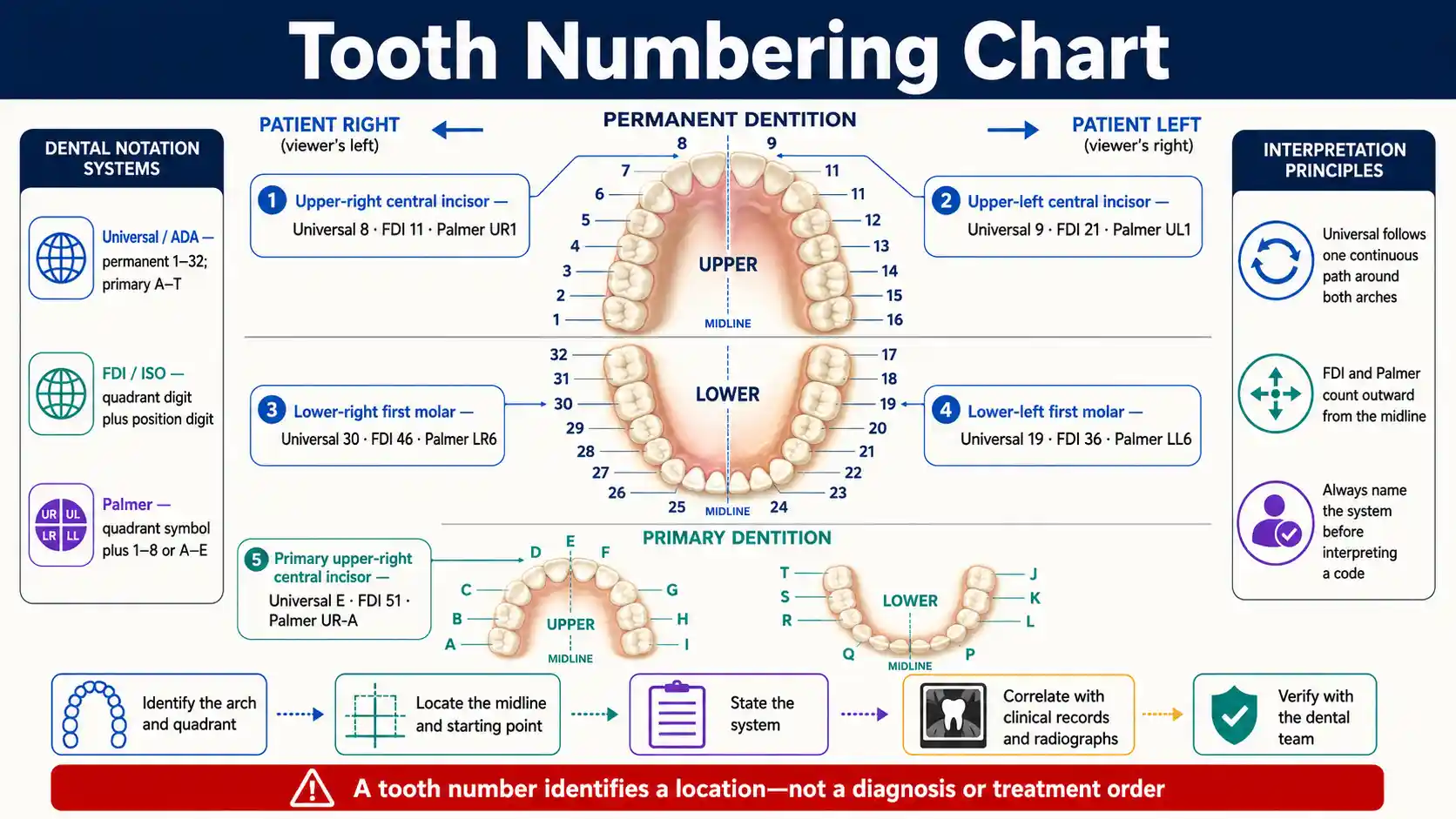
How are teeth numbered?
The Universal system labels permanent teeth 1–32 and primary teeth A–T. FDI notation uses two digits for quadrant and position. Palmer notation combines a quadrant symbol with 1–8 for permanent teeth or A–E for primary teeth.
No single number is universal. For example, Universal 11 is the permanent upper-left canine, while FDI 11 is the permanent upper-right central incisor. Always name the system before interpreting the code.
Universal / ADA
1–32 and A–T
Permanent teeth use numbers; primary teeth use a continuous letter sequence.
FDI / ISO
Two-digit code
The first digit identifies dentition and quadrant; the second counts from the midline.
Palmer
Quadrant + position
Permanent teeth use 1–8 and primary teeth use A–E inside each quadrant.
Orientation
Use the patient’s side
Patient right normally appears on the viewer’s left in a standard dental chart.
Permanent Tooth Numbering: Universal, FDI and Palmer
The complete 32-position permanent chart is arranged from the patient’s upper right around the maxillary arch, then from the patient’s lower left around the mandibular arch.
Swipe horizontally inside the table to view every column.
| Patient location | Permanent tooth name | Universal / ADA | FDI / ISO | Palmer |
|---|---|---|---|---|
| Upper right | Third molar (wisdom tooth) | 1 | 18 | UR8 — 8⏌ |
| Upper right | Second molar | 2 | 17 | UR7 — 7⏌ |
| Upper right | First molar | 3 | 16 | UR6 — 6⏌ |
| Upper right | Second premolar | 4 | 15 | UR5 — 5⏌ |
| Upper right | First premolar | 5 | 14 | UR4 — 4⏌ |
| Upper right | Canine | 6 | 13 | UR3 — 3⏌ |
| Upper right | Lateral incisor | 7 | 12 | UR2 — 2⏌ |
| Upper right | Central incisor | 8 — Universal upper-right central incisor | 11 | UR1 — 1⏌ |
| Upper left | Central incisor | 9 — Universal upper-left central incisor | 21 | UL1 — ⎿1 |
| Upper left | Lateral incisor | 10 | 22 | UL2 — ⎿2 |
| Upper left | Canine | 11 | 23 | UL3 — ⎿3 |
| Upper left | First premolar | 12 | 24 | UL4 — ⎿4 |
| Upper left | Second premolar | 13 | 25 | UL5 — ⎿5 |
| Upper left | First molar | 14 | 26 | UL6 — ⎿6 |
| Upper left | Second molar | 15 | 27 | UL7 — ⎿7 |
| Upper left | Third molar (wisdom tooth) | 16 | 28 | UL8 — ⎿8 |
| Lower left | Third molar (wisdom tooth) | 17 | 38 | LL8 — ⎾8 |
| Lower left | Second molar | 18 | 37 | LL7 — ⎾7 |
| Lower left | First molar | 19 — Universal lower-left first molar | 36 | LL6 — ⎾6 |
| Lower left | Second premolar | 20 | 35 | LL5 — ⎾5 |
| Lower left | First premolar | 21 | 34 | LL4 — ⎾4 |
| Lower left | Canine | 22 | 33 | LL3 — ⎾3 |
| Lower left | Lateral incisor | 23 | 32 | LL2 — ⎾2 |
| Lower left | Central incisor | 24 | 31 | LL1 — ⎾1 |
| Lower right | Central incisor | 25 | 41 | LR1 — 1⏋ |
| Lower right | Lateral incisor | 26 | 42 | LR2 — 2⏋ |
| Lower right | Canine | 27 | 43 | LR3 — 3⏋ |
| Lower right | First premolar | 28 | 44 | LR4 — 4⏋ |
| Lower right | Second premolar | 29 | 45 | LR5 — 5⏋ |
| Lower right | First molar | 30 — Universal lower-right first molar | 46 | LR6 — 6⏋ |
| Lower right | Second molar | 31 | 47 | LR7 — 7⏋ |
| Lower right | Third molar (wisdom tooth) | 32 | 48 | LR8 — 8⏋ |
UR, UL, LL, and LR mean the patient’s upper right, upper left, lower left, and lower right.
- • Universal numbering follows a continuous 1–32 sequence. FDI and Palmer count outward from the midline inside each quadrant.
- • A standard dental chart is shown from the clinician’s viewpoint: the patient’s right appears on the viewer’s left.
- • Third-molar positions remain part of the numbering system even when wisdom teeth are absent, unerupted, impacted, or previously removed.
Download or export
Primary Tooth Numbering: Universal, FDI and Palmer
Primary teeth use 20 positions. Universal notation runs A–T around the arches; FDI uses primary quadrant digits 5–8; Palmer uses A–E from the midline in each quadrant.
Swipe horizontally inside the table to view every column.
| Patient location | Primary tooth name | Universal / ADA | FDI / ISO | Palmer |
|---|---|---|---|---|
| Upper right | Second molar | A | 55 | UR-E — E⏌ |
| Upper right | First molar | B | 54 | UR-D — D⏌ |
| Upper right | Canine | C | 53 | UR-C — C⏌ |
| Upper right | Lateral incisor | D | 52 | UR-B — B⏌ |
| Upper right | Central incisor | E — Universal primary upper-right central incisor | 51 | UR-A — A⏌ |
| Upper left | Central incisor | F — Universal primary upper-left central incisor | 61 | UL-A — ⎿A |
| Upper left | Lateral incisor | G | 62 | UL-B — ⎿B |
| Upper left | Canine | H | 63 | UL-C — ⎿C |
| Upper left | First molar | I | 64 | UL-D — ⎿D |
| Upper left | Second molar | J | 65 | UL-E — ⎿E |
| Lower left | Second molar | K | 75 | LL-E — ⎾E |
| Lower left | First molar | L | 74 | LL-D — ⎾D |
| Lower left | Canine | M | 73 | LL-C — ⎾C |
| Lower left | Lateral incisor | N | 72 | LL-B — ⎾B |
| Lower left | Central incisor | O — Universal primary lower-left central incisor | 71 | LL-A — ⎾A |
| Lower right | Central incisor | P — Universal primary lower-right central incisor | 81 | LR-A — A⏋ |
| Lower right | Lateral incisor | Q | 82 | LR-B — B⏋ |
| Lower right | Canine | R | 83 | LR-C — C⏋ |
| Lower right | First molar | S | 84 | LR-D — D⏋ |
| Lower right | Second molar | T | 85 | LR-E — E⏋ |
Primary, deciduous, milk, and baby teeth describe the same dentition in this chart.
- • Primary teeth have no premolars and no third molars.
- • Universal primary letters A–T are not the same as Palmer A–E; Palmer requires a quadrant symbol or quadrant name.
- • During mixed dentition, a retained primary tooth and its permanent successor must be documented as separate teeth.
Download or export
How to read a tooth numbering chart
Start with dentition, arch, and the patient's side. Then identify the tooth's position from the midline. Convert only after those four attributes agree.
1
Name the dentition
Permanent and primary teeth use different ranges, letters, and FDI quadrant digits.
2
Use the patient’s side
Upper right means the patient’s upper right, which appears on the viewer’s left.
3
Find the midline position
FDI and Palmer count outward from the central incisor toward the back tooth.
4
Verify before treatment
Repeat the full tooth name, compare records, and confirm the clinical site.
A tooth number identifies a location in one notation system. It does not show whether the tooth is present, healthy, restored, impacted, retained, or planned for treatment.
Universal, FDI and Palmer answer the same location differently
Universal / ADA
The ADA Universal value set uses one continuous sequence around both arches. It is common in U.S. dental records and claim reporting.
FDI / ISO 3950
The ISO 3950 two-digit system stores quadrant and position in one code. Read 36 as three-six: permanent lower-left quadrant, position six.
Palmer
Palmer repeats the position in each quadrant. The RCS England dental safety toolkit pairs standardized notation with full written descriptions and site checks.
How the Three Tooth Numbering Systems Differ
The same tooth receives a different label in each system. Always state the notation system before interpreting an isolated code.
Swipe horizontally inside the table to view every column.
| Attribute | Universal / ADA | FDI / ISO 3950 | Palmer |
|---|---|---|---|
| Main pattern | One continuous sequence around both arches | Two digits: quadrant, then position | Quadrant bracket plus position from midline |
| Permanent labels | 1–32 | 11–18, 21–28, 31–38, 41–48 | 1–8 repeated in each quadrant |
| Primary labels | A–T | 51–55, 61–65, 71–75, 81–85 | A–E repeated in each quadrant |
| Starting reference | Upper-right posterior tooth | Central incisor is position 1 | Central incisor is position 1 or A |
| Quadrant information | Implied by place in the full sequence | First digit identifies dentition and quadrant | Bracket or UR/UL/LL/LR identifies quadrant |
| Typical context | Common in U.S. dental records and claims | Used internationally and in interoperable records | Common in orthodontic and UK clinical communication |
| Keyboard-friendly form | Plain numbers or letters | Plain two-digit number | Often written as UR6, UL4, LL7, or LR1 when a bracket glyph is impractical |
| Main ambiguity risk — Ambiguity warning | A number may resemble an FDI code | A two-digit code may resemble Universal or a date | Position alone is incomplete without its quadrant |
ADA means American Dental Association. FDI/ISO refers to the ISO 3950 two-digit system.
- • Universal tooth 11 is the permanent upper-left canine, while FDI 11 is the permanent upper-right central incisor.
- • The words “upper,” “lower,” “right,” and “left” refer to the patient.
- • Local software may display or pronounce a system differently, so verify the chart legend.
Download or export
FDI Quadrant and Position Code Chart
In FDI notation, the first digit identifies dentition and quadrant. The second digit counts from the midline toward the back of that quadrant.
Swipe horizontally inside the table to view every column.
| Dentition and quadrant | First digit | Possible second digits | Example |
|---|---|---|---|
| Permanent upper right | 1 | 1–8 | 11 = upper-right central incisor — FDI code example |
| Permanent upper left | 2 | 1–8 | 26 = upper-left first molar |
| Permanent lower left | 3 | 1–8 | 36 = lower-left first molar |
| Permanent lower right | 4 | 1–8 | 48 = lower-right third molar |
| Primary upper right | 5 | 1–5 | 51 = primary upper-right central incisor — Primary FDI example |
| Primary upper left | 6 | 1–5 | 64 = primary upper-left first molar |
| Primary lower left | 7 | 1–5 | 75 = primary lower-left second molar |
| Primary lower right | 8 | 1–5 | 83 = primary lower-right canine |
Read FDI 36 as “three-six,” not “thirty-six,” to preserve its two-part structure.
- • Permanent quadrant order is 1 upper right, 2 upper left, 3 lower left, and 4 lower right.
- • Primary quadrant order follows the same path using digits 5, 6, 7, and 8.
- • FDI position 1 is always nearest the midline; the largest normal position is 8 permanent or 5 primary.
Download or export
Palmer Notation Quadrants and Symbols
Palmer notation repeats the position inside each quadrant and uses a bracket-like symbol to show the patient’s arch and side. Alphanumeric forms make the same location explicit in text.
Swipe horizontally inside the table to view every column.
| Patient quadrant | Permanent example | Primary example | Plain-text reading |
|---|---|---|---|
| Upper right | 6⏌ | D⏌ | UR6 = first permanent molar; UR-D = first primary molar — Modified Palmer example |
| Upper left | ⎿6 | ⎿D | UL6 = first permanent molar; UL-D = first primary molar |
| Lower left | ⎾6 | ⎾D | LL6 = first permanent molar; LL-D = first primary molar — Modified Palmer example |
| Lower right | 6⏋ | D⏋ | LR6 = first permanent molar; LR-D = first primary molar |
| Permanent central incisor | Position 1 | Not applicable | Use 1 with the quadrant symbol or UR/UL/LL/LR |
| Permanent third molar | Position 8 | Not applicable | Use 8 with the quadrant symbol or UR/UL/LL/LR |
| Primary central incisor | Not applicable | Position A | Use A with the quadrant symbol or UR/UL/LL/LR |
| Primary second molar | Not applicable | Position E | Use E with the quadrant symbol or UR/UL/LL/LR |
Palmer bracket appearance depends on quadrant and font support.
- • A Palmer position without its bracket or quadrant is incomplete because the same number or letter repeats four times.
- • Clinical teams may use the modified labels UR, UL, LL, and LR when electronic text cannot reproduce Palmer glyphs reliably.
- • For invasive care, use the notation required by the treating organization and add the full written tooth description when clarity matters.
Download or export
Tooth Number Converter
Convert a known tooth between numbering systems
Select the dentition, patient quadrant, and position from the midline. The converter returns the matching Universal, FDI, and Palmer labels without interpreting an ambiguous number by itself.
Selected tooth
permanent upper right central incisor
Position 1 from the midline in the patient's upper right quadrant.
Universal / ADA
8
FDI / ISO
11
Palmer
UR1
Copyable conversion
Tooth numbering conversion
Dentition: Permanent
Patient quadrant: Upper right
Position from midline: 1
Tooth: permanent upper right central incisor
Universal / ADA: 8
FDI / ISO: 11
Palmer: UR1 (1⏌)
Verification note: Confirm the notation system, patient side, clinical chart, images, and treatment plan with the dental team before care.
Do not use a converted label alone to authorize treatment. A number does not prove that the tooth is present, healthy, erupted, or the intended procedure site. Dental teams must verify the patient, notation, full tooth description, examination, images, consent, and treatment plan. Nothing entered here is stored or transmitted.
Direct answers for common tooth numbers
These answers use the system named in each question. They are location references, not statements about whether the tooth is present or needs treatment.
What tooth is Universal #8?
Permanent upper-right central incisor
FDI 11 · Palmer UR1
What tooth is Universal #9?
Permanent upper-left central incisor
FDI 21 · Palmer UL1
What tooth is Universal #19?
Permanent lower-left first molar
FDI 36 · Palmer LL6
What tooth is Universal #30?
Permanent lower-right first molar
FDI 46 · Palmer LR6
What tooth is FDI 11?
Permanent upper-right central incisor
Universal #8 · Palmer UR1
What tooth is FDI 21?
Permanent upper-left central incisor
Universal #9 · Palmer UL1
What tooth is FDI 36?
Permanent lower-left first molar
Universal #19 · Palmer LL6
What tooth is FDI 46?
Permanent lower-right first molar
Universal #30 · Palmer LR6
What tooth is Universal E?
Primary upper-right central incisor
FDI 51 · Palmer UR-A
What tooth is Universal P?
Primary lower-right central incisor
FDI 81 · Palmer LR-A
Does “tooth 11” have one meaning?
No—Universal 11 and FDI 11 are different teeth
Name the system before converting
How many standard tooth positions are there?
32 permanent and 20 primary positions
Actual tooth counts can differ
Tooth Position Names from the Midline
FDI and Palmer share a position-from-midline concept. Primary dentition stops at the second molar and has no premolar positions.
Swipe horizontally inside the table to view every column.
| Position from midline | Permanent tooth class | Primary Palmer letter | Primary tooth class |
|---|---|---|---|
| 1 | Central incisor | A | Central incisor |
| 2 | Lateral incisor | B | Lateral incisor |
| 3 | Canine | C | Canine |
| 4 | First premolar — Permanent premolar differs from primary molar | D | First molar — Primary molar differs from permanent premolar |
| 5 | Second premolar | E | Second molar |
| 6 | First molar | — | No primary equivalent position |
| 7 | Second molar | — | No primary equivalent position |
| 8 | Third molar | — | No primary equivalent position |
Position is counted separately in each of the four patient quadrants.
- • A primary molar may be replaced by a permanent premolar, but they are different tooth classes with different labels.
- • Canine may also be called cuspid; premolar may also be called bicuspid in some records.
- • Third molars are commonly called wisdom teeth.
Download or export
Dental Chart Orientation and Side Checks
Most tooth-numbering errors begin with an unstated viewpoint, dentition, or system. These checks make each attribute explicit.
Swipe horizontally inside the table to view every column.
| Check | Correct interpretation | Common mistake | Safer wording |
|---|---|---|---|
| Patient right | The patient’s right side | Treating viewer right as patient right | Say “patient’s upper right” |
| Patient left | The patient’s left side | Mirroring the side when reading a diagram | Say “patient’s lower left” |
| Viewer orientation | Patient right usually appears on chart left — Orientation rule | Reading a dental chart like a selfie | Confirm the R and L labels |
| Maxillary arch | Upper jaw | Using upper and right as interchangeable | State arch and side separately |
| Mandibular arch | Lower jaw | Assuming the second arch starts on the same side | Trace the system’s published sequence |
| Radiograph mounting | Viewed in the clinical orientation used by the service | Flipping an image without checking markers | Verify image orientation and side marker |
| Mixed dentition | Primary and permanent teeth can coexist | Assuming every visible tooth uses one label range | State primary or permanent for each tooth |
| Isolated code | Meaning depends on the named system | Treating “11” as universally unique — Ambiguous code warning | Write system + code + full tooth name |
R and L always refer to the patient unless a source explicitly states another convention.
- • Universal 11 and FDI 11 identify different permanent teeth.
- • A tooth converter is safe only after dentition, quadrant, and position are known.
- • For a planned procedure, the treating team must verify the site against the patient, examination, images, consent, and treatment plan.
Download or export
Code 51 can identify two very different dental records
FDI 51 is the primary upper-right central incisor. In the ADA Universal supernumerary range, #51 identifies an extra permanent tooth beside the upper-right third-molar position. The system name, dentition, and full description must resolve the collision.
Missing, Supernumerary and Mixed-Dentition Cases
Standard tooth labels describe expected positions. Clinical records add status, findings, and local conventions for teeth or sites that differ from the usual arch.
Swipe horizontally inside the table to view every column.
| Situation | Numbering context | What the label does not prove | Safe next step |
|---|---|---|---|
| Missing or extracted tooth | The position keeps its standard label | That a tooth is currently present | Check the examination and chart status |
| Unerupted or impacted tooth | Uses its normal tooth designation | That it has erupted or is accessible | Confirm with clinical and imaging findings |
| Permanent supernumerary tooth in ADA Universal | 51–82 correspond to areas beside 1–32 — Universal supernumerary range | Exact morphology or treatment need | Use the record’s stated system and description |
| Primary supernumerary tooth in ADA Universal | S follows the adjacent primary letter, such as AS | That every software stores the suffix identically | Confirm the local record convention |
| FDI code beginning with 5 | Normally primary upper-right quadrant | That “51” means ADA supernumerary — Cross-system collision | Do not convert until the system is named |
| Retained primary tooth | Keeps its primary designation | That the permanent successor is absent | Chart both teeth and their status separately |
| Mixed dentition | Primary and permanent labels coexist | That age alone identifies each tooth | Use eruption, morphology, records, and imaging |
| Implant at a tooth site | Often referenced by the site designation | That a natural tooth remains there | Add implant status in the clinical chart |
| Edentulous span | Sites may still be referenced by tooth positions | That a tooth or root is present | Use the record’s area and status terminology |
| Tooth surface or restoration | Recorded separately from the tooth designation | Which surface is affected or what treatment exists | Add the surface, finding, and procedure explicitly |
Special-case conventions can vary by jurisdiction, software, payer, and clinical organization.
- • The characters “51” are a critical collision: they can mean ADA Universal supernumerary #51 or FDI primary upper-right central incisor 51.
- • Do not convert supernumerary, fused, transposed, retained, or anomalous teeth with a normal-tooth lookup alone.
- • A dentist must identify and document the actual clinical anatomy.
Download or export
How to Communicate a Tooth Number Safely
A clear tooth reference combines the notation system, code, dentition, patient side, arch, and full tooth name. Treatment decisions require additional verification.
Swipe horizontally inside the table to view every column.
| Use case | Include | Example wording | Verification |
|---|---|---|---|
| Patient asking about a bill | System and full tooth name | “Universal #30, permanent lower-right first molar” | Compare the itemized record with the dental office |
| Referral letter | Notation plus written location | “Palmer LR6, permanent lower-right first molar” | Check referral, examination, and images |
| International record | Original system and mapped code | “Universal #19 / FDI 36, permanent lower-left first molar” | Retain the source notation and document the conversion |
| Primary tooth record | Explicitly say primary | “Universal E / FDI 51, primary upper-right central incisor” | Confirm the tooth is primary rather than permanent |
| Radiograph request | Precise tooth or smallest necessary region | “UR3 canine region; patient’s upper right” | Confirm image orientation and clinical reason |
| Extraction or surgery | Organization-approved notation and full description | “UL4, permanent upper-left first premolar” | Complete the team’s formal site-verification process — Formal site verification required |
| Ambiguous message | Ask for system and patient side | “Does 11 mean Universal #11 or FDI 11?” — Ambiguity check | Do not assume from context alone |
| Home symptom note | Location and symptoms, not a self-diagnosis | “Pain near the permanent lower-left first molar area” | A dentist must identify the tooth and cause |
| Range of teeth | Start, end, system, and whether every position is included | “Universal #6–#11, inclusive” | Confirm the intended individual teeth |
| Emergency or trauma | Plain-language site and visible change | “Upper-right front permanent tooth is loose after a fall” | Seek prompt dental assessment; do not delay for a number |
The code is an identifier, not a diagnosis or authorization for treatment.
- • Repeating the complete tooth name catches side and system errors that a bare number can hide.
- • Clinical site verification must follow the treating organization’s policy.
- • A patient can use the chart to understand records, but only the dental team can confirm the tooth in the mouth.
Download or export
Tooth numbering questions
What is the Universal tooth numbering system?
The Universal or ADA system labels permanent teeth 1–32 and primary teeth A–T in a continuous path around the arches. It is widely used in the United States. The system must still be named because the same characters can mean different teeth in FDI or Palmer notation.
What tooth is Universal number 1?
Universal #1 is the permanent maxillary right third molar—the patient’s upper-right wisdom tooth. FDI 11 is a different tooth, so a bare “1” or “11” should never be converted without knowing the system.
What tooth is Universal number 8?
Universal #8 is the permanent upper-right central incisor. Its matching FDI code is 11, and its Palmer designation is upper-right position 1.
What tooth is Universal number 9?
Universal #9 is the permanent upper-left central incisor. Its matching FDI code is 21, and its Palmer designation is upper-left position 1.
What tooth is Universal number 19?
Universal #19 is the permanent lower-left first molar. The same tooth is FDI 36 and Palmer LL6.
What tooth is Universal number 30?
Universal #30 is the permanent lower-right first molar. The same tooth is FDI 46 and Palmer LR6.
What tooth is FDI 11?
FDI 11 is the permanent upper-right central incisor. Read the digits separately: quadrant 1 means permanent upper right, and position 1 means central incisor. In Universal notation, that same tooth is #8.
What tooth is FDI 36?
FDI 36 is the permanent lower-left first molar. The first digit 3 identifies the permanent lower-left quadrant, and the second digit 6 identifies the first molar. Its Universal number is 19.
How are primary teeth numbered?
Universal notation labels primary teeth A–T. FDI uses quadrants 5–8 with positions 1–5. Palmer uses A–E from the midline and requires a quadrant bracket or an explicit label such as UR, UL, LL, or LR.
How many teeth appear on a full numbering chart?
A conventional full permanent chart contains 32 positions, including four third molars. A full primary chart contains 20 positions. A person may have fewer or more teeth because of development, eruption, extraction, trauma, or supernumerary teeth.
Are wisdom teeth included in tooth numbering?
Yes. Permanent third molars are Universal 1, 16, 17, and 32; FDI 18, 28, 38, and 48; and Palmer position 8 in each quadrant. Their labels remain valid even when they are absent, impacted, or removed.
Why does patient right appear on the left side of a dental chart?
Dental charts are commonly viewed as though the clinician is facing the patient. That makes the patient’s right appear on the viewer’s left. The labels right and left still describe the patient, not the viewer.
Can one tooth number identify a tooth without the system name?
Not reliably. Universal 11 is the permanent upper-left canine, while FDI 11 is the permanent upper-right central incisor. Palmer position 1 is incomplete until its quadrant is shown.
How are supernumerary teeth numbered?
In the ADA Universal value set, permanent supernumerary teeth use 51–82 in positions adjacent to 1–32, while primary supernumerary labels add S after the adjacent letter, such as AS. Other systems and software can use different conventions, so the record must name the system.
What should I say when asking a dentist about a tooth number?
State the notation system, code, and full location—for example, “Universal #30, the permanent lower-right first molar.” If the system is unknown, share the original record or image and ask the dental office to identify it rather than converting it yourself.
Sources
Primary standards, dental organizations, and clinical safety resources used for the notation mappings and interpretation guidance.
American Dental Association — Universal Tooth Designation System Value Set
Defines ADA Universal designations for permanent, primary, and supernumerary teeth and maps standard permanent and primary labels to ISO designations.
https://www.ada.org/-/media/project/ada-organization/ada/ada-org/files/publications/cdt/ada_utds_value_set_v1_2022_aug.pdf
American Dental Association — ADA Dental Claim Form and Completion Resources
Explains use of the Universal Tooth Designation System on the ADA Dental Claim Form and distinguishes tooth numbers from oral-cavity and tooth-surface reporting.
https://www.ada.org/publications/cdt/ada-dental-claim-form
American Dental Association — Designation Systems for Teeth and Areas of the Oral Cavity
Describes the Universal/National and ISO 3950 systems as two principal tooth-designation systems and explains why mapping supports clear communication.
https://adanews.ada.org/ada-news/2024/december/ada-standards-available-for-comment-by-feb-10-2025/
International Organization for Standardization — ISO 3950:2016 Dentistry — Designation System for Teeth and Areas of the Oral Cavity
Official standard record for the two-digit system used to designate teeth and oral-cavity areas.
https://www.iso.org/standard/68292.html
Royal College of Surgeons of England — Local Safety Standards for Invasive Procedures: Dental Extraction
Provides dental extraction site-verification guidance, including standardized Palmer notation, full written descriptions, record checks, and verbal counting.
https://www.rcseng.ac.uk/-/media/files/rcs/fds/publications/locssips-toolkit-dental-extraction.pdf
Newcastle Hospitals NHS Foundation Trust — Imaging Referral Criteria for Newcastle Dental Hospital
Uses modified Palmer labels such as UR6 and stresses precise tooth nomenclature on dental imaging requests.
https://www.newcastle-hospitals.nhs.uk/wp-content/uploads/2020/10/Imaging-Referral-Criteria-for-Newcastle-Dental-Hospital_v2.3-1-1.pdf
Unicode Consortium — Miscellaneous Technical Character Chart
Defines the Unicode dentistry symbols used to represent the four Palmer quadrant brackets in compatible fonts and digital text.
https://www.unicode.org/charts/PDF/U2300.pdf
American Dental Association — MouthHealthy — Baby and Permanent Teeth Eruption Charts
Explains the conventional full complement of 20 primary teeth and 32 permanent teeth and distinguishes the two dentitions.
https://www.mouthhealthy.org/all-topics-a-z/eruption-charts
American Academy of Pediatric Dentistry — Management of the Developing Dentition and Occlusion
Provides clinical context for primary, mixed, and permanent dentitions, retained or missing teeth, supernumerary teeth, and developing occlusion.
https://www.aapd.org/globalassets/media/policies_guidelines/bp_developdentition.pdf