Health & Medical · Urinary Health
Urine Color Chart for Meanings, Causes and Warning Signs
Compare pale straw, yellow, amber, orange, pink, red, brown, tea, cola, blue, green, cloudy, and foamy urine with hydration context, exposures, symptoms, tests, and care timing.
Seek emergency help for inability to urinate with pain or clots, red or brown urine with fainting or severe weakness, or tea/cola urine with severe muscle pain, weakness, or unusual fatigue. A color chart cannot measure blood, diagnose rhabdomyolysis, or determine kidney or liver function. Read the ChartsLoom Disclaimer.
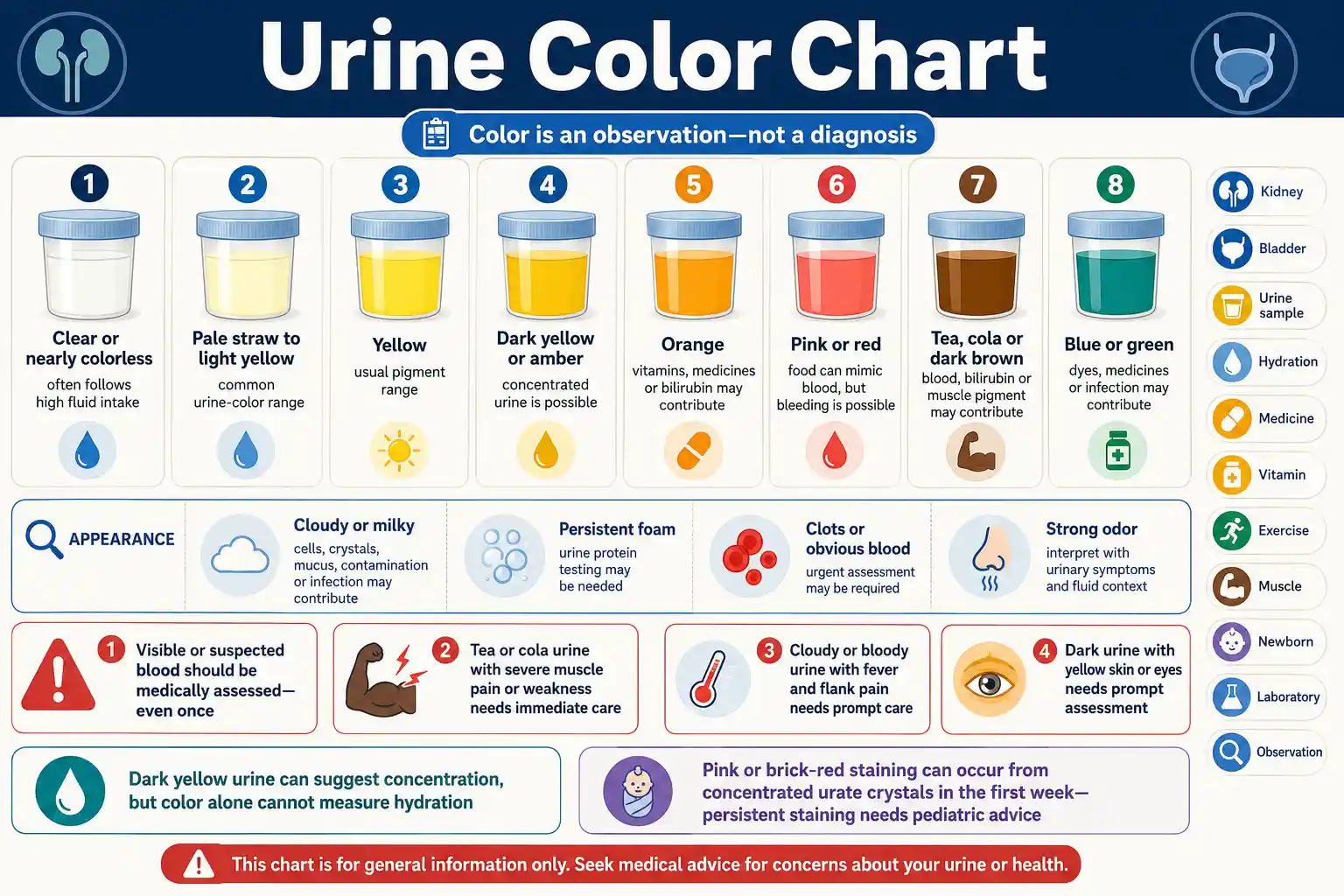
What does urine color mean?
Pale straw to yellow is the usual urine-color range. Concentration, food, vitamins, medicines, blood, bilirubin, muscle pigment, cells, crystals, and contamination can change the appearance.
The MedlinePlus abnormal urine-color guide distinguishes ordinary straw-yellow urine from cloudy, dark, blood-colored, orange, blue, and green changes. Color suggests a direction; urine amount, symptoms, exposures, medical history, and testing determine what it means.
Common range
Pale straw to yellow
Urine pigment and concentration create a normal range that can vary through the day.
Best context
Color + output + symptoms
Clarity, foam, urine amount, duration, exposures, pain, fever, and illness refine meaning.
Blood warning
Pink, red or brown
Visible or suspected blood deserves medical assessment even when painless or seen once.
Exercise warning
Tea or cola + muscle symptoms
Dark urine with severe muscle pain, weakness, or unusual fatigue needs immediate care.
Quick answers to common urine-color questions
These short answers identify the next useful distinction. They do not replace symptom-based care or laboratory testing.
What color is usual urine?
Pale straw to yellow is a common range.
What does clear urine mean?
It often follows high fluid intake; it does not prove ideal hydration.
What does dark yellow urine mean?
It often reflects concentrated urine, but symptoms and output matter.
Why is urine fluorescent yellow?
B-complex vitamins, especially riboflavin, commonly cause this shade.
What can cause orange urine?
Concentration, vitamins, carotene, phenazopyridine, rifampin, or bilirubin may contribute.
Can food make urine red?
Beets, blackberries, and dye can mimic blood, but uncertainty still needs assessment.
Does painless red urine matter?
Yes. Visible hematuria can be painless and should be medically assessed.
What does tea or cola urine after exercise mean?
With muscle pain or weakness, it can signal rhabdomyolysis and needs immediate care.
What can cause blue or green urine?
Food dye, methylene blue, medicines, medical dyes, bilirubin, or infection may contribute.
Does cloudy urine prove a UTI?
No. Symptoms and a properly collected urine test are needed.
Does foamy urine mean protein?
Persistent foam can occur with proteinuria, but visual appearance cannot confirm it.
Why is a newborn diaper brick red?
Early concentrated urate crystals can stain it; persistent staining needs pediatric advice.
Urine Color Meanings at a Glance
Urine is usually pale straw to yellow. A color observation can suggest concentration, pigment, blood, medicine, food, or illness, but color alone cannot identify the cause.
Swipe horizontally inside the table to view every column.
| Observed color or appearance | Common context | What else to check | Care direction |
|---|---|---|---|
| Clear or nearly colorless | High recent fluid intake or a medicine that increases urine output may dilute color | Thirst, very frequent urination, medicines, fluid instructions, and duration | Often temporary; persistent high thirst or urine volume deserves review |
| Pale straw to light yellow — Common expected color | Common urine pigment range with relatively dilute urine | Personal baseline, output, symptoms, and fluid losses | Usually expected when no concerning symptoms are present |
| Yellow | Common urochrome pigment range | Whether it becomes lighter later in the day and whether output is usual | Usually expected |
| Dark yellow or amber | More concentrated urine is common after sleep, sweating, fever, vomiting, diarrhea, or low intake | Thirst, dry mouth, dizziness, reduced output, fluid losses, and medical fluid limits | Address the whole hydration context; seek advice for persistent or symptomatic change |
| Orange | Concentrated urine, vitamins, carotene, phenazopyridine, rifampin, or another medicine may contribute | Exact product, timing, pale stool, yellow skin or eyes, pain, and persistence | Check the label or pharmacist; dark orange with jaundice needs prompt assessment |
| Pink, red, or reddish brown | Blood is possible; beets, blackberries, dye, medicine, menstruation, or another source can mimic it | Clots, burning, frequency, flank pain, trauma, exercise, and bleeding source | Visible or suspected blood should be medically assessed even once — Visible blood assessment |
| Tea, cola, smoky brown, or dark brown | Blood, bilirubin, severe dehydration, or muscle breakdown may cause a similar appearance | Muscle pain, weakness, heavy exertion, jaundice, pale stool, low output, and illness | Prompt or immediate assessment depends on the accompanying symptoms — Symptom-based urgent assessment |
| Blue or green | Food or medicine dye, methylene blue, another medicine, bilirubin, or infection is possible | Recent procedures, medicines, burning, fever, odor, and duration | Contact a clinician when unexplained, persistent, or symptomatic |
| Cloudy, hazy, or milky | Cells, crystals, mucus, vaginal material, bacteria, or contamination may affect clarity | Burning, urgency, frequency, fever, flank pain, odor, and sample method | Symptoms—not cloudiness alone—determine urgency; persistent change may need testing |
| Purple in a catheter drainage bag | Pigments can form in the catheter bag in a special bacteriuria context | Catheter blockage, poor drainage, fever, pain, confusion, and clinical instructions | Contact the catheter-care team; do not interpret it like ordinary voided urine |
Describe the closest color in neutral light. Toilet cleaner, bowl color, lighting, dilution, vaginal bleeding, and phone cameras can alter appearance.
- • Pale yellow is common, but one urine color cannot prove that hydration, kidney function, or liver function is normal.
- • A familiar food or medicine can explain pigment without proving that blood or illness is absent.
- • Severe symptoms and reduced urine output outweigh the apparent shade.
Download or export
How to read a urine color chart safely
Treat color as one observation. Clarity, foam, sediment, odor, urine amount, duration, food, medicines, exercise, age, pregnancy, urinary devices, and symptoms make the description clinically useful.
1
Name the closest color
Use pale straw, yellow, amber, orange, pink, red, tea, cola, blue, or green.
2
Separate other features
Record clear, cloudy, milky, foamy, sediment, odor, clots, and urine amount.
3
Check recent context
Note fluid losses, food, vitamins, medicines, menstruation, exercise, and procedures.
4
Let symptoms set urgency
Blood, retention, fever, flank pain, jaundice, muscle symptoms, or confusion outweigh color.
A color chart is not a urinalysis. Only testing can evaluate blood, protein, glucose, ketones, bilirubin, cells, crystals, casts, bacteria, and other urine components.
Foods, vitamins and medicines can imitate warning colors
Beets and red dye can resemble blood. B-complex vitamins can look fluorescent yellow. Phenazopyridine and rifampin can look orange-red. Nitrofurantoin can look brownish. Methylene blue and other dyes can look blue or green. Record the exact exposure, but do not stop prescribed treatment or dismiss pain, clots, fever, jaundice, muscle symptoms, or reduced urine output.
Foods, Vitamins and Medicines That Can Change Urine Color
Pigments and medicine metabolites can create striking changes. Record the exact exposure and timing, but never stop a prescribed medicine or dismiss warning symptoms based on color alone.
Swipe horizontally inside the table to view every column.
| Exposure | Possible appearance | Useful distinction | Safety note |
|---|---|---|---|
| Large recent fluid intake | Clear or very pale yellow | The change usually follows intake and may vary through the day | Persistent excessive thirst or urination needs medical context |
| B-complex vitamins or riboflavin | Bright or fluorescent yellow | Often begins after a vitamin dose | Check the product label; color does not measure vitamin absorption |
| Carotene-rich food or supplement | Yellow-orange or orange | Timing follows the exposure | Jaundice, pale stool, pain, or persistent dark orange urine needs assessment |
| Beets | Pink or red | Beeturia can mimic visible blood | Do not assume beets explain clots, pain, or unexplained recurrence — Blood mimic caution |
| Blackberries or red food coloring | Pink, red, or reddish brown | Review foods and drinks from the prior day | Uncertain red urine should be treated as possible blood |
| Phenazopyridine | Orange to red-orange | A known labeled effect can stain fabric or contact lenses | It treats discomfort, not the cause of urinary symptoms; follow the product and clinician instructions |
| Rifampin or rifabutin | Orange-red body fluids, including urine | The effect may also involve tears or sweat | Do not stop the antibiotic without prescriber advice |
| Nitrofurantoin | Dark yellow or brownish | A known medicine effect may occur | New jaundice, pale stool, severe illness, or unexplained dark urine still needs advice |
| Methylene blue or blue/green dye | Blue or green | Exposure may occur through a medicine, test, or procedure | Contact the care team if the change was not expected |
| Some laxatives or medicine metabolites | Pink, red, brown, orange, blue, or green depending on product | The exact drug matters more than a generic list | Ask a pharmacist to check the specific product |
| A new supplement or medicine | Any unusual shade | Compare onset with the exact start or dose change | Do not start, stop, or change treatment using this chart — Medicine safety caution |
| Toilet cleaner or colored bowl water | Artificial blue, green, red, or mixed color | Compare a fresh sample in a clean, clear container when medically appropriate | Do not handle urine if infection-control or specimen instructions say otherwise |
Record the product name, dose, start time, last dose, food exposure, and number of affected urinations.
- • Medicine lists are not exhaustive. Official labeling or a pharmacist can confirm whether a specific product changes urine color.
- • Blood can be present even when food or medicine pigment is also possible.
- • Never stop an antibiotic, blood thinner, or other prescribed medicine without clinician advice.
Download or export
Urine Color Context Guide
Build a clearer urine-change summary
Combine color with clarity, foam, visible blood, urine amount, exposures, age or device context, duration, and symptoms. The result is a communication note with safety reminders—not a diagnosis, fluid prescription, or treatment plan.
Safety reminder
No selected warning sign
A brief pale-yellow, clear, dark-yellow, bright-yellow, or exposure-linked change without warning symptoms can often be observed in context. Seek advice if it persists, recurs, becomes painful, reduces urine output, or no longer fits the selected exposure.
Generated summary
Urine color and symptom summary
Age or device context: Adult or older child
Closest color: Pale straw or light yellow
Clarity, foam, blood, or odor: Clear, without unusual foam
Urine amount: Usual amount and frequency
Recent exposure or fluid-loss context: No known explanation
Duration: One urination
Most important other symptom: No warning symptom selected
Additional context: Not specified
Safety reminder: No selected warning sign.
Interpretation note: Appearance cannot diagnose dehydration, infection, bleeding, proteinuria, bilirubin, kidney disease, liver disease, or rhabdomyolysis.
Do not wait for another urination when emergency signs appear. Call local emergency services for inability to urinate with pain or clots, red or brown urine with fainting or severe weakness, or tea/cola urine with severe muscle pain, weakness, or unusual fatigue. Nothing entered here is stored or transmitted.
Urine Color With Symptoms and Pattern Clues
The same shade can have different meanings. Combine color with pain, fever, output, muscle symptoms, jaundice, swelling, urinary symptoms, exposures, and duration.
Swipe horizontally inside the table to view every column.
| Pattern | Possible context | Key questions | Action |
|---|---|---|---|
| Dark yellow plus thirst, dry mouth, or low output | Concentrated urine during dehydration is possible | Are fluids staying down; is there dizziness, confusion, fever, diarrhea, or a fluid restriction? | Use symptom severity and medical context; severe dehydration signs need urgent care |
| Pink or red with clots or inability to urinate | Bleeding with urinary blockage is possible | Is the lower abdomen painful or swollen; is urine still passing? | Seek emergency medical assessment — Emergency urinary blockage |
| Pink, red, or brown without pain | Visible hematuria can be painless | Was there food, medicine, menstruation, exercise, or a procedure? | Arrange medical assessment even when it happened once |
| Red or cloudy plus burning and frequent urges | Bladder or urinary-tract infection is possible | Is there fever, flank pain, pregnancy, immune suppression, or vomiting? | Contact a clinician; fever or flank pain increases urgency |
| Pink or red plus severe side or groin pain | A urinary stone or another acute urinary problem is possible | Can urine pass; is there vomiting, fever, or one kidney? | Obtain prompt or urgent assessment |
| Tea or cola urine after heavy exertion plus muscle pain or weakness | Rhabdomyolysis is possible and can resemble dehydration | Was exertion, heat, crush injury, seizure, or a new medicine involved? | Seek immediate medical attention — Rhabdomyolysis warning |
| Dark brown or orange plus yellow eyes or skin and pale stool | Bilirubin from liver or bile-flow disease is possible | Is there itching, abdominal pain, fever, vomiting, or medicine exposure? | Seek prompt medical assessment |
| Cloudy or foul-smelling plus burning or urgency | Bladder infection is possible | How long, how frequent, and is there blood or lower-abdominal pain? | Arrange clinical advice and testing |
| Cloudy or bloody plus fever, chills, flank pain, nausea, or vomiting | Kidney infection is possible | Is the person pregnant, older, immunocompromised, or becoming confused? | Seek care right away |
| Persistent foam plus swelling around eyes, hands, abdomen, legs, or feet | Protein in urine or another kidney problem is possible | Is blood pressure high; is urine output changing? | Arrange medical assessment and urine testing |
| Usual yellow color plus severe pain, confusion, fainting, or very low output | A serious condition can occur without unusual color | Which severe symptom is present and when did it begin? | Use the symptom—not the normal-looking color—to decide urgency — Symptoms override color |
Pattern = color + clarity or foam + urine amount + timing + exposures + associated symptoms.
- • Clear or yellow urine does not rule out infection, kidney disease, diabetes, or another illness.
- • Pregnancy, infancy, older age, immune suppression, one kidney, urinary obstruction, and recent urologic procedures can justify earlier assessment.
- • Do not force fluids when a clinician has prescribed a fluid limit or when vomiting, severe illness, or inability to urinate is present.
Download or export
Urine Color Versus Clarity, Foam, Sediment and Odor
Color is only one visual property. Clarity, bubbles, persistent foam, sediment, odor, frequency, pain, and laboratory results describe different attributes.
Swipe horizontally inside the table to view every column.
| Observation | What it describes | Possible context | Useful next step |
|---|---|---|---|
| Clear-looking urine | Transparency, not necessarily colorless urine | Many normal samples are clear; infection or disease can still exist | Use symptoms and testing when indicated |
| Brief bubbles after a forceful stream | Air and turbulence | Often disappears quickly | Compare with persistent, dense foam over repeated urinations |
| Persistent or recurrent foam | Stable bubbles or froth | Proteinuria is one possible cause | Discuss persistent foam, especially with swelling or high blood pressure — Persistent foam assessment |
| Cloudy or hazy urine | Reduced clarity | Cells, crystals, mucus, vaginal material, bacteria, or contamination may contribute | Symptoms and a properly collected sample help interpretation |
| Milky urine | Marked cloudiness or suspended material | Bacteria, white or red cells, crystals, fat, or mucus may be present | Seek testing when unexplained or symptomatic |
| Visible sediment or crystals after standing | Particles settling in the sample | Crystals, cells, mucus, contamination, or storage changes are possible | A fresh laboratory sample is more useful than home inspection |
| Strong ammonia-like or concentrated smell | Odor intensity | Concentrated urine, time in the bowl, food, or bacteria may contribute | Check hydration context and urinary symptoms |
| Food-related odor after asparagus or coffee | Volatile food metabolites | Usually follows a recognizable exposure | Persistent foul odor with urinary symptoms needs clinical context |
| Foul odor plus burning, urgency, fever, or flank pain | Odor combined with urinary symptoms | Bladder or kidney infection is possible | Contact a clinician; fever or flank pain warrants prompt care — Infection symptom warning |
Describe color, clarity, foam, sediment, odor, amount, and symptoms as separate observations.
- • A home visual check cannot measure protein, blood, glucose, ketones, bilirubin, white cells, or bacteria.
- • Toilet water, cleaning products, dehydration, diet, and sample age can change appearance or odor.
- • Urinalysis and, when indicated, microscopy or culture can evaluate findings that color cannot identify.
Download or export
Urine color is a hydration clue, not a hydration diagnosis
Dark yellow urine often reflects concentration after sleep, sweating, fever, vomiting, diarrhea, or lower intake. Clear urine often follows a large recent drink. Neither shade sets a universal fluid target. Urine amount, thirst, losses, dizziness, age, medicines, kidney function, and prescribed fluid limits also matter.
Using Urine Color in Hydration Context
Urine usually becomes darker as it concentrates, but color is an imperfect hydration clue. Illness, medicines, food, kidney function, fluid loss, and prescribed fluid limits change interpretation.
Swipe horizontally inside the table to view every column.
| Situation | Expected influence | What color cannot tell you | Safer interpretation |
|---|---|---|---|
| First urine after sleep | Often darker because urine concentrated overnight | It cannot prove dehydration by itself | Compare later output, intake, symptoms, and personal baseline |
| Hot weather or prolonged sweating | Urine may darken and output may fall | It cannot distinguish simple fluid loss from heat illness or muscle breakdown | Use temperature, mental status, muscle symptoms, output, and work conditions |
| Vomiting, diarrhea, or fever | Fluid loss may produce dark yellow urine and less output | Color cannot grade dehydration severity | Watch for inability to keep fluids down, dizziness, confusion, and very low output |
| Clear urine after drinking a large volume | Temporary dilution is common | Clear color does not prove ideal hydration or electrolyte balance | Avoid chasing permanently clear urine |
| Diuretic or medicine that increases urination | Output and color may change | Color does not show whether electrolytes or kidney function are safe | Follow the prescriber’s fluid and monitoring plan |
| Kidney failure, heart failure, liver disease, or prescribed fluid restriction | Usual drink-more advice may be unsafe | Color cannot set a personal fluid target | Use the clinician’s individualized fluid and weight plan — Fluid restriction caution |
| Pregnancy, infancy, childhood, or older age | Fluid needs and dehydration risk differ | An adult color strip cannot diagnose dehydration in another age group | Use age-specific symptoms, intake, output, behavior, and clinical advice |
| Heavy exercise with tea or cola urine | Muscle pigment may darken urine | It can be mistaken for ordinary concentration | Seek immediate assessment when dark urine occurs with muscle pain or weakness — Exercise-related dark urine warning |
| Repeatedly dark urine despite usual intake | Persistent concentration, pigment, blood, bilirubin, or medicine effect is possible | Color cannot identify which mechanism is present | Arrange medical advice rather than repeatedly forcing fluids |
Hydration assessment uses intake, losses, thirst, mouth moisture, dizziness, body weight, urine output, vital signs, age, and medical history—not color alone.
- • Do not use a generic color chart to prescribe liters of water.
- • People with kidney, heart, or liver disease may have individualized fluid or sodium limits.
- • Very low output, confusion, fainting, severe weakness, or inability to keep fluids down deserves urgent assessment.
Download or export
Pink, red, brown, tea and cola urine need different safety checks
NIDDK hematuria guidance explains that visible blood can make urine pink, red, or brown and can be painless. Foods, medicines, menstruation, infection, stones, injury, exercise, prostate conditions, kidney disease, and other causes can overlap. Visible or suspected blood should be assessed even when it appears once.
Tea- or cola-colored urine after exertion becomes an immediate warning when severe or unexpected muscle pain, weakness, or unusual fatigue is present. The CDC rhabdomyolysis symptom guide advises immediate medical attention because a blood test—not urine color—confirms muscle breakdown.
Newborn, Menstrual, Pregnancy and Catheter Context
Age, anatomy, pregnancy, menstruation, recent procedures, exercise, and urinary devices can change what a color means and how a sample should be interpreted.
Swipe horizontally inside the table to view every column.
| Context | Possible observation | Important distinction | Care direction |
|---|---|---|---|
| Newborn in the first week | Pink or brick-red staining in the diaper may be concentrated urate crystals | This is not the same as confirmed blood | Discuss persistent staining, poor feeding, painful urination, or too few wet diapers with the pediatric team |
| Newborn after the early transitional period | Pink, red, or bloody staining | Diaper rash, vaginal withdrawal bleeding, urine, or another source may be responsible | Contact the pediatrician; systemic symptoms need urgent care — Pediatric assessment |
| Menstruation or vaginal bleeding | A urine sample may look pink or test positive for blood | The blood may come from outside the urinary tract | Tell the clinician or laboratory; repeat collection may be requested |
| Pregnancy | Dark, cloudy, strong-smelling, pink, or red urine may occur with several causes | Pregnancy changes the threshold for evaluating urinary symptoms | Contact the prenatal care team for urinary symptoms, fever, blood, or reduced output |
| Indwelling catheter | Cloudy, bloody, concentrated, or purple bag discoloration may appear | Colonization, infection, trauma, blockage, and bag pigments require device-specific assessment | Follow the catheter-care plan and report poor drainage, fever, pain, confusion, or bright blood |
| Recent urinary procedure or catheter insertion | Temporary pink urine may be expected under specific discharge instructions | Expected duration and amount depend on the procedure | Follow the procedure team’s instructions; clots, worsening bleeding, fever, pain, or retention is urgent |
| Vigorous endurance exercise | Pink, red, brown, tea, or cola urine may appear | Exercise-associated hematuria and rhabdomyolysis are different problems | Stop exercise and seek immediate care for muscle pain, weakness, or tea/cola urine — Rhabdomyolysis caution |
| Blood thinner or bleeding-risk medicine | Visible blood may appear or seem more pronounced | The medicine does not explain why bleeding started | Do not stop the medicine independently; seek medical assessment — Blood thinner caution |
| Blue or green after a procedure or test | A dye or medicine may have been administered | The care team can confirm whether the change was expected | Contact the team if unexplained, persistent, painful, or accompanied by fever |
Always state age, pregnancy status, menstruation, catheter or procedure status, exercise, and medicines when reporting a urine-color change.
- • Outside blood can contaminate a sample without proving that blood is absent from the urinary tract.
- • Catheter users should follow their device-specific care plan rather than a general voided-urine chart.
- • Newborn wet-diaper count, feeding, alertness, and weight are more useful than color alone.
Download or export
How to Track and Report a Urine-Color Change
A short, structured record helps a clinician separate a temporary pigment change from blood, infection, concentration, bilirubin, muscle pigment, or another problem.
Swipe horizontally inside the table to view every column.
| Record | What to include | Why it matters | Avoid |
|---|---|---|---|
| Onset and duration | Date, time, first affected urination, and whether every void looks similar | Distinguishes one episode from persistent or recurrent change | Vague labels such as “for a while” |
| Color and lighting | Closest color word in neutral light; note toilet cleaner or colored bowl water | Reduces visual distortion | Relying only on a filtered phone image |
| Clarity, foam, and sediment | Clear, hazy, cloudy, milky, foamy, particles, or clots | Separates different urine attributes | Calling every bubble “protein” |
| Urine amount and frequency | Usual, reduced, increased, drops only, or unable to pass urine | Output and retention can change urgency — Urine output context | Using color as a substitute for output |
| Symptoms | Burning, urgency, fever, chills, flank pain, muscle pain, weakness, jaundice, swelling, dizziness, or vomiting | Symptoms guide the care pathway | Waiting for color to worsen before reporting severe symptoms — Do not delay for severe symptoms |
| Exposures | Foods, dyes, vitamins, medicines, exercise, heat, trauma, procedures, and menstruation | Explains plausible mimics and risks | Stopping a medicine to test a theory |
| Relevant history | Pregnancy, kidney or liver disease, stones, UTI, bleeding disorder, one kidney, catheter, and fluid restriction | Changes interpretation and timing | Assuming one chart fits every medical context |
| Sample collection | Follow clean-catch, sterile cup, timing, storage, and delivery instructions exactly | Reduces contamination and unreliable results | Collecting from a toilet, catheter bag, or old container unless instructed |
A useful report answers: what color, when, how often, how much urine, what symptoms, what exposures, and what medical context?
- • Do not delay urgent care to take a photograph or obtain a home test.
- • Tell the clinician about menstruation, vaginal bleeding, hemorrhoidal bleeding, medicines, and recent procedures.
- • A laboratory may request a new sample when collection, storage, or contamination makes the first result unreliable.
Download or export
Urinalysis can identify what a color chart cannot
Clinicians combine the history, medicines, examination, vital signs, and urine amount with selected dipstick, microscopy, culture, urine albumin, blood, imaging, or cystoscopy tests. Color cannot confirm blood, protein, infection, bilirubin, glucose, ketones, crystals, kidney disease, liver disease, or muscle breakdown.
How Clinicians Assess Abnormal Urine Color
Testing depends on the color, symptoms, examination, medicines, age, pregnancy status, and history. No single test explains every discoloration.
Swipe horizontally inside the table to view every column.
| Assessment or test | What it evaluates | Why it may be used | Limitation |
|---|---|---|---|
| History and examination | Timing, output, symptoms, foods, medicines, exercise, procedures, vital signs, hydration, abdomen, back, skin, and swelling | Builds the differential and identifies instability | Appearance alone cannot confirm the cause |
| Urinalysis dipstick | Blood pigment, protein, glucose, ketones, bilirubin, pH, concentration, nitrite, and leukocyte esterase | Rapid screening for several urine abnormalities | A positive result may need microscopy or confirmation |
| Urine microscopy | Red and white cells, bacteria, crystals, casts, and other formed elements | Clarifies dipstick and cloudy-urine findings | Collection and timing affect reliability |
| Urine culture | Growth and identification of bacteria or other germs when indicated | Helps evaluate suspected urinary infection | Cloudiness or odor alone does not establish infection |
| Urine albumin-to-creatinine ratio | Albumin relative to creatinine in a spot sample | Assesses possible albuminuria when kidney disease is a concern | Visible foam cannot estimate the albumin level |
| Blood tests for kidney function and blood count | Creatinine, filtration context, electrolytes, anemia, or systemic illness | Evaluates kidney impact, bleeding, or dehydration context | Results require age, history, and trend interpretation |
| Liver tests and bilirubin | Liver-cell injury, bile-flow markers, and bilirubin context | May be used for dark urine with jaundice or pale stool | Urine color cannot locate a liver or bile-duct problem |
| Creatine kinase blood test | Marker of muscle injury | Needed when rhabdomyolysis is suspected — Rhabdomyolysis blood test | Urine color cannot diagnose or exclude rhabdomyolysis |
| Imaging or cystoscopy | Kidneys, ureters, bladder, urethra, stones, obstruction, masses, or bleeding source | May follow confirmed or recurrent hematuria and other findings | Selection depends on clinical risk and prior results |
Test selection is individualized; not every urine-color change requires every test.
- • Home urine strips can be affected by timing, storage, technique, medicines, and interfering substances.
- • A dipstick that detects “blood” can react to red-cell pigment or muscle pigment and may need microscopy and clinical correlation.
- • Repeat testing does not replace urgent assessment when severe symptoms, clots, retention, sepsis signs, or rhabdomyolysis symptoms are present.
Download or export
When a Urine-Color Change Needs Medical Care
Use the most serious associated symptom to choose timing. Local emergency and urgent-care pathways differ, so follow local medical advice.
Swipe horizontally inside the table to view every column.
| Finding | Why it matters | Suggested timing | What to report |
|---|---|---|---|
| Unable to urinate, painful swollen lower abdomen, or blood clots blocking flow | Acute urinary retention or obstruction can harm the urinary tract and kidneys | Emergency assessment now — Emergency urinary retention | Last urination, clot amount, medicines, procedure, and pain |
| Red or brown urine with fainting, confusion, severe weakness, breathing difficulty, or signs of shock | Significant bleeding or severe illness is possible | Call local emergency services | Color, amount, clots, onset, injury, medicines, and severe symptoms |
| Tea or cola urine with severe muscle pain, weakness, or unusual fatigue after exertion, heat, injury, or seizure | Rhabdomyolysis can damage the kidneys and cannot be confirmed by color | Immediate medical attention — Immediate rhabdomyolysis assessment | Trigger, timing, muscle symptoms, output, medicines, and supplements |
| Cloudy or bloody urine with fever, chills, flank pain, nausea, vomiting, or confusion | Kidney infection or sepsis is possible | Urgent same-day assessment; emergency care if severely unwell | Temperature, pain location, urinary symptoms, pregnancy, and immune status |
| Very low output with confusion, fainting, persistent vomiting, or severe dehydration symptoms | Severe fluid or kidney problems may be present | Urgent or emergency assessment | Intake, losses, last urination, medicines, fluid restriction, and mental status |
| Visible pink, red, or brown urine, even once | Gross hematuria may be painless and needs a cause assessment | Contact a clinician promptly — Visible blood assessment | Foods, medicines, menstruation, exercise, pain, clots, and recurrence |
| Dark brown or orange urine with yellow skin or eyes, pale stool, itching, fever, or abdominal pain | Bilirubin and liver or bile-flow disease are possible | Prompt same-day medical advice | Color, stool change, skin or eye color, pain, fever, and medicines |
| Burning, urgency, frequency, lower-abdominal pain, cloudy urine, or strong odor | A bladder infection is possible | Contact a clinician for assessment | Duration, fever, flank pain, blood, pregnancy, and prior UTI |
| Persistent unexplained blue, green, orange, brown, cloudy, or milky urine | Medicine, pigment, infection, blood, bilirubin, crystals, or another cause may need testing | Arrange medical advice | Duration, exposures, symptoms, and photographs if safe |
| Persistent or recurrent foam, especially with swelling or high blood pressure | Proteinuria or another kidney problem is possible | Arrange clinical assessment and urine testing | Frequency, swelling, blood pressure, diabetes, pregnancy, and kidney history |
| A brief exposure-linked change without pain, fever, blood, low output, jaundice, muscle symptoms, or illness | A food, vitamin, medicine, or temporary concentration change may explain it | Observe within the known context; seek advice if it persists or recurs | Exact exposure, timing, color, and any new symptom |
When in doubt, use the symptom and urine output—not the color category—to choose urgency.
- • Visible blood should be assessed even when it is painless or appears only once.
- • Do not wait for urine to become darker before seeking help for severe pain, fever, confusion, fainting, retention, or muscle symptoms.
- • Do not change prescribed medicines or fluid restrictions without professional advice.
Download or export
Frequently asked questions
What color should healthy urine be?
Pale straw to yellow is a common urine-color range. Color varies with concentration, time of day, food, vitamins, medicines, fluid loss, and health conditions, so one pale-yellow sample does not prove that hydration or kidney function is ideal.
Does clear urine mean I am overhydrated?
Clear urine often follows a large recent fluid intake, but one clear sample does not diagnose overhydration. Persistent clear urine with intense thirst, very frequent urination, illness, or a medicine that affects urine output deserves clinical context.
Does dark yellow urine always mean dehydration?
No. Dark yellow urine often means the sample is concentrated, especially after sleep or sweating, but vitamins, medicines, illness, and reduced kidney output can also affect it. Thirst, urine amount, fluid losses, dizziness, and medical fluid limits matter.
Why is my urine bright yellow?
Bright or fluorescent yellow urine commonly follows B-complex vitamins, especially riboflavin. Concentration and other pigments can contribute. Check the product timing, and seek advice if the color is unexplained, persistent, or accompanied by other symptoms.
Can beets turn urine red?
Yes. Beets can cause pink or red urine in some people, and blackberries or food dyes can also mimic blood. A food exposure should not be used to dismiss clots, pain, repeated red urine, or uncertainty about visible blood.
Is blood in urine always painful?
No. Visible hematuria can be painless, and only a small amount of blood may turn urine pink, red, or brown. Visible or suspected blood should be medically assessed even when it happens once and causes no discomfort.
What does orange urine mean?
Orange urine may reflect concentration, vitamins, carotene, phenazopyridine, rifampin, or another medicine. Dark orange urine with yellow skin or eyes, pale stool, itching, fever, or abdominal pain needs prompt assessment for bilirubin-related causes.
What causes green or blue urine?
Green or blue urine may follow food coloring, methylene blue, another medicine, or a medical dye. Bilirubin and some infections are also possible. Contact a clinician when the change was not expected, persists, or comes with pain, fever, odor, or urinary symptoms.
What does tea- or cola-colored urine mean after exercise?
Tea- or cola-colored urine with severe or unexpected muscle pain, weakness, or unusual fatigue after exertion can signal rhabdomyolysis. Seek immediate medical attention because color cannot distinguish muscle pigment from dehydration or blood.
Does cloudy urine mean a urinary tract infection?
Not by itself. Cells, crystals, mucus, vaginal material, bacteria, or contamination can make urine cloudy. Burning, frequent urges, lower-abdominal pain, fever, flank pain, nausea, or vomiting makes infection more concerning and may require prompt testing.
Does foamy urine mean kidney disease?
Brief bubbles can result from a forceful stream, but persistent or recurrent foam can occur with protein in urine. Arrange testing when foam continues, especially with swelling, high blood pressure, diabetes, pregnancy, or known kidney risk.
Why is my urine dark brown with yellow eyes?
Dark brown or orange urine with yellow skin or eyes may reflect bilirubin from liver or bile-flow disease. Pale stool, itching, abdominal pain, fever, vomiting, or worsening illness increases the need for prompt medical assessment.
What does pink or brick-red staining mean in a newborn diaper?
In the first week, concentrated urate crystals can leave pink or brick-red diaper staining that parents may mistake for blood. Persistent staining, poor feeding, painful urination, too few wet diapers, illness, or actual blood needs pediatric guidance.
Can menstruation affect a urine test for blood?
Yes. Menstrual or other vaginal blood can enter a urine sample and affect its appearance or test result. Tell the clinician or laboratory when collecting the sample; they may request a carefully collected repeat sample after bleeding stops.
When should an unusual urine color receive urgent care?
Seek urgent or emergency care for clots or inability to urinate; red or brown urine with fainting or severe weakness; tea or cola urine with muscle symptoms; fever with flank pain; severe dehydration signs; or dark urine with jaundice and illness.
Sources
These urine-color, hematuria, urinary-infection, kidney, hydration, newborn, rhabdomyolysis, and urinalysis resources support the chart interpretations and care guidance.
MedlinePlus — Urine — Abnormal Color
https://medlineplus.gov/ency/article/003139.htm
Describes usual straw-yellow urine, food and medicine effects, cloudy urine, red or pink urine, dark brown urine, orange urine, and blue or green urine.
MedlinePlus — Urinalysis
https://medlineplus.gov/urinalysis.html
Explains that urinalysis evaluates color, clarity, odor, pH, blood, protein, glucose, ketones, bilirubin, cells, crystals, casts, bacteria, and other findings.
MedlinePlus — Blood in Urine
https://medlineplus.gov/lab-tests/blood-in-urine/
Distinguishes visible and microscopic hematuria, explains clean-catch collection, and notes that foods, medicines, menstruation, infection, stones, injury, and other conditions can affect results.
National Institute of Diabetes and Digestive and Kidney Diseases — Hematuria (Blood in the Urine)
https://www.niddk.nih.gov/health-information/urologic-diseases/hematuria-blood-urine
Explains that visible hematuria can look pink, red, or brown and describes possible urinary-tract, kidney, prostate, exercise, trauma, medicine, and systemic causes.
National Institute of Diabetes and Digestive and Kidney Diseases — Bladder Infection in Adults
https://www.niddk.nih.gov/health-information/urologic-diseases/bladder-infection-uti-in-adults
Lists burning, frequent urges, lower-abdominal discomfort, and cloudy, bloody, or strong-smelling urine among possible bladder-infection symptoms.
National Institute of Diabetes and Digestive and Kidney Diseases — Symptoms and Causes of Kidney Infection
https://www.niddk.nih.gov/health-information/urologic-diseases/kidney-infection-pyelonephritis/symptoms-causes
Lists fever, chills, painful or frequent urination, cloudy or bloody urine, back or side pain, nausea, and vomiting, and advises prompt care for kidney-infection symptoms.
Centers for Disease Control and Prevention — Signs and Symptoms of Rhabdomyolysis
https://www.cdc.gov/niosh/rhabdo/signs-symptoms/index.html
Identifies severe or unexpected muscle pain, tea- or cola-colored urine, and weakness or unusual fatigue as rhabdomyolysis warning symptoms requiring immediate medical attention.
National Health Service — Dehydration
https://www.nhs.uk/conditions/dehydration/
Lists dark yellow, strong-smelling urine, reduced urination, thirst, dry mouth, dizziness, headache, and fatigue among dehydration symptoms in adults and children.
National Institute of Diabetes and Digestive and Kidney Diseases — The Urinary Tract and How It Works
https://www.niddk.nih.gov/health-information/urologic-diseases/urinary-tract-how-it-works
Explains urine production, storage, and emptying and how fluid intake, fluid loss, food, medicines, health conditions, age, and medical fluid limits affect urine output.
National Institute of Diabetes and Digestive and Kidney Diseases — Glomerular Disease
https://www.niddk.nih.gov/health-information/kidney-disease/glomerular-disease
Explains that persistent bubbles or foam can occur with proteinuria and that blood can make urine appear pink or cola-colored.
American Academy of Pediatrics — HealthyChildren.org — Baby’s First Days: Bowel Movements and Urination
https://www.healthychildren.org/English/ages-stages/baby/Pages/babys-first-days-bowel-movements-and-urination.aspx
Describes concentrated newborn urine and temporary pink or brick-red urate staining in the first week while advising pediatric review for persistent staining, painful urination, or actual blood.
National Kidney Foundation — Urinalysis (Urine Test)
https://www.kidney.org/kidney-topics/urinalysis-urine-test
Describes visual, dipstick, and microscopic urine testing and explains why color, cloudiness, foam, blood, protein, glucose, bilirubin, cells, and bacteria require laboratory context.
Berkshire Healthcare NHS Foundation Trust — Urinary Catheter Passport
https://www.berkshirehealthcare.nhs.uk/media/rzvnkeql/nhs-catheter-passport-2026-bh827.pdf
Provides catheter-specific warning signs and explains that rare purple urine bag discoloration can occur in catheter users and should be reported to the responsible health professional.
National Health Service — Side Effects of Nitrofurantoin
https://www.nhs.uk/medicines/nitrofurantoin/side-effects-of-nitrofurantoin/
Explains that nitrofurantoin can turn urine dark yellow or brownish while distinguishing this expected effect from dehydration and other symptoms that need medical advice.
National Institute of Diabetes and Digestive and Kidney Diseases — Albuminuria: Albumin in the Urine
https://www.niddk.nih.gov/health-information/kidney-disease/chronic-kidney-disease-ckd/tests-diagnosis/albuminuria-albumin-urine
Explains albuminuria and the urine albumin-to-creatinine ratio used to detect and monitor albumin leakage that cannot be measured from urine foam or color.