Health & Medical · Vision and Eye Care
Vision Prescription Chart for SPH, CYL, Axis, ADD and PD
Decode OD, OS, sphere, cylinder, axis, near addition, prism, base direction, and pupillary distance. Compare cylinder formats, eyeglass and contact-lens fields, visual acuity, fitting measurements, and safety checks.
Seek emergency eye care for sudden vision loss, severe eye pain, many new floaters, flashes, a curtain or shadow, chemical exposure, penetration, or major eye trauma. A prescription chart cannot assess eye health, explain an acute symptom, or replace a contact-lens fitting. Read the ChartsLoom Disclaimer.
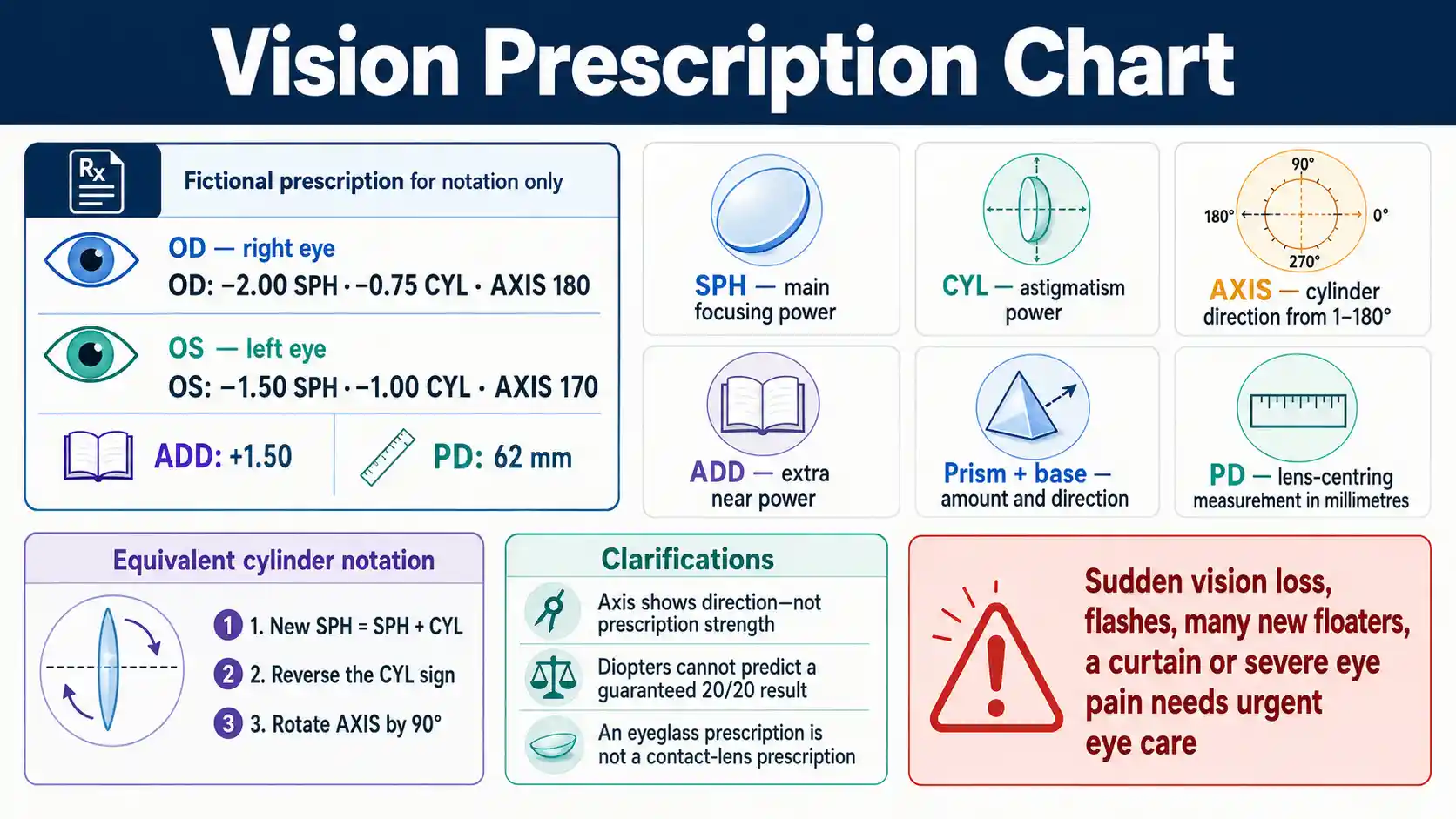
How do you read a vision prescription?
Start with the eye: OD is right and OS is left. SPH gives the main focusing power. CYL gives astigmatism power, and AXIS gives its direction. ADD supplies near power. Prism needs a base direction, while PD centres the lenses.
The Cambridge University Hospitals prescription-field guide explains the core fields. Read the sign and unit with each value. Diopters describe lens power; they do not directly convert into a Snellen fraction or prove that the eye is healthy.
Eye labels
OD right · OS left
OU means both eyes. Keep every sphere, cylinder, axis, add, and prism value in its eye row.
Lens power
SPH and CYL use diopters
Sphere gives the main focus power. Cylinder gives astigmatism power.
Cylinder direction
AXIS uses 1–180°
Axis tells orientation. A larger axis number does not mean stronger astigmatism.
Critical limit
Prescription ≠ acuity
Diopters cannot be converted into a guaranteed 20/20 result or an eye-health diagnosis.
Quick answers to common prescription questions
These direct answers explain notation. Use the original signed prescription and ask the prescriber or dispenser about any blank, unclear, or conflicting field.
Which eye is OD?
OD is the right eye; OS is the left eye.
What does SPH mean?
Sphere is the main focusing power measured in diopters.
What does a minus sphere mean?
Minus sphere commonly corrects myopia, or nearsightedness.
What does a plus sphere mean?
Plus sphere commonly corrects hyperopia or supplies near addition.
What does CYL mean?
Cylinder is the lens power used to correct astigmatism.
What does axis 180 mean?
It is cylinder orientation, not a measure of severity.
What does plano mean?
Plano or PL means zero spherical power in that field.
What does ADD mean?
ADD is extra plus power for near or intermediate viewing.
What is PD?
Pupillary distance centres spectacle lenses and is measured in millimetres.
Can two cylinder formats be equivalent?
Yes. Full transposition changes sphere, cylinder sign, and axis together.
Can a prescription predict 20/20 vision?
No. Visual acuity must be measured under defined test conditions.
Can glasses numbers order contact lenses?
No. Contact lenses require a separate fitted prescription.
Vision Prescription Fields and Abbreviations
A spectacle prescription records each eye separately. Read the field name, sign, number, unit, and eye together; an isolated number is not a complete prescription.
Swipe horizontally inside the table to view every column.
| Field | Full meaning | What the value describes | Important distinction |
|---|---|---|---|
| OD | Oculus dexter; right eye | The row or values for the right eye | OD does not mean the stronger or dominant eye |
| OS | Oculus sinister; left eye | The row or values for the left eye | Keep OD and OS values in their written rows |
| OU | Oculus uterque; both eyes | An instruction or finding that applies to both eyes | OU does not prove both eyes have identical prescriptions |
| SPH or Sphere — Primary lens-power field | Spherical lens power | The main plus or minus focusing power in diopters | Minus commonly corrects myopia; plus commonly corrects hyperopia |
| CYL or Cylinder | Astigmatism lens power | The difference in power between the two principal meridians | The sign may be plus or minus depending on notation |
| AXIS | Cylinder orientation | A direction from 1 to 180 degrees | Axis gives orientation, not astigmatism strength — Axis is orientation |
| ADD | Near addition | Extra plus power added to the distance prescription for near or intermediate tasks | ADD is not a replacement for the sphere value |
| Prism | Prismatic lens power | Image displacement measured in prism diopters | Prism addresses selected alignment or binocular-vision needs |
| Base | Direction of prism base | Base up, down, in, or out | A prism number without its base direction is incomplete — Base direction required |
| PD | Pupillary distance | Horizontal lens-centering measurement in millimetres | PD fits lenses to the wearer; it is not refractive power |
| PL or Plano | Zero spherical power | A sphere value of 0.00 D | Plano can still appear with cylinder, add, or prism |
| DS or SPH | Dioptres sphere | Spherical correction without a separate cylinder entry | Confirm local notation rather than assuming a blank field |
| DV or Distance | Distance-vision portion | Power prescribed for far viewing | Distance power forms the starting point for an add |
| NV or Near | Near-vision portion | Power or addition intended for reading distance | Working distance and lens design still matter |
| INT or Intermediate | Intermediate-vision portion | Power or addition for arm’s-length tasks | It may differ from the full near addition |
Sphere, cylinder, and add use diopters (D); axis uses degrees; prism uses prism diopters (Δ); PD uses millimetres (mm).
- • Prescription layouts vary. Use the headings printed on the original document.
- • A blank field can mean “not prescribed,” “not measured,” or “recorded elsewhere”; ask the prescriber or dispenser when unclear.
- • Never move a value from OD to OS or infer a missing sign.
Download or export
How to read a vision prescription safely
Treat the prescription as a structured record. The eye label, field heading, sign, number, and unit create the meaning together. Visual acuity, eye health, lens design, and contact-lens fit require separate measurements.
1
Identify the eye
OD is right, OS is left, and OU means both eyes. Never swap the rows.
2
Keep fields together
Read sphere, cylinder, axis, add, prism, base, and PD under their headings.
3
Preserve signs and units
Plus, minus, diopters, degrees, prism diopters, and millimetres are distinct.
4
Separate power from health
A prescription cannot predict acuity or rule out retinal, corneal, or nerve disease.
A prescription tells a lens maker what optical power to produce. It does not show visual acuity, eye pressure, retinal health, visual field, or whether contact lenses fit safely.
Plus, minus, diopters and degrees answer different questions
The sign tells the direction of optical power. The absolute value tells magnitude within that field. Sphere, cylinder, and add use diopters. Axis uses degrees. Prism uses prism diopters and a base direction. Pupillary distance uses millimetres.
Prescription Signs, Numbers and Units
The sign describes the direction of lens power. The absolute number describes magnitude within that field; plus and minus are not rankings of good or bad vision.
Swipe horizontally inside the table to view every column.
| Notation | Plain-language meaning | Example | Do not assume |
|---|---|---|---|
| Minus sphere | A concave distance correction commonly used for myopia | −2.00 D SPH | The number alone cannot predict uncorrected acuity |
| Plus sphere | A convex correction commonly used for hyperopia or near addition | +1.50 D SPH | Plus is not automatically weaker than minus |
| 0.00, PL, or Plano | No spherical power in that field | PL / −0.75 × 180 | Plano does not mean the entire prescription is zero |
| Minus cylinder | Astigmatism written in minus-cylinder form | −1.00 D CYL | A minus cylinder does not mean myopia by itself |
| Plus cylinder | The same astigmatic correction can be written in plus-cylinder form after transposition | +1.00 D CYL | Do not flip the sign without changing sphere and axis — Full transposition required |
| Axis 1–180° | Orientation of the cylinder meridian | × 180 | A larger axis number is not stronger astigmatism — Axis is not strength |
| D | Diopter; reciprocal-metre unit of optical power | −3.25 D | Diopters are not a percentage or Snellen fraction |
| Δ or PD after prism number | Prism diopter | 1.0 Δ base out | Prism diopters are different from spherical diopters |
| mm | Millimetres used for PD, base curve, or diameter depending on the document | PD 62 mm | A millimetre value is not lens power |
| Quarter-diopter steps | Many spectacle powers appear in 0.25 D increments | −1.25, −1.50, −1.75 | A missing plus sign should not be guessed from the increment |
Preserve leading plus or minus signs. Write two decimal places when copying a prescription so 1.00 is not mistaken for 100.
- • Strength comparisons should use the absolute value within the same field: −4.00 D has more minus sphere power than −2.00 D.
- • Cylinder and sphere describe different optical components, so their magnitudes should not be compared as a single severity score.
- • Axis wraps at 180 degrees; standard prescriptions normally write 180 rather than 0.
Download or export
Vision Prescription Reader
Translate a written eyeglass prescription
Enter the fields exactly as written. The reader keeps both eyes separate, checks cylinder and prism completeness, and displays equivalent cylinder notation. It does not select a prescription, measure PD, or create a contact-lens order.
Notation check
No incomplete field combination detected
OD: No warning from the entered fields.
OS: No warning from the entered fields.
Equivalent notation
OD transposed: Enter sphere, nonzero cylinder, and axis.
OS transposed: Enter sphere, nonzero cylinder, and axis.
Transposition rewrites the same power. It does not authorize a lens change.
Generated interpretation
Vision prescription interpretation note
OD (right eye): no values entered
OS (left eye): no values entered
PD: Not entered
Lens purpose: Not specified
OD transposition: not available
OS transposition: not available
OD spherical equivalent: not available
OS spherical equivalent: not available
OD checks: no incomplete notation detected
OS checks: no incomplete notation detected
Safety note: This reader does not prescribe lenses, verify identity or validity, measure acuity or PD, assess eye health, or convert an eyeglass prescription into a contact-lens prescription.
Do not use this reader to choose or order an unverified lens. Compare every field with the signed original and ask the prescriber or dispenser about missing signs, axes, prism bases, PD type, validity, or lens purpose. Nothing entered here is stored or transmitted.
Worked Eyeglass Prescription Example
This fictional example demonstrates how fields combine. It is not a recommendation, normal range, or prescription for any reader.
Swipe horizontally inside the table to view every column.
| Example entry | How to read it | What it suggests | What it cannot tell you |
|---|---|---|---|
| OD −2.00 SPH — Right-eye sphere example | Right-eye sphere is minus 2.00 D | A myopic distance correction is present | Uncorrected or corrected visual acuity |
| OD −0.75 CYL | Right-eye cylinder is minus 0.75 D | Astigmatism correction is present | Corneal health or astigmatism cause |
| OD AXIS 180 | Right-eye cylinder is oriented at 180° | The cylinder meridian is horizontal in notation | Astigmatism severity |
| OS −1.50 SPH — Left-eye sphere example | Left-eye sphere is minus 1.50 D | A myopic distance correction is present | Whether the eye is healthy |
| OS −1.00 CYL | Left-eye cylinder is minus 1.00 D | Astigmatism correction is present | Whether this is a contact-lens power |
| OS AXIS 170 | Left-eye cylinder is oriented at 170° | The axis differs from the right eye | Whether a ten-degree difference is clinically important |
| ADD +1.50 OU | Add 1.50 D of plus power for both eyes | Near support is prescribed over the distance correction | The final lens design or reading distance |
| PD 62 mm | Binocular distance PD totals 62 mm | The dispenser can centre distance lenses horizontally | Monocular PD or fitting height |
| No prism entry | No prism is shown in this example | Prism was not recorded in the displayed fields | Whether binocular vision was fully tested |
| Full document | Eye rows, signs, values, headings, prescriber, and validity information stay together | The prescription can be checked as a complete record | Diagnosis, eye pressure, retina, or visual fields — Prescription is not an eye-health report |
Fictional example: OD −2.00 −0.75 × 180; OS −1.50 −1.00 × 170; ADD +1.50 OU; PD 62 mm.
- • The first number after each eye is not always sphere unless the column heading confirms it.
- • An ADD applies on top of the distance prescription; it is not simply substituted for sphere.
- • A spectacle prescription summarizes lens power, not the complete eye examination.
Download or export
Refractive Error Patterns Behind Common Prescriptions
Prescription patterns describe optical correction. Diagnosis and prescribing decisions require refraction, acuity, symptoms, age, binocular vision, and eye-health findings.
Swipe horizontally inside the table to view every column.
| Pattern | Typical prescription clue | Common visual effect | Clinical context |
|---|---|---|---|
| Myopia | Minus sphere is commonly present | Far objects may blur more than near objects without correction | Amount and progression require an eye examination |
| Hyperopia | Plus sphere may be present | Near work may blur or strain; distance can also blur | Younger eyes may compensate through focusing |
| Astigmatism | Cylinder plus axis are present — Cylinder and axis pair | Blur or distortion can occur at distance and near | Cylinder magnitude and axis describe the optical correction |
| Presbyopia | ADD or a separate near prescription is present | Near focusing becomes harder with age | It can coexist with myopia, hyperopia, or astigmatism |
| Anisometropia | Right and left prescriptions differ meaningfully | Image clarity or size can differ between eyes | Tolerance and lens choice require individualized assessment |
| Antimetropia | One eye has plus sphere and the other minus sphere | Each eye has an opposite-sign refractive pattern | Do not swap eye rows when ordering or checking lenses — Eye-row verification |
| Simple spherical correction | Sphere is present; cylinder is plano or blank | Correction is the same in all meridians | Acuity and eye health still need separate assessment |
| Compound sphero-cylindrical correction | Sphere, cylinder, and axis all appear | Two principal meridians need different powers | Plus- and minus-cylinder forms can be equivalent |
These are qualitative patterns, not diopter severity bands. Prescription need depends on function, age, symptoms, and examination findings.
- • A small number can matter greatly in one person and little in another.
- • Children may receive full, partial, or monitored correction based on development and examination findings.
- • Prescription magnitude cannot determine eye disease, disability, or best-corrected acuity.
Download or export
Cylinder transposition changes notation, not lens power
Add the original cylinder to the sphere, reverse the cylinder sign, and rotate the axis by 90 degrees. All three steps are required. A plus-cylinder and minus-cylinder form can describe the same lens, but a sign-only or axis-only change creates an error.
Plus- and Minus-Cylinder Transposition Chart
Transposition rewrites the same sphero-cylindrical lens in the opposite cylinder convention. It changes all three values together but does not change optical power.
Swipe horizontally inside the table to view every column.
| Original form | Sphere step | Cylinder step | Equivalent transposed form |
|---|---|---|---|
| −2.00 −1.00 × 180 | −2.00 + (−1.00) = −3.00 | Reverse −1.00 to +1.00; rotate 180 by 90 | −3.00 +1.00 × 090 — Equivalent notation |
| −1.50 −0.50 × 170 | −1.50 + (−0.50) = −2.00 | Reverse −0.50 to +0.50; rotate 170 by 90 | −2.00 +0.50 × 080 |
| +2.00 −0.75 × 045 | +2.00 + (−0.75) = +1.25 | Reverse −0.75 to +0.75; rotate 45 by 90 | +1.25 +0.75 × 135 |
| PL −1.25 × 090 | 0.00 + (−1.25) = −1.25 | Reverse −1.25 to +1.25; rotate 90 by 90 | −1.25 +1.25 × 180 |
| −3.00 +1.50 × 020 | −3.00 + (+1.50) = −1.50 | Reverse +1.50 to −1.50; rotate 20 by 90 | −1.50 −1.50 × 110 |
| +1.25 +0.50 × 120 | +1.25 + (+0.50) = +1.75 | Reverse +0.50 to −0.50; rotate 120 by 90 | +1.75 −0.50 × 030 |
| Sphere only | No cylinder to add | No cylinder sign or axis to rotate | Sphere remains unchanged |
| Cylinder written as 0.00 | Sphere is unchanged | Axis has no optical effect when cylinder is zero — Zero cylinder has no active axis | Record as sphere-only unless the original must be copied verbatim |
Formula: new sphere = sphere + cylinder; new cylinder = opposite sign; new axis = axis ± 90°, normalized to 1–180°.
- • Transposition is a notation conversion, not a new prescription.
- • Rounding, transcription, or sign errors can change the lens. Compare the result with the original document.
- • Spherical equivalent equals sphere + one-half cylinder, but it discards axis and is not a substitute for the full prescription.
Download or export
PD positions lenses; prism changes image direction
Pupillary distance is a horizontal centring measurement, not lens power. Monocular and binocular PD formats are different. Prism is a separate optical value that must include base up, down, in, or out. Fitting heights depend on the selected frame and lens design.
Pupillary Distance, Prism and Lens-Fitting Fields
Refraction determines lens power; dispensing measurements place that power correctly in the chosen frame. Prism adds a separate magnitude and direction.
Swipe horizontally inside the table to view every column.
| Measurement or field | What it controls | Common notation | Verification point |
|---|---|---|---|
| Binocular distance PD | Total horizontal distance between pupil centres for distance viewing | 62 mm | Confirm that the number is total PD, not one monocular value |
| Monocular distance PD | Each pupil centre measured from the facial midline | 31 / 32 mm — Monocular PD example | Keep right and left order clear |
| Near PD | Horizontal centration for a near viewing position | Near PD in mm | Do not substitute distance PD when near PD is specified |
| Fitting height | Vertical placement of a lens design in the selected frame | Right and left heights in mm | Measure with the actual frame fitted |
| Segment height | Vertical location of a bifocal or other segmented lens | Height in mm | Frame size and wearing position affect the result |
| Prism amount | Magnitude of image displacement | 0.5 Δ, 1.0 Δ, 2.0 Δ | Do not read it as sphere or cylinder power — Prism is separate power |
| Base out | Prism base points away from the nose | BO | Eye and base direction must stay together |
| Base in | Prism base points toward the nose | BI | Do not reverse right and left rows |
| Base up or down | Vertical prism direction | BU or BD | Small transcription errors can affect binocular comfort |
| No PD printed | The measurement may be recorded separately or taken during dispensing | Blank prescription field | Do not invent, average, or copy another person’s PD — Do not invent PD |
PD and fitting heights use mm. Prism uses prism diopters (Δ) plus base direction. These measurements are not interchangeable.
- • A valid lens power can still be uncomfortable when optical centres or multifocal heights are misplaced.
- • Frame fit, vertex distance, tilt, wrap, and lens design can influence dispensing decisions.
- • Persistent double vision, eyestrain, distortion, or imbalance needs professional checking rather than repeated self-adjustment.
Download or export
An eyeglass prescription is not a contact-lens prescription
The FDA contact-lens prescription guide lists power, material or manufacturer, base curve, diameter when applicable, and prescription details. The lens must be fitted on the eye. Spectacle power, PD, and a generic conversion cannot supply those device-specific decisions.
Eyeglass Prescription Versus Contact Lens Prescription
Contact lenses sit on the eye and are regulated medical devices. A glasses prescription is not a complete contact-lens prescription and should not be converted by a generic chart.
Swipe horizontally inside the table to view every column.
| Field or issue | Eyeglass prescription | Contact-lens prescription | Why it matters |
|---|---|---|---|
| Power | Sphere, cylinder, axis, add, and prism as prescribed | Lens power selected after contact-lens fitting | Contact-lens power can differ from spectacle power |
| Base curve | Not usually a spectacle field | Lens curvature or approved designation | Fit, movement, centration, and corneal response matter |
| Diameter | Not usually a spectacle field | Overall contact-lens diameter when applicable | It contributes to physical fit |
| Brand or manufacturer | Lens material and design are chosen during dispensing | Exact prescribed material, manufacturer, or brand may be required | Brands are not automatically interchangeable — Brand substitution caution |
| Lens material | Spectacle material affects thickness, weight, optics, and safety | Contact material affects oxygen, wetting, and wear characteristics | Material is part of safe device selection |
| Toric stabilization | Cylinder axis is manufactured into the spectacle lens | Toric lens design must stabilize on the eye | Rotation changes effective axis |
| Multifocal design | Bifocal, progressive, occupational, or reading design | Brand-specific multifocal design and add system | The same ADD label may not translate directly |
| PD and fitting height | Used to centre spectacle lenses in a frame | Not substitutes for corneal fitting measurements | Different devices require different geometry |
| Wear schedule | Not a spectacle-prescription parameter | Daily wear, replacement schedule, and other instructions | Overwear can increase complication risk |
| Expiration and verification | Governed by applicable prescription rules | Fitting completion, validity, and seller verification apply | Use the current exact prescription |
| Ordering from a glasses Rx | Can be filled as spectacles after dispensing checks | Not appropriate without a contact-lens prescription | A chart cannot perform a fitting or evaluate corneal health — Fitting required |
Contact-lens BC and DIA are commonly recorded in mm; power uses D. Available parameters and labels depend on the prescribed product.
- • Do not calculate contact-lens power, base curve, diameter, or brand from an eyeglass prescription.
- • Decorative contact lenses also require a valid prescription and professional fitting where regulated.
- • Pain, redness, light sensitivity, discharge, or reduced vision during contact-lens wear needs prompt lens removal and clinical advice.
Download or export
Lens power cannot be converted into a guaranteed acuity
Sphere and cylinder describe optical correction in diopters. Snellen, metric, decimal, and logMAR values describe measured detail under stated conditions. Two people with the same prescription can have different uncorrected and best-corrected acuity because the eyes and test conditions differ.
Prescription Power Versus Visual Acuity and Eye Findings
Diopters describe optical power. Visual acuity describes resolved detail under specific test conditions. Eye health, field, contrast, focusing, and binocular function are separate findings.
Swipe horizontally inside the table to view every column.
| Record | What it measures | Typical format | Cannot be derived from it |
|---|---|---|---|
| Spectacle prescription | Lens power intended to improve focus | SPH / CYL × AXIS / ADD | Exact Snellen, metric, decimal, or logMAR acuity — No direct acuity conversion |
| Uncorrected distance acuity | Distance detail without glasses or contacts | 20/40, 6/12, decimal, or logMAR | The full lens prescription |
| Best-corrected acuity | Best measured detail with refraction | 20/20, 6/6, or another value | Retinal health by itself |
| Near acuity | Detail at a stated near distance | Near notation plus test distance | Distance prescription or ADD alone |
| Spherical equivalent | Sphere plus one-half cylinder as a summary value | SE = SPH + CYL ÷ 2 | Axis or the full astigmatic correction — Summary value only |
| Keratometry or corneal topography | Corneal curvature or shape | Instrument-specific values and maps | Complete spectacle or contact-lens prescription |
| Eye pressure | Intraocular pressure at the test time | mmHg | Refractive error or glaucoma status alone |
| Visual field | Central and peripheral sensitivity | Screening or threshold-test result | Sphere, cylinder, or acuity |
| Binocular and focusing tests | How the eyes align, team, converge, and focus | Test-specific findings | A single prism or ADD decision without assessment |
| Dilated eye examination | Internal eye structures and health | Clinical findings | Guaranteed normality from a clear prescription — Prescription does not prove eye health |
Never convert diopters into a guaranteed 20/20, 6/6, decimal, or logMAR result. Acuity must be measured.
- • Two people with the same prescription can have different uncorrected and corrected acuity.
- • A strong prescription can correct to excellent acuity, while a small prescription can coexist with eye disease.
- • A prescription update does not replace examination when symptoms, risk factors, or vision changes need assessment.
Download or export
Sudden eye symptoms are not routine prescription problems
The National Eye Institute retinal-detachment guidance treats sudden new floaters, flashes, and a curtain or shadow as emergency warning signs. Sudden vision loss, severe pain, chemical exposure, penetration, and major trauma also require immediate care rather than a routine glasses check.
Prescription Error Checks and Vision Care Timing
Most notation questions are not emergencies. Sudden vision or eye symptoms override any prescription explanation and require symptom-based care.
Swipe horizontally inside the table to view every column.
| Situation | Useful check | Next step | Timing |
|---|---|---|---|
| Missing plus or minus sign | Compare with the signed original; do not infer from prior glasses | Ask the prescriber or dispenser to verify | Before lenses are made |
| Cylinder present but axis blank | A nonzero cylinder normally needs an axis | Request clarification from the issuing practice | Before ordering |
| Prism amount without base | Prism direction is incomplete | Request the full prism notation | Before ordering |
| OD and OS may be reversed | Compare row labels, original document, and order entry | Stop the order until verified — Verify eye rows before ordering | Before manufacturing |
| New glasses feel mildly different | Check wear instructions, frame alignment, and whether the prescription or design changed | Contact the dispenser if adaptation is difficult or persistent | Routine to prompt review |
| Persistent blur, headache, distortion, or imbalance | Check each eye, task distance, frame fit, and onset | Arrange prescription and dispensing review | Prompt appointment |
| New double vision | Covering either eye may distinguish binocular from monocular doubling, but does not diagnose the cause | Obtain urgent professional advice, especially when sudden | Urgent |
| Painful red eye with contact-lens wear or reduced vision | Remove the lens; do not reinsert it | Seek urgent eye care | Urgent or emergency |
| Sudden vision loss or severe eye pain | Do not drive yourself | Use local emergency eye or medical services | Emergency — Emergency vision symptom |
| Sudden flashes, many new floaters, curtain, or shadow | Note the affected eye and onset without delaying care | Seek immediate dilated eye assessment | Emergency — Retinal warning symptoms |
| Chemical splash | Begin immediate continuous rinsing with clean water | Continue first aid and obtain emergency medical assessment — Irrigate immediately | Immediate |
| Eye penetration, high-speed injury, or major trauma | Do not press, rub, or remove an embedded object | Protect the eye without pressure and seek emergency care | Emergency |
Care timing is symptom-based. Use local emergency services and eye-care pathways; do not wait for a routine prescription appointment when sight-threatening signs appear.
- • A wrong or poorly fitted prescription can cause blur or discomfort, but it does not explain away sudden vision loss, severe pain, flashes, a curtain, trauma, or chemical exposure.
- • Children who reject glasses, close one eye, turn the head, or show persistent visual difficulty need the prescribing team’s guidance.
- • Prescription validity, release, and dispensing rules vary by country and jurisdiction.
Download or export
Frequently asked questions
What do OD, OS, and OU mean on a vision prescription?
OD means the right eye, OS means the left eye, and OU means both eyes. Keep every number in its labeled eye row. OU can describe an instruction that applies to both eyes, but it does not prove that the two prescriptions are identical.
What does SPH mean on an eyeglass prescription?
SPH means sphere, the main focusing power measured in diopters. A minus sphere commonly corrects myopia, while a plus sphere commonly corrects hyperopia. The number does not directly predict a Snellen or 20/20 acuity result.
What do CYL and AXIS mean?
CYL is cylinder power for astigmatism. AXIS gives the cylinder orientation from 1 to 180 degrees. Cylinder magnitude describes the amount of astigmatic lens power; the axis number describes direction, so 180 is not stronger than 90.
Is a minus prescription stronger than a plus prescription?
No. The sign describes the direction of lens power, not a strength ranking. Within the same field, a larger absolute value means more lens power: for example, −4.00 D has more minus sphere power than −2.00 D.
What does plano mean on a prescription?
Plano, PL, or 0.00 means zero spherical power in that field. The same eye can still have cylinder and axis for astigmatism, an ADD for near tasks, or prism, so plano does not always mean a zero-power lens.
What does ADD mean on a glasses prescription?
ADD is extra plus power placed over the distance prescription for near or intermediate viewing. It is commonly used in reading, bifocal, progressive, or occupational lenses. The prescriber and dispenser still choose the lens design and working distance.
What is PD, and why might it be missing?
PD is pupillary distance in millimetres. It helps centre spectacle lenses in front of the pupils. It may be binocular or monocular and may be recorded separately during dispensing. Inclusion requirements vary, so never invent or reuse another person’s PD.
What do prism and base mean?
Prism is image-displacing lens power measured in prism diopters. Base identifies its direction: up, down, in, or out. A prism amount without a base direction is incomplete and should be clarified before lenses are made.
Can plus-cylinder and minus-cylinder prescriptions both be correct?
Yes. They can be two mathematically equivalent ways to describe the same sphero-cylindrical lens. Correct transposition adds cylinder to sphere, reverses the cylinder sign, and rotates the axis by 90 degrees. Changing only one field creates a different lens.
Can I convert an eyeglass prescription to 20/20 vision?
No. Diopters measure optical power; visual acuity measures resolved detail under test conditions. The same prescription can produce different uncorrected or corrected acuity in different people, and eye disease can limit acuity independently of refraction.
Can I order contact lenses using my glasses prescription?
No. A contact-lens prescription follows a fitting and can include a different power plus base curve, diameter, material, manufacturer or exact brand, and wear instructions. A generic chart cannot assess fit, corneal health, or product substitution.
Why do my new glasses feel different?
A changed sphere, cylinder, axis, add, prism, lens design, frame position, pupillary distance, or fitting height can alter the experience. Mild adjustment can occur, but persistent blur, headache, imbalance, or distortion deserves a dispenser or prescriber check.
Does a strong glasses prescription mean the eyes are unhealthy?
Not necessarily. A strong refractive correction can coexist with healthy eyes and excellent corrected acuity. A small prescription can coexist with eye disease. Only an appropriate eye examination can assess ocular health and best-corrected vision.
When should a vision change receive urgent care?
Seek urgent or emergency eye care for sudden vision loss, severe eye pain, sudden double vision, a painful red eye with reduced vision, many new floaters, flashes, a curtain or shadow, chemical exposure, penetration, or major trauma.
What should I verify before ordering glasses?
Verify the patient name, OD and OS rows, every plus or minus sign, sphere, cylinder and axis pairing, add, prism amount and base, PD type, lens purpose, prescription validity, and the original prescriber’s document. Ask rather than guessing at a blank field.
Sources
These ophthalmology, optometry, eye-health, contact-lens, dispensing, consumer, and emergency-care resources support the notation, comparison, and safety guidance.
National Eye Institute — Eyeglasses for Refractive Errors
https://www.nei.nih.gov/eye-health-information/eye-conditions-and-diseases/refractive-errors/eyeglasses-refractive-errors
Explains that eyeglass prescriptions follow an eye examination and that eyeglasses provide optical correction while a dilated examination checks eye health.
National Eye Institute — Refractive Errors
https://www.nei.nih.gov/eye-health-information/eye-conditions-and-diseases/refractive-errors
Describes myopia, hyperopia, astigmatism, presbyopia, symptoms, examination, and correction with eyeglasses or fitted contact lenses.
National Eye Institute — Get a Dilated Eye Exam
https://www.nei.nih.gov/eye-health-information/healthy-vision/finding-eye-doctor/get-dilated-eye-exam
Separates visual acuity, visual field, eye movement, pupil response, pressure, dilation, and internal eye-health checks within a comprehensive examination.
Cambridge University Hospitals NHS Foundation Trust — Advice Regarding Glasses for Children
https://www.cuh.nhs.uk/patient-information/advice-regarding-glasses-for-children-parent-information/
Defines sphere, cylinder, axis, near addition, prism, and base fields and stresses accurate dispensing and fitting for children.
Cambridge University Hospitals NHS Foundation Trust — How to Fit a Fresnel Prism
https://www.cuh.nhs.uk/patient-information/how-to-fit-a-fresnel-prism/
Shows that prism strength, correct eye, and base-out, base-in, base-up, or base-down orientation must stay together for the prism to work as prescribed.
University of Iowa Department of Ophthalmology — Optics Review
https://webeye.ophth.uiowa.edu/eyeforum/video/Refraction/pdfs/Optics-Review.pdf
Provides the standard cylinder-transposition method: add sphere and cylinder, reverse the cylinder sign, and rotate the axis by 90 degrees.
U.S. Food and Drug Administration — Contact Lens Prescription
https://www.fda.gov/medical-devices/contact-lenses/contact-lens-prescription
Lists contact-lens prescription elements including power, manufacturer or material, base curve, diameter, issue and expiration information, and prescriber details.
U.S. Food and Drug Administration — Buying Contact Lenses
https://www.fda.gov/medical-devices/contact-lenses/buying-contact-lenses
Advises buyers to use the exact prescribed lens and explains why brand, material, shape, power, and professional fitting matter.
U.S. Federal Trade Commission — Complying With the Eyeglass Rule
https://www.ftc.gov/business-guidance/resources/complying-eyeglass-rule
Explains U.S. prescription-release requirements and notes that pupillary-distance inclusion depends on state requirements even though dispensing needs the measurement.
U.S. Federal Trade Commission — Buying Prescription Glasses or Contact Lenses: Your Rights
https://consumer.ftc.gov/articles/buying-prescription-glasses-or-contact-lenses-your-rights
Distinguishes eyeglass and contact-lens prescriptions and explains U.S. consumer access, fitting, verification, and prescription-copy rights.
National Eye Institute — Retinal Detachment
https://www.nei.nih.gov/eye-health-information/eye-conditions-and-diseases/retinal-detachment
Identifies sudden new floaters, flashes, and a curtain or shadow as retinal-detachment warning symptoms that need immediate assessment.
National Eye Institute — First Aid Tips for Eye Injuries
https://www.nei.nih.gov/eye-health-information/healthy-vision/nei-for-kids/first-aid-tips
Provides immediate first-aid direction for chemical splashes and eye trauma and emphasizes prompt professional assessment.
National Health Service — Eye Pain
https://www.nhs.uk/symptoms/eye-pain/
Lists severe pain, sudden symptoms, vision loss, painful red eye, contact-lens-related pain, injury, and recent-surgery symptoms that need urgent or emergency care.