Fitness & Sports · Cardiorespiratory Fitness
VO₂ Max Chart by Age, Percentile and Test Method
Compare adult VO₂ max percentiles, convert mL/kg/min and L/min, understand direct CPET and estimated scores, interpret changes, plan comparable retests, and recognize when maximal exercise testing needs professional oversight.
Stop exercise and seek emergency care for chest pressure, fainting, collapse, severe breathlessness, or new neurological symptoms. A high fitness score does not make warning symptoms safe. This chart does not provide exercise clearance. Read the ChartsLoom Disclaimer.
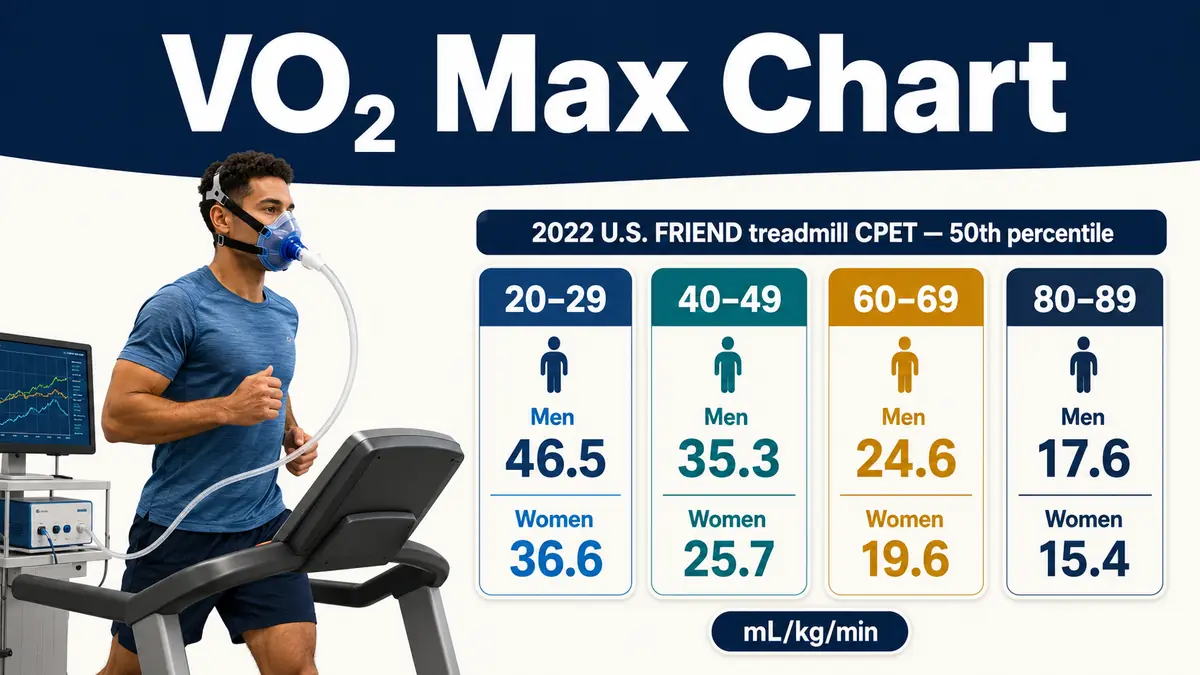
What does your VO₂ max score mean?
VO₂ max or VO₂peak is the highest oxygen uptake reached during a graded exercise test. Relative VO₂ uses mL/kg/min. Absolute VO₂ uses L/min. Read the method and unit first, then compare the score with a reference matching age, study group, health status, country, and exercise mode.
The 2022 FRIEND reference report supplies the adult treadmill percentile values on this page. Its categories describe a U.S. testing cohort. They do not create universal normal ranges, pediatric cutoffs, or medical diagnoses.
Common unit
mL/kg/min
Relative VO₂ divides oxygen uptake by body mass. Absolute oxygen uptake uses L/min.
Direct method
CPET gas analysis
A calibrated treadmill or cycle test measures inspired and expired respiratory gases.
Displayed reference
Adults ages 20–89
The percentile tables use the 2022 U.S. FRIEND treadmill CPET cohort.
Critical limit
Percentile ≠ diagnosis
A reference rank cannot provide medical clearance, explain symptoms, or prescribe training.
Quick answers to common VO₂ max questions
These short answers explain common result fields. Use the complete laboratory, device, or field-test report when making a comparison.
What does VO₂ max measure?
It describes the highest rate of oxygen uptake reached during intense exercise.
What is the standard relative unit?
Relative VO₂ is usually reported in millilitres per kilogram per minute.
What does L/min mean?
Litres per minute is absolute oxygen uptake before adjustment for body mass.
What is the median percentile?
The 50th percentile is the median of the matching reference group.
Is a watch score directly measured?
No. A watch normally estimates VO₂ max from sensor and activity data.
Is VO₂peak the same as VO₂ max?
VO₂peak is the highest observed value; VO₂ max may require added maximal criteria.
Can treadmill and cycle results differ?
Yes. Exercise mode and local muscle fatigue can change the peak value.
Can body mass change the score?
Yes. Relative mL/kg/min changes when body mass changes, even if L/min is stable.
Can VO₂ max predict race time?
Not alone. Economy, threshold, endurance, pacing, skill, and conditions also matter.
Do adult tables apply to children?
No. Children and adolescents need pediatric protocols and reference data.
Can a low score diagnose disease?
No. Many health, training, body-mass, effort, and measurement factors can contribute.
What makes a trend comparable?
Use the same method, mode, protocol, preparation, device, and body-mass context.
VO₂ Max Percentiles for Men by Age
Selected 10th, 50th, and 90th percentiles from the 2022 U.S. FRIEND treadmill CPET cohort. The labels reproduce the study’s male comparison group; they are not diagnostic cutoffs.
Swipe horizontally inside the table to view every column.
| Age | 10th percentile | 50th percentile | 90th percentile | How to use the row |
|---|---|---|---|---|
| 20–29 | 28.6 | 46.5 — Median for ages 20–29 | 58.6 | Compare only with a treadmill CPET result from the matching FRIEND study group; values between shown cut points fall between those percentile ranks. |
| 30–39 | 24.9 | 39.7 | 55.5 | Compare only with a treadmill CPET result from the matching FRIEND study group; values between shown cut points fall between those percentile ranks. |
| 40–49 | 22.1 | 35.3 | 50.8 | Compare only with a treadmill CPET result from the matching FRIEND study group; values between shown cut points fall between those percentile ranks. |
| 50–59 | 18.6 | 29.2 | 43.4 | Compare only with a treadmill CPET result from the matching FRIEND study group; values between shown cut points fall between those percentile ranks. |
| 60–69 | 15.8 | 24.6 | 37.1 | Compare only with a treadmill CPET result from the matching FRIEND study group; values between shown cut points fall between those percentile ranks. |
| 70–79 | 13.6 | 20.6 | 29.4 | Compare only with a treadmill CPET result from the matching FRIEND study group; values between shown cut points fall between those percentile ranks. |
| 80–89 | 12.9 | 17.6 | 22.8 | Compare only with a treadmill CPET result from the matching FRIEND study group; values between shown cut points fall between those percentile ranks. — Oldest reference group |
All values are relative peak oxygen uptake in mL/kg/min.
- • The median is the 50th percentile: half of the matching reference group scored below it and half scored above it.
- • Do not compare a cycle, field-test, wearable, pediatric, rehabilitation, or disease-specific result directly with these treadmill values.
- • A percentile describes position in one reference cohort; it is not a diagnosis, treatment target, or guarantee of performance.
Download or export
VO₂ Max Percentiles for Women by Age
Selected 10th, 50th, and 90th percentiles from the 2022 U.S. FRIEND treadmill CPET cohort. The labels reproduce the study’s female comparison group; they are not diagnostic cutoffs.
Swipe horizontally inside the table to view every column.
| Age | 10th percentile | 50th percentile | 90th percentile | How to use the row |
|---|---|---|---|---|
| 20–29 | 22.5 | 36.6 — Median for ages 20–29 | 49.0 | Compare only with a treadmill CPET result from the matching FRIEND study group; values between shown cut points fall between those percentile ranks. |
| 30–39 | 18.6 | 28.3 | 42.1 | Compare only with a treadmill CPET result from the matching FRIEND study group; values between shown cut points fall between those percentile ranks. |
| 40–49 | 17.2 | 25.7 | 37.8 | Compare only with a treadmill CPET result from the matching FRIEND study group; values between shown cut points fall between those percentile ranks. |
| 50–59 | 16.5 | 22.9 | 32.4 | Compare only with a treadmill CPET result from the matching FRIEND study group; values between shown cut points fall between those percentile ranks. |
| 60–69 | 13.4 | 19.6 | 27.3 | Compare only with a treadmill CPET result from the matching FRIEND study group; values between shown cut points fall between those percentile ranks. |
| 70–79 | 12.3 | 17.2 | 22.8 | Compare only with a treadmill CPET result from the matching FRIEND study group; values between shown cut points fall between those percentile ranks. |
| 80–89 | 11.4 | 15.4 | 20.8 | Compare only with a treadmill CPET result from the matching FRIEND study group; values between shown cut points fall between those percentile ranks. — Oldest reference group |
All values are relative peak oxygen uptake in mL/kg/min.
- • Use the row matching age at the time of testing and keep the exercise mode and measurement method with the result.
- • Sex-group differences in a reference dataset reflect multiple physiological and cohort factors and do not define any individual’s capacity.
- • People whose comparison needs are not represented by these groups should use clinician- or laboratory-selected reference data.
Download or export
How to read a VO₂ max result correctly
A VO₂ max number becomes meaningful only when its method, unit, exercise mode, protocol, body mass, effort criteria, and reference population stay attached. Start with those attributes before using a percentile or judging a trend.
1
Identify the method
Direct gas analysis, workload equation, field test, and wearable estimate are different.
2
Keep the unit
L/min is absolute. mL/kg/min is body-mass-relative. They are not interchangeable.
3
Match the reference
Use age, study group, country, health status, and exercise mode that fit the result.
4
Compare like with like
Trend the same mode, protocol, preparation, device, and body-mass measurement.
Direct treadmill CPET is the method behind the displayed FRIEND percentile tables. Cycle CPET, wearables, field tests, and workload equations need their own interpretation.
Relative and absolute VO₂ answer different questions
Absolute L/min describes total oxygen uptake. Relative mL/kg/min divides that uptake by body mass. A weight change can move the relative score even when absolute aerobic capacity stays stable, so record both values when they are available.
VO₂ Max Units and Conversion Chart
Absolute oxygen uptake describes total oxygen used per minute. Relative oxygen uptake divides that value by body mass. Standardized MET conversion is useful context, not a measured resting metabolic rate.
Swipe horizontally inside the table to view every column.
| Quantity | Unit | Formula or relationship | Interpretation |
|---|---|---|---|
| Relative VO₂ | mL/kg/min | Absolute L/min × 1,000 ÷ body mass kg — Relative conversion formula | Common fitness-comparison unit adjusted for body mass |
| Absolute VO₂ | L/min | Relative mL/kg/min × body mass kg ÷ 1,000 | Total oxygen uptake per minute |
| Absolute VO₂ | mL/min | L/min × 1,000 | Same absolute quantity in millilitres |
| Body mass | kg | Pounds ÷ 2.20462 | Use body mass recorded near the test date |
| Standard MET equivalent | METs | Relative mL/kg/min ÷ 3.5 | Uses the conventional 3.5 mL/kg/min per MET |
| One standardized MET | 3.5 mL/kg/min | Convention for resting energy expenditure | An individual measured resting value may differ — Standardized MET limitation |
| Example: relative to absolute | 40 mL/kg/min at 70 kg | 40 × 70 ÷ 1,000 = 2.80 L/min | Body mass is required for the conversion |
| Example: absolute to relative | 3.50 L/min at 70 kg | 3.50 × 1,000 ÷ 70 = 50.0 mL/kg/min | Changing body mass changes the relative result |
| Same absolute capacity, lower mass | 3.00 L/min at 75 kg versus 70 kg | 40.0 versus 42.9 mL/kg/min | Relative fitness can rise without absolute VO₂ rising |
| Same relative capacity, higher mass | 40 mL/kg/min at 60 kg versus 80 kg | 2.40 versus 3.20 L/min | Equal relative scores can represent different absolute uptake |
Keep the original unit with every number. Never compare L/min directly with mL/kg/min.
- • Use measured body mass from the same testing period when possible.
- • Round only after completing the calculation; displayed examples use two decimal places for L/min and one decimal place for mL/kg/min.
- • MET conversion does not turn an estimated VO₂ max into a direct gas-analysis measurement.
Download or export
VO₂ Max Unit and Percentile Interpreter
Convert a score and place it between reported thresholds
Enter a relative or absolute oxygen-uptake value. The tool converts units, calculates a standardized MET equivalent, and compares an adult result with the 2022 FRIEND treadmill deciles. It does not interpolate an exact percentile.
The reference groups reproduce the published FRIEND categories. Choose the group used by your laboratory or clinician. Reference group unavailable for this age or situation means the adult table should not be forced onto the result.
Calculated context
Enter a valid score
- • Enter a positive oxygen-uptake value.
Percentile threshold context
Enter a valid value to compare thresholds.
The selected reference is method-aligned with a directly measured treadmill CPET, although protocol, cohort, health, and effort criteria still matter.
Generated interpretation
VO₂ max interpretation note
Input: not entered Relative mL/kg/min
Body mass: not entered kg
Test method: Treadmill CPET with gas analysis
FRIEND comparison group: men, ages 20–29
Relative VO₂: unavailable
Absolute VO₂: unavailable without body mass
Standardized MET equivalent: unavailable
Reference context: unavailable
Method note: The selected reference is method-aligned with a directly measured treadmill CPET, although protocol, cohort, health, and effort criteria still matter.
Input checks: Enter a positive oxygen-uptake value.
Safety note: This tool converts units and compares reported adult thresholds. It does not verify the original test, calculate an exact percentile, or diagnose a condition. It does not provide medical clearance or prescribe training.
Do not use a wearable estimate, field result, or this calculator for medical clearance. New chest pressure, fainting, collapse, severe breathlessness, or neurological symptoms during exercise requires stopping and urgent assessment. Nothing entered here is stored or transmitted.
Estimated ≠ measured
Direct CPET analyzes respiratory gases during graded exercise. Workload equations, submaximal heart-rate tests, timed runs, step tests, and wearables estimate fitness. The ACSM estimation guidance explains how heart-rate error, maximum-heart-rate assumptions, protocol choice, and equipment calibration can change a submaximal estimate.
VO₂ Max Measurement and Estimation Methods
Method determines what the number means. Direct CPET measures expired gases during graded exercise; workload, field, wearable, and nonexercise methods estimate cardiorespiratory fitness.
Swipe horizontally inside the table to view every column.
| Method | What is measured | Result label | Main limitation |
|---|---|---|---|
| Laboratory treadmill CPET | Breath-by-breath oxygen and carbon dioxide during graded treadmill exercise | Measured VO₂peak or VO₂max — Direct treadmill measurement | Requires calibrated equipment, appropriate protocol, and trained supervision |
| Laboratory cycle CPET | Expired gases plus cycle workload during graded pedalling | Measured VO₂peak or VO₂max | Leg fatigue and exercise-mode specificity can lower the result for some people |
| Maximal treadmill test without gas analysis | Peak speed, grade, time, heart rate, symptoms, and ECG when used | Estimated exercise capacity or estimated VO₂ | Workload equations do not directly measure oxygen uptake |
| Submaximal cycle or treadmill test | Heart rate at known workloads below maximum | Estimated VO₂max | Depends on heart-rate assumptions, medication effects, and steady-state accuracy |
| Step test | Recovery or exercise heart rate after a fixed stepping task | Estimated aerobic fitness | Step height, cadence, body size, technique, and heart-rate error matter |
| Timed run or walk | Distance, pace, time, and sometimes heart rate | Field estimate or performance index | Weather, terrain, pacing, motivation, and running economy affect the estimate |
| Wearable estimate | Heart rate, speed, motion, GPS, profile data, and proprietary modeling | Device-estimated VO₂ max | Algorithm, sensor contact, supported activity, and device generation differ — Wearable estimate limitation |
| Nonexercise equation | Age, sex, body size, resting heart rate, and activity questionnaire or other inputs | Nonexercise CRF estimate | Useful for population screening but not a direct maximal test |
| Race-based VDOT or performance score | Recent running performance | Performance index | Includes running economy and endurance; it is not laboratory VO₂ max |
| Clinical functional test | Walking distance, symptoms, oxygen saturation, or workload | Functional capacity measure | Clinically useful but not interchangeable with measured VO₂ max |
Report the method, mode, protocol, unit, and whether the value was measured or estimated.
- • A maximal effort does not make a workload equation a direct measurement; expired-gas analysis is still required.
- • VO₂peak is the highest observed value. VO₂max is often reserved for a result meeting the laboratory’s maximal-response criteria.
- • Repeat comparisons are most meaningful when the same method and protocol are used.
Download or export
Adult treadmill references require adult treadmill results
The displayed FRIEND values describe directly measured treadmill CPET in adults. Cycle tests, pediatric tests, clinical disease cohorts, field estimates, and wearables need method-appropriate references. Mode, protocol, effort, and body mass must remain visible when tracking a result.
How to Compare VO₂ Max Results Correctly
A change is credible only when the underlying tests are comparable. Record enough context to distinguish physiological change from method and condition differences.
Swipe horizontally inside the table to view every column.
| Comparison factor | Keep consistent | Why it changes the result | Best record to save |
|---|---|---|---|
| Measurement type — Measurement type first | Direct CPET versus estimate | Estimated values contain model error that direct gas analysis does not | Measured or estimated label |
| Exercise mode | Treadmill, cycle, rower, arm ergometer, or field test | Movement specificity and local muscle fatigue alter peak uptake | Exact mode |
| Protocol | Ramp or stage design, speed, grade, watts, and stage duration | Work-rate increments affect fatigue and test duration | Protocol name and settings |
| Peak definition | VO₂max criteria or highest VO₂peak averaging interval | Plateau, respiratory exchange, effort, and sampling rules differ | Laboratory interpretation |
| Body mass | Mass measured near each test | Relative mL/kg/min changes when the denominator changes — Body-mass effect | kg plus absolute L/min when available |
| Environment | Temperature, humidity, altitude, surface, and wind | Heat, altitude, and resistance change physiological strain | Location and conditions |
| Preparation | Sleep, hydration, meals, caffeine, alcohol, and prior exercise | Acute readiness can suppress or inflate performance | Standardized pretest routine |
| Health status | Recent infection, anemia evaluation, pain, pregnancy, and chronic disease context | Oxygen delivery, symptoms, and effort tolerance can change | Relevant clinical context |
| Medicines | Especially heart-rate-altering medicines | Heart-rate-based estimates can become invalid or shift | Current medicine list |
| Device and software | Same wearable model, firmware, sensor, and settings | Algorithms and sensor behavior change across devices | Device, software, and activity type |
Do not pool unlike tests into one trend line without clearly marking method changes.
- • A treadmill percentile should not grade a cycle result unless the source specifically supports that comparison.
- • Wearable trends can be useful within one device ecosystem, but they remain estimates.
- • When a result changes unexpectedly, check data quality and test conditions before assigning a fitness explanation.
Download or export
One score reflects many oxygen-delivery and testing factors
Heart function, lungs, blood, working muscle, training, body composition, movement skill, environment, medicines, health, effort, and the stopping reason can all shape the observed peak. VO₂ max cannot identify the cause by itself.
Factors That Influence a VO₂ Max Score
VO₂ max reflects integrated oxygen delivery and use. A single score cannot identify which cardiac, pulmonary, blood, muscle, training, body-composition, or testing factor contributed.
Swipe horizontally inside the table to view every column.
| Factor | Possible direction | Mechanism or context | Interpretation limit |
|---|---|---|---|
| Age | Population medians generally decline across adult decades | Maximum heart rate, stroke volume, muscle oxidative capacity, activity, and health change | Cross-sectional percentiles do not predict one person’s exact decline |
| Reference sex group | Distributions differ in FRIEND data | Body size, hemoglobin, body composition, physiology, and cohort factors contribute | Group data do not define an individual |
| Endurance training | Often raises measured or estimated CRF | Central and peripheral adaptations improve oxygen delivery and use | Response size varies |
| Detraining or inactivity | Can lower fitness | Training stimulus and plasma volume decline | Short interruptions and long-term inactivity are not equivalent |
| Body mass change | Changes relative mL/kg/min even if L/min is stable | Body mass is the denominator of the relative score — Denominator effect | Inspect absolute and relative values together |
| Hemoglobin and iron status | Low oxygen-carrying capacity may reduce performance | Blood transports oxygen to working muscle | VO₂ max cannot diagnose anemia or iron deficiency |
| Heart or lung condition | May limit oxygen delivery, ventilation, or circulation | Clinical mechanisms vary widely | A low score cannot identify the disease |
| Altitude and heat | Acute exposure can reduce performance | Available oxygen, cardiovascular strain, and thermoregulation change | Acclimatization and protocol matter |
| Movement skill and economy | Can change field or mode-specific performance | Technique affects the workload achieved for a given oxygen cost | Race performance is not determined by VO₂ max alone |
| Effort and test termination | Early stopping can lower the observed peak | Symptoms, motivation, local fatigue, discomfort, or safety criteria end the test | The report should state whether the effort was considered maximal — Effort qualification required |
Interpret the score with symptoms, health history, protocol, body mass, effort criteria, and prior comparable tests.
- • Higher cardiorespiratory fitness is generally favorable, but the highest possible number is not a universal training target.
- • A low or falling result is a signal for context, not a stand-alone diagnosis.
- • Running economy, threshold, skill, strength, recovery, and tactics also shape endurance performance.
Download or export
Check method and body mass before calling a change real
A change can reflect adaptation, detraining, illness, body-mass movement, effort, mode, protocol, environment, sensor data, or ordinary test variation. A comparable repeat is stronger evidence than a single decimal-place difference.
How to Interpret a Change in VO₂ Max
Before calling a change improvement or decline, separate real physiological change from body-mass, method, protocol, environment, health, and measurement effects.
Swipe horizontally inside the table to view every column.
| Observed pattern | First check | Possible explanation | Useful next step |
|---|---|---|---|
| Relative rises; absolute stable | Body mass trend — Check body mass | Lower body mass raised mL/kg/min without changing L/min | Record both units |
| Relative falls; absolute stable | Body mass trend | Higher body mass lowered mL/kg/min without changing L/min | Avoid assuming aerobic loss |
| Both relative and absolute rise | Same method and protocol | Aerobic capacity may have improved | Confirm with a comparable repeat when decisions depend on it |
| Both fall after illness | Symptoms and recovery | Temporary deconditioning or unresolved illness may contribute | Delay maximal self-testing and seek advice if symptoms persist |
| Wearable drops suddenly | Sensor fit, GPS, supported workout, and profile data | Data-quality or algorithm conditions may have changed | Review several valid sessions |
| Cycle result below treadmill result | Exercise mode | Mode specificity or local leg fatigue may explain part of the difference | Use mode-specific references |
| Field estimate improves; lab value stable | Pacing, economy, weather, and course | Performance improved without a measurable VO₂ change | Treat both outcomes as useful but different |
| Lab result lower with early symptoms | Termination reason and clinical report | The observed peak may reflect symptoms or a new limitation | Discuss the report with the testing clinician — Clinical review |
| Small change near expected test noise | Lab reproducibility and rounding | Normal biological and measurement variation may explain it | Avoid overinterpreting one decimal point |
A meaningful-change threshold depends on the method, laboratory, protocol, population, and reason for testing.
- • Do not apply a universal percentage as proof that fitness changed.
- • Trend interpretation is strongest when preparation, protocol, mode, equipment, and body-mass measurement are standardized.
- • New exertional symptoms matter even when the numerical score remains high.
Download or export
Consistent aerobic training can improve cardiorespiratory fitness
Build regular aerobic activity, progress gradually, recover, and add vigorous work only when it suits health and training status. The Physical Activity Guidelines for Americans support moving more, reducing inactivity, and building toward population-level aerobic and strengthening targets.
Improving VO₂ Max and Planning a Retest
Aerobic fitness usually responds to consistent, progressive training. The safest program fits current activity, health, symptoms, recovery, goals, and access to supervision.
Swipe horizontally inside the table to view every column.
| Action | Practical approach | Why it helps | Important limit |
|---|---|---|---|
| Build regular aerobic volume | Accumulate manageable walking, cycling, swimming, running, or other rhythmic activity | Repeated aerobic stimulus supports cardiovascular and muscular adaptation | Choose joint- and condition-appropriate modes |
| Progress gradually | Increase one training variable at a time when recovery is acceptable — Gradual progression | Allows adaptation while limiting abrupt overload | More is not always better |
| Include vigorous work when appropriate | Use structured intervals only after a suitable base and screening | Higher-intensity stimulus can improve cardiorespiratory fitness | Not appropriate during illness or unexplained symptoms — High-intensity limit |
| Keep easy sessions easy | Separate lower-intensity volume from hard sessions | Supports repeatable training and recovery | Device zones are estimates unless individualized |
| Add muscle strengthening | Train major muscle groups on separate or compatible days | Supports function, resilience, and exercise capacity | Strength training does not replace aerobic practice |
| Recover | Allow sleep, nutrition, hydration, and lower-load days | Adaptation occurs between training sessions | Persistent fatigue or falling performance needs context |
| Choose a retest method | Repeat the same laboratory, field test, or wearable conditions | Improves trend comparability | Do not switch methods to chase a higher number |
| Use an adequate interval | Allow enough consistent training for adaptation before retesting | Avoids reacting to day-to-day variation | The exact interval depends on program and purpose |
| Track function too | Record pace, power, symptoms, recovery, and task tolerance | Fitness is broader than one oxygen-uptake number | Performance and health need separate interpretation |
Public-health activity targets guide population behavior; individualized training intensity and clinical rehabilitation require personal assessment.
- • People returning from inactivity can begin with small amounts and build gradually.
- • A clinician or qualified exercise professional can help when disease, pregnancy, disability, medication effects, or symptoms change the risk-benefit balance.
- • Stop exercise and follow the safety guidance below when warning symptoms occur.
Download or export
Symptoms override the score
Maximal testing creates high cardiovascular and respiratory demand. Unexplained exertional chest pain, fainting, marked breathlessness, or palpitations should be assessed before a self-directed maximal test. Stop immediately when an emergency symptom appears.
VO₂ Max Testing Safety and Care Timing
Maximal exercise deliberately creates high cardiovascular and respiratory demand. Testing method, supervision, emergency planning, health history, and current symptoms must match the person.
Swipe horizontally inside the table to view every column.
| Situation | Why it matters | Action | Timing |
|---|---|---|---|
| Chest pressure, severe breathlessness, fainting, or collapse during exercise | May signal a serious cardiac, pulmonary, or circulatory problem | Stop and activate emergency care — Emergency action | Immediately |
| New neurological symptoms during exercise | Weakness, facial droop, speech change, severe imbalance, or confusion can be emergencies | Stop and activate emergency care | Immediately |
| Sustained rapid or irregular heartbeat with chest symptoms, faintness, or severe breathlessness | A symptomatic rhythm problem needs urgent assessment | Stop and seek emergency care | Immediately |
| Known heart or lung disease with a planned maximal test | Risk, monitoring, protocol, and termination criteria may need clinical oversight | Use clinician-directed testing | Before testing |
| Unexplained exertional chest pain, fainting, marked breathlessness, or palpitations | A maximal self-test could reproduce a concerning symptom without support | Defer testing and obtain medical assessment | Before testing |
| Fever, acute infection, significant dehydration, or uncontrolled symptoms | Acute illness changes performance and may increase risk | Postpone the maximal test | Until recovered or advised |
| Pregnancy, major mobility limitation, or significant medication effect | Protocol, exercise mode, and monitoring may need adaptation | Ask the treating clinician or qualified tester | Before testing |
| Child or adolescent result | Adult FRIEND percentiles do not represent growth and maturation | Use pediatric protocols and references | At interpretation |
| Unexpectedly low result without urgent symptoms | Method, effort, anemia, disease, medication, and deconditioning are among many possibilities | Review the full report and health context | Routine or prompt depending on symptoms |
| High result with warning symptoms | A strong fitness number does not rule out disease or make symptoms safe | Prioritize symptom assessment over the score — Symptoms override score | Urgent or emergency depending on symptoms |
Emergency guidance depends on local services. Do not continue a maximal test to obtain a final number after a termination symptom appears.
- • Laboratories use screening, trained personnel, calibrated equipment, monitoring, and predefined stopping criteria to reduce risk.
- • This table does not provide exercise clearance or replace the testing professional’s instructions.
- • If you are unsure whether a symptom is an emergency, use local emergency services rather than attempting another test.
Download or export
Frequently asked questions
What is VO₂ max?
VO₂ max is the highest rate at which the body can take in, transport, and use oxygen during intense whole-body exercise. A laboratory usually reports the highest observed value as VO₂peak unless the test and response satisfy its criteria for maximal oxygen uptake.
What is a good VO₂ max for my age?
A good score is not one universal number. Compare a directly measured treadmill result with the matching age and reference-sex group from an appropriate cohort, then read its percentile. Method, country, health status, and exercise mode can change the comparison.
What do the 10th, 50th, and 90th percentiles mean?
The 50th percentile is the median for the matching reference group. A 90th-percentile threshold means about 90 percent of that group scored at or below the listed value, while the 10th-percentile threshold marks the lower decile of that cohort.
Is VO₂ max measured in mL/kg/min or L/min?
Both units are valid but describe different quantities. L/min is absolute oxygen uptake. mL/kg/min divides absolute uptake by body mass, which supports body-size-adjusted comparisons but can change when body mass changes.
How do I convert VO₂ max from L/min to mL/kg/min?
Multiply L/min by 1,000, then divide by body mass in kilograms. For example, 3.50 L/min at 70 kg equals 50.0 mL/kg/min. Use body mass recorded near the test and keep rounding until the final step.
How do I convert VO₂ max to METs?
Divide relative oxygen uptake in mL/kg/min by 3.5 to obtain a standardized MET equivalent. This uses the conventional value for one MET; it does not measure your personal resting metabolic rate or turn an estimate into a direct CPET result.
What is the difference between VO₂ max and VO₂ peak?
VO₂peak is the highest oxygen uptake observed during a specific test. VO₂max traditionally implies that maximal-response criteria were reached, often including a plateau or other supporting evidence. Laboratories may use the terms differently, so read the report’s definition.
Can a smartwatch measure VO₂ max?
Most smartwatches estimate VO₂ max from heart rate, pace, movement, GPS, profile data, and a proprietary model. They do not perform breath-by-breath gas analysis. Trends can be useful when the same device and supported activity are used consistently.
Why is my cycling VO₂ max lower than my running score?
Treadmill and cycle results are mode-specific. People who are not cycle-trained may stop because of local leg fatigue before reaching the same whole-body oxygen uptake achieved on a treadmill. Use cycle references for cycle tests and treadmill references for treadmill tests.
Can weight loss raise relative VO₂ max?
Yes. Because mL/kg/min divides oxygen uptake by body mass, relative VO₂ max can rise when body mass falls even if absolute L/min stays unchanged. Record both absolute and relative values when evaluating physiological change.
Does VO₂ max decline with age?
Population medians generally decline across adult age groups, but an individual’s trajectory depends on training, health, body composition, medicines, testing method, and other factors. Cross-sectional age tables do not predict a fixed personal rate of decline.
Can two people with the same VO₂ max perform differently?
Yes. Endurance performance also depends on movement economy, threshold, fatigue resistance, skill, strength, pacing, environment, fueling, and the fraction of capacity that can be sustained. VO₂ max is important but does not determine race time by itself.
How often should I retest VO₂ max?
Retest after enough consistent training for a meaningful adaptation and when the result will change a decision. Use the same method, mode, protocol, preparation, and body-mass measurement. Frequent testing can magnify ordinary biological and measurement variation.
Do the adult FRIEND tables apply to children?
No. The displayed FRIEND treadmill tables cover adults aged 20 through 89 years. Children and adolescents need pediatric protocols and references that account for age, sex, body size, maturation, and the specific exercise-test method.
When should VO₂ max testing be medically supervised?
Clinical supervision is appropriate when known disease, unexplained exertional symptoms, pregnancy, major mobility limitations, medication effects, or the reason for testing changes risk or protocol needs. Chest pressure, fainting, collapse, or severe breathlessness requires stopping and urgent care.
Sources
These cardiopulmonary exercise-testing, cardiorespiratory-fitness, population reference, physical-activity, interpretation, and testing-safety resources support the page.
PubMed — Updated Reference Standards for Cardiorespiratory Fitness
https://pubmed.ncbi.nlm.nih.gov/34809986/
Indexes the 2022 FRIEND report of directly measured treadmill and cycle-ergometer cardiopulmonary exercise tests in U.S. adults aged 20 through 89 years.
Mayo Clinic Proceedings — Updated FRIEND Cardiorespiratory Fitness Reference Standards
https://www.mayoclinicproceedings.org/article/S0025-6196%2821%2900645-5/fulltext
Reports age-, sex-, and test-mode-specific peak oxygen-uptake percentiles from 22,379 cardiopulmonary exercise tests contributed by 34 U.S. laboratories.
National Library of Medicine — FRIEND Treadmill Cardiorespiratory Fitness Reference Standards
https://pmc.ncbi.nlm.nih.gov/articles/PMC4919021/
Provides the original directly measured U.S. treadmill reference data and explains the strong age and sex differences in relative maximal oxygen uptake.
PubMed — FRIEND Cycle-Ergometry Cardiorespiratory Fitness Standards
https://pubmed.ncbi.nlm.nih.gov/27938891/
Provides directly measured U.S. cycle-ergometer reference values and demonstrates why treadmill percentiles should not be applied to cycle results.
American Heart Association — Cardiorespiratory Fitness as a Clinical Vital Sign
https://www.ahajournals.org/doi/10.1161/cir.0000000000000461
Explains the health importance of cardiorespiratory fitness, distinguishes direct measurement from estimation, and supports routine fitness assessment in clinical practice.
PubMed — Clinician’s Guide to Cardiopulmonary Exercise Testing in Adults
https://pubmed.ncbi.nlm.nih.gov/20585013/
Summarizes adult CPET procedures, measured gas-exchange variables, clinical interpretation, test limitations, and the role of symptom-limited exercise testing.
American Heart Association — Exercise Standards for Testing and Training
https://www.ahajournals.org/doi/10.1161/cir.0b013e31829b5b44
Covers exercise-test preparation, supervision, termination criteria, interpretation, and safety for clinical and fitness testing environments.
American College of Sports Medicine — We Can and Should Do Better When Estimating Cardiorespiratory Fitness
https://acsm.org/estimating-cardiorespiratory-fitness/
Explains how heart-rate measurement error, estimated maximum heart rate, protocol choice, equipment calibration, and unmet assumptions can distort submaximal estimates.
American College of Sports Medicine — ACSM’s Guidelines for Exercise Testing and Prescription
https://acsm.org/education-resources/books/guidelines-exercise-testing-prescription/
Describes the professional reference used for evidence-based exercise testing, preparticipation screening, result interpretation, and exercise prescription.
U.S. Department of Health and Human Services — Physical Activity Guidelines for Americans, Second Edition
https://health.gov/sites/default/files/2019-09/Physical_Activity_Guidelines_2nd_edition.pdf
Provides population-level aerobic and muscle-strengthening guidance and emphasizes gradual progression based on current activity, health, and ability.
American Heart Association — Cardiorespiratory Fitness in Youth
https://www.ahajournals.org/doi/10.1161/CIR.0000000000000866
Explains why child and adolescent cardiorespiratory fitness needs age- and development-appropriate assessment rather than adult reference tables.
National Library of Medicine — Dutch and Flemish VO₂ Max Reference Values
https://pmc.ncbi.nlm.nih.gov/articles/PMC7966187/
Provides population-specific CPET reference values and illustrates why country, cohort, protocol, and test mode matter when comparing oxygen-uptake results.
National Library of Medicine — German Cycle-Ergometry Peak Oxygen-Uptake References
https://pmc.ncbi.nlm.nih.gov/articles/PMC5855221/
Reports age- and sex-specific cycle-ergometry reference values and reinforces that modality-specific data should guide interpretation.
National Library of Medicine — Brazilian Treadmill Cardiorespiratory Fitness Data
https://pmc.ncbi.nlm.nih.gov/articles/PMC6326491/
Presents treadmill CPET percentiles from a large Brazilian cohort and demonstrates that reference distributions can differ between populations.