Health & Medical · Exercise energy reference
Calories Burned by Exercise Chart for Cardio, Weights, Classes, and HIIT
Compare exercise calories by workout type, body weight, duration, machine workload, class intensity, and active work time. Use the calculator to separate gross calories from calories above resting energy.
Exercise calorie numbers are estimates, not prescriptions. Stop activity and seek appropriate help for chest pain, fainting, severe or unusual breathlessness, confusion, new neurologic symptoms, heat illness, or a significant injury. Read the ChartsLoom Disclaimer.
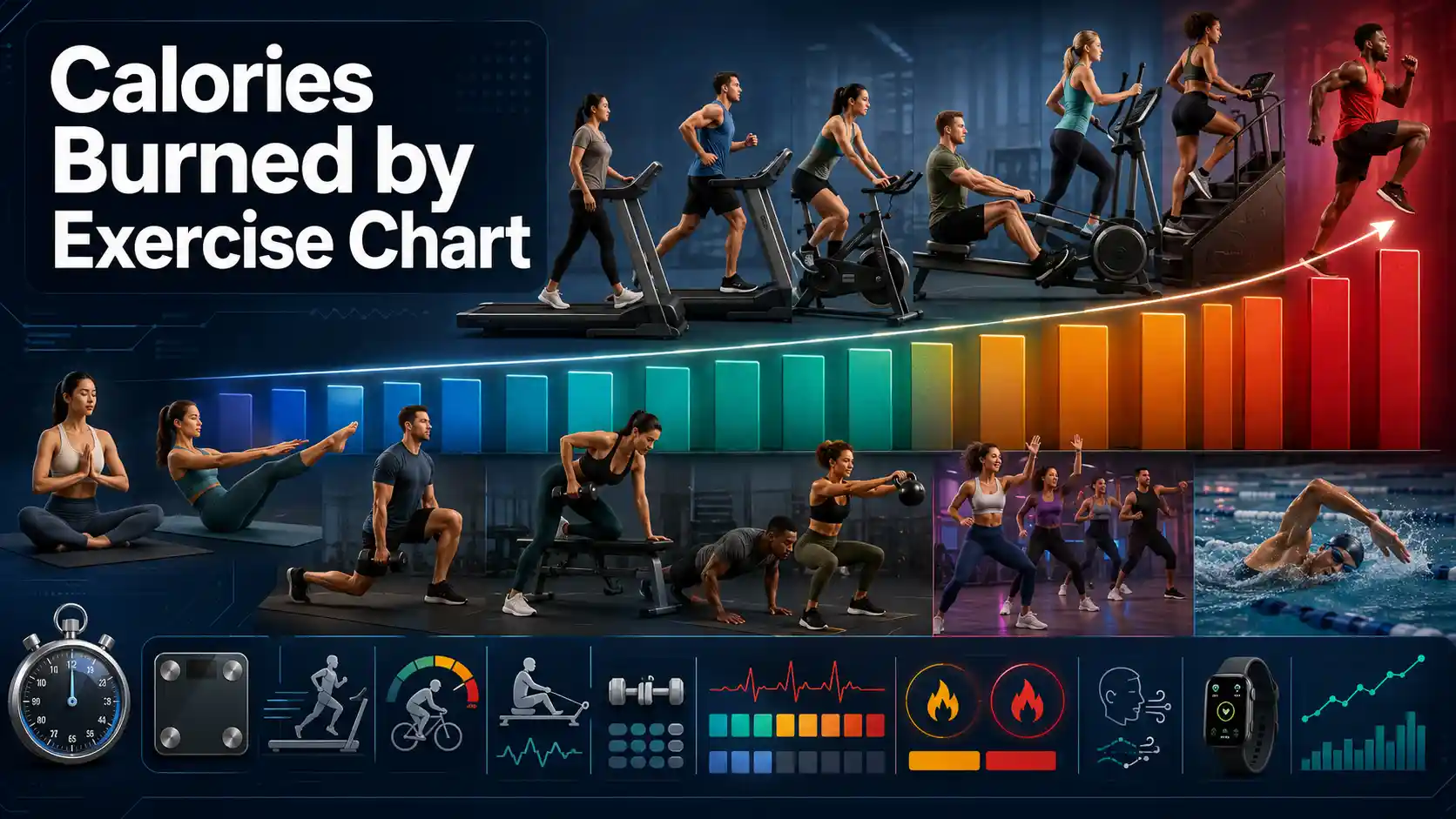
How many calories does a workout burn?
For a 155-pound adult, 30 minutes is approximately 177 gross calories for brisk treadmill walking, 214 for stationary cycling at 70–80 watts, 277 for rowing at 100–149 watts, 314 for running near 5 mph, and 129 for a general mixed resistance workout.
These values use exercise-specific METs from the 2024 Adult Compendium of Physical Activities. The number changes with weight and active time, but individual movement economy, fitness, machine calibration, body composition, temperature, and recovery periods can shift real expenditure.
- Main intensity unit
- MET
- Session detail
- Active minutes matter
- Weight input
- Changes the estimate
- Best use
- Compare workouts
A MET compares exercise energy cost with the conventional cost of quiet rest.
Warm-up, recovery, equipment changes, and long rests reduce average workout intensity.
The standard equation scales calories with body weight but does not measure personal efficiency.
Use the same method to compare patterns rather than treating one number as exact.
Match the workload, not just the exercise name
“Cycling,” “rowing,” “weights,” and “HIIT” each cover large workload ranges. A row with measured watts, pace, incline, or a defined work-to-recovery pattern is more useful than a generic label. For strength training, count how much of the session contains active sets rather than applying a vigorous MET to every minute in the gym.
Calories burned in 30 minutes by exercise and body weight
Estimated gross calories for common workouts using published MET values. The figures include the energy that the body would have used during quiet rest.
Swipe horizontally inside the table to view every column.
| Exercise | METs | 125 lb | 155 lb | 185 lb | 215 lb |
|---|---|---|---|---|---|
| Treadmill walk, 3.5–3.9 mph, level | 4.8 — Moderate exercise reference | 143 | 177 | 211 | 246 |
| Treadmill run, 5.0–5.9 mph | 8.5 | 253 | 314 | 374 | 435 |
| Stationary bike, 70–80 watts | 5.8 | 173 | 214 | 256 | 297 |
| Stationary bike, 126–150 watts | 8 | 238 | 295 | 352 | 410 |
| Rowing ergometer, under 100 watts | 5 | 149 | 185 | 220 | 256 |
| Rowing ergometer, 100–149 watts | 7.5 | 223 | 277 | 330 | 384 |
| Elliptical trainer, moderate | 5 | 149 | 185 | 220 | 256 |
| Elliptical trainer, vigorous | 9 | 268 | 332 | 396 | 461 |
| Stair treadmill ergometer | 9.3 | 277 | 343 | 410 | 476 |
| Swimming freestyle, slow | 5.8 | 173 | 214 | 256 | 297 |
| Swimming freestyle, fast | 9.8 | 292 | 362 | 432 | 502 |
| Resistance training, multiple exercises | 3.5 | 104 | 129 | 154 | 179 |
| Resistance training, vigorous | 6 | 179 | 221 | 264 | 307 |
| Circuit training, moderate | 5 | 149 | 185 | 220 | 256 |
| Body-weight resistance, high intensity | 6.5 | 193 | 240 | 286 | 333 |
| HIIT, moderate effort | 7 | 208 | 258 | 308 | 358 |
| HIIT, vigorous effort | 11 — Very vigorous interval reference | 327 | 406 | 485 | 563 |
| Zumba group class | 6.5 | 193 | 240 | 286 | 333 |
Estimated kilocalories during 30 minutes. Body weights are approximately 57, 70, 84, and 98 kg.
- • Values use the conventional equation: calories per minute = MET × 3.5 × body weight in kg ÷ 200.
- • Choose the exercise description that best matches pace, watts, resistance, technique, and active time. A generic machine name can cover a wide intensity range.
Download or export
Calories burned by workout duration at 155 pounds
Estimated gross calories for a 155-pound adult. Duration scales the equation only when the selected exercise intensity remains reasonably consistent.
Swipe horizontally inside the table to view every column.
| Exercise | METs | 15 min | 30 min | 45 min | 60 min |
|---|---|---|---|---|---|
| Treadmill walk, 3.5–3.9 mph | 4.8 | 89 | 177 | 266 | 354 |
| Treadmill run, 5.0–5.9 mph | 8.5 | 157 | 314 | 471 | 627 |
| Stationary bike, 90–100 watts | 6 | 111 | 221 — Common 30-minute cycling reference | 332 | 443 |
| Stationary bike, 126–150 watts | 8 | 148 | 295 | 443 | 591 |
| Rowing ergometer, under 100 watts | 5 | 92 | 185 | 277 | 369 |
| Rowing ergometer, 100–149 watts | 7.5 | 138 | 277 | 415 | 554 |
| Elliptical trainer, moderate | 5 | 92 | 185 | 277 | 369 |
| Stair treadmill ergometer | 9.3 | 172 | 343 | 515 | 687 |
| Resistance training, multiple exercises | 3.5 | 65 | 129 | 194 | 258 |
| Circuit training, vigorous | 7.5 | 138 | 277 | 415 | 554 |
| HIIT, vigorous effort | 11 | 203 | 406 — High-intensity interval estimate | 609 | 812 |
| Zumba group class | 6.5 | 120 | 240 | 360 | 480 |
Estimated gross kilocalories for a 155 lb (70 kg) adult.
- • Warm-up, cooldown, equipment changes, and recovery intervals lower average session intensity unless they are included in the selected activity value.
- • Doubling clock time does not always double real exercise calories because fatigue and pace changes can alter the work rate.
Download or export
Visual comparison of exercise intensity
A higher MET generally raises the calorie estimate for the same body weight and duration. The bars compare published activity values, not personal laboratory measurements.
Lower-intensity exercise
About 1.8–2.9 METs
Traditional Pilates, Hatha yoga, light mobility work
Moderate exercise
3.0–5.9 METs
Brisk walking, moderate rowing, general weights, low-impact aerobics
Vigorous exercise
6.0+ METs
Running, spin, stair machines, vigorous circuits, high-impact classes
Text summary
Pilates and gentle yoga usually sit below the moderate absolute-intensity threshold. Brisk cardio and mixed gym exercise often fall in the moderate range. Running, vigorous cycling, stair climbing, and dense intervals commonly fall in the vigorous range. Relative difficulty can still be much higher or lower for a particular person.
Absolute intensity and personal effort are different
The CDC intensity guide classifies 3.0–5.9 METs as moderate absolute intensity and 6.0 METs or more as vigorous. Personal effort can differ. A 5-MET machine setting may feel easy to a trained adult and very demanding to someone recovering from illness or beginning exercise.
Use breathing, the talk test, perceived exertion, symptoms, and the planned training goal alongside the chart. Heart-rate response can also change with medicines, dehydration, heat, altitude, sleep, stress, and caffeine.
Exercise calorie calculator
Select a workout, weight, session duration, and active-work percentage. The calculator lowers the average MET when a session contains recovery periods, setup, or long rests.
Estimated gross calories
177
Total energy used during the complete session.
Estimated active calories
140
Approximate energy above quiet resting expenditure.
Session intensity
4.8 average METs
Moderate absolute intensity · 30 active minutes · 0 recovery minutes.
The selected exercise has a 4.8 MET work value. The session estimate averages that work with light 1.5-MET recovery for the nonworking portion.
This browser-only tool does not transmit entered values. It provides a group-based estimate, not indirect calorimetry, a nutrition prescription, or proof of exact energy balance.
Cardio machine calorie chart by setting and workload
Machine type alone does not determine calorie burn. Speed, incline, watts, stroke rate, resistance, handrail use, and actual technique shape the workload.
Swipe horizontally inside the table to view every column.
| Machine and setting | METs | 30 min at 155 lb | Practical intensity clue | Important limitation |
|---|---|---|---|---|
| Treadmill walking, 3.0–3.4 mph, 0% grade | 3.8 | 140 | Steady moderate walk | Incline, handrail support, and actual belt speed can change cost |
| Treadmill walking, 3.5–3.9 mph, 0% grade | 4.8 | 177 | Brisk walk | Grade and stride economy matter |
| Treadmill running, 5.0–5.9 mph | 8.5 | 314 | About 10–12 min/mile | Running economy and incline alter expenditure |
| Stationary bike, 70–80 watts | 5.8 | 214 | Moderate workload | Displayed resistance levels are not standardized across brands |
| Stationary bike, 90–100 watts | 6.0 — Moderate-to-vigorous cycling | 221 | Moderate to vigorous workload | Cadence and calibrated watts are more useful than level number |
| Stationary bike, 126–150 watts | 8.0 | 295 | Vigorous workload | Fit and pedaling efficiency affect real energy use |
| Rowing ergometer, under 100 watts | 5.0 | 185 | Moderate rowing | Technique, stroke rate, and drag setting affect output |
| Rowing ergometer, 100–149 watts | 7.5 | 277 | Vigorous rowing | Use average power rather than peak strokes |
| Elliptical trainer, moderate | 5.0 | 185 | Moderate effort | Machine stride and arm use vary |
| Elliptical trainer, vigorous | 9.0 | 332 | Vigorous effort | Console calorie totals may use proprietary assumptions |
| Stair treadmill ergometer, general | 9.3 — High-demand stair exercise | 343 | Continuous stair climbing | Leaning on rails can reduce actual work |
| Arm ergometer, moderate | 4.3 | 159 | Upper-body cycling | Relevant for some adapted exercise sessions |
Estimated gross kilocalories for a 155 lb (70 kg) adult.
- • Watts provide a more transferable workload measure than an uncalibrated resistance level, but machine calibration can still differ.
- • Do not hold treadmill or stair-machine rails unless needed for safety; body-weight support can reduce the actual exercise cost.
Download or export
Use measurable machine settings when possible
On a stationary bike or rower, average watts usually describe workload more clearly than a brand-specific resistance level. On a treadmill, speed and grade matter. Holding rails can reduce body-weight support and lower the actual demand. Elliptical stride mechanics and arm use vary between machines, so two consoles can report different totals for similar perceived effort.
Strength training calorie burn by session style
Strength sessions vary because sets, repetitions, load, exercise selection, and recovery time change the average energy cost. The listed calories assume 30 minutes at the stated MET.
Swipe horizontally inside the table to view every column.
| Session style | METs | 30 min at 155 lb | Typical structure | How to interpret it |
|---|---|---|---|---|
| Body-weight exercises, general | 3.0 | 111 | Push-ups, squats, lunges, crunches | Long rests can lower session average |
| Resistance training, multiple exercises | 3.5 — General mixed resistance session | 129 | 8–15 repetitions at varied resistance | A common mixed-session reference |
| Squats and deadlifts, slow or explosive | 5.0 | 185 | Large compound lifts | Actual work time is often much shorter than clock time |
| Resistance training, vigorous | 6.0 | 221 | Power lifting, bodybuilding, heavy free weights | Use only when effort and density match the description |
| Body-weight resistance, high intensity | 6.5 | 240 | Fast circuits with limited rest | Technique and joint tolerance still take priority |
| Reciprocal supersets or peripheral-heart-action circuit | 5.8 | 214 | Alternating movements with short rest | Session density drives the estimate |
| Circuit training, moderate | 5.0 | 185 | Mixed resistance and movement stations | Includes transitions and moderate recovery |
| Circuit training, vigorous | 7.5 | 277 | Kettlebells and aerobic movement with minimal rest | Not equivalent to isolated heavy sets |
| Kettlebell swings | 9.8 — Continuous kettlebell work | 362 | Continuous high-output swings | A short work interval should not be applied to the full session |
| Calisthenics, vigorous | 7.5 | 277 | Burpees, jumping jacks, battling ropes | Impact and conditioning demands can be high |
Estimated gross kilocalories for a 155 lb (70 kg) adult.
- • A 60-minute gym visit can include much less than 60 minutes of active lifting. Apply a high MET only to work periods that truly match the description.
- • Strength training supports muscle, bone, function, and metabolic health even when the session calorie total is lower than continuous vigorous cardio.
Download or export
Strength training should not be judged only by workout calories
A resistance session can include demanding sets, low-energy rest periods, equipment changes, and coaching time. A watch may miss isometric and muscular work, while a generic chart may overstate energy use if a high MET is applied to the entire visit. Sets, repetitions, load, range of motion, exercise quality, and progression remain more useful strength records.
Muscle-strengthening exercise provides bone, function, strength, and metabolic benefits that do not appear in the immediate calorie total.
Calories burned in fitness classes and guided workouts
Class names do not guarantee one intensity. Instructor style, choreography, impact, range of motion, participant fitness, breaks, and modifications change the actual workload.
Swipe horizontally inside the table to view every column.
| Class or guided exercise | METs | 30 min at 155 lb | Absolute intensity |
|---|---|---|---|
| Traditional mat Pilates | 1.8 | 66 | Light |
| General Pilates | 2.8 | 103 | Light |
| Hatha yoga | 2.3 | 85 | Light |
| Power yoga | 4.0 | 148 | Moderate |
| Low-impact aerobic dance | 4.8 — Moderate low-impact class | 177 | Moderate |
| Step aerobics, 4-inch step | 5.5 | 203 | Moderate |
| Water aerobics | 5.3 | 196 | Moderate |
| Zumba, home video | 5.5 | 203 | Moderate |
| Zumba, group class | 6.5 | 240 | Vigorous |
| Aerobic exercise, general | 7.3 | 269 | Vigorous |
| High-impact aerobic dance | 8.0 | 295 | Vigorous |
| Indoor cycling or spin class | 9.0 — Vigorous indoor cycling | 332 | Vigorous |
Estimated gross kilocalories for a 155 lb (70 kg) adult.
- • Yoga and Pilates vary from restorative or technical practice to demanding continuous sequences.
- • Low-impact does not always mean low intensity, and high-impact exercise can be inappropriate for some joints, pregnancies, injuries, or medical conditions.
Download or export
Interval training calories by work-to-recovery structure
This table illustrates how recovery periods change average session intensity. It combines the listed work MET with a light 1.5-MET recovery estimate for a 30-minute session.
Swipe horizontally inside the table to view every column.
| Interval session | Work MET | Work:recovery | Estimated average MET | 30 min at 155 lb |
|---|---|---|---|---|
| Moderate circuit | 6.0 | 1:1 | 3.8 — Recovery-adjusted average | 138 |
| Vigorous circuit | 7.5 | 2:1 | 5.5 | 203 |
| Kettlebell intervals | 9.8 | 1:2 | 4.3 | 157 |
| Tabata-style bodyweight intervals | 11.0 | 2:1 | 7.8 — Vigorous interval example | 289 |
| Stationary-bike intervals | 8.8 | 1:1 | 5.2 | 190 |
| Hard bike intervals | 10.3 | 2:1 | 7.4 | 272 |
| High-power rowing intervals | 14.0 | 1:2 | 5.7 | 209 |
| Stair intervals | 9.3 | 3:1 | 7.4 | 271 |
Illustrative gross kilocalorie estimates for a 155 lb (70 kg) adult.
- • These are mathematical examples, not prescriptions. Actual warm-up, transitions, fatigue, work output, and recovery movement can change the average substantially.
- • Do not apply the peak work-interval MET to the entire session unless the exercise is truly continuous at that intensity.
Download or export
Why peak HIIT calories should not cover the full workout
A work interval can reach a high MET, but the session also contains recovery, warm-up, cooldown, and transitions. A 20-second hard interval followed by 10 seconds of easier movement does not equal 30 continuous minutes at the peak work value. The interval table averages work with light recovery to demonstrate the difference.
The average remains illustrative because output usually falls across repeated intervals. Power, speed, repetitions, and work completion provide stronger session context than the maximum MET alone.
Gross calories versus active exercise calories
Gross calories include resting energy used during the workout period. Active calories subtract approximately one resting MET, so they are lower.
Swipe horizontally inside the table to view every column.
| Exercise | METs | Gross calories | Active calories | Approximate resting portion |
|---|---|---|---|---|
| Treadmill walk, brisk | 4.8 | 177 | 140 | 37 |
| Treadmill run, 5 mph | 8.5 | 314 | 277 | 37 |
| Stationary bike, 90–100 watts | 6 | 221 | 185 | 36 |
| Rowing, 100–149 watts | 7.5 | 277 | 240 | 37 |
| Elliptical, moderate | 5 | 185 | 148 | 37 |
| Resistance training, multiple exercises | 3.5 | 129 — Gross total | 92 — Active estimate | 37 |
| Circuit training, vigorous | 7.5 | 277 | 240 | 37 |
| Zumba group class | 6.5 | 240 | 203 | 37 |
Illustrative 30-minute estimates for a 155 lb (70 kg) adult.
- • Apps and machines may label gross calories as total calories and net calories as active calories.
- • The one-MET subtraction is a convention. Personal resting metabolism can differ from the standard value.
Download or export
Total calories and active calories answer different questions
Gross calories estimate all energy used during the workout period. Active calories try to remove what the body would have used during rest. Two devices can therefore show different values for the same exercise even before algorithm error is considered. Confirm which definition a watch, app, or machine uses before comparing totals.
Why exercise calorie estimates differ
Charts, watches, and machine consoles infer energy expenditure from limited inputs. A precise display can still contain substantial individual error.
Swipe horizontally inside the table to view every column.
| Source of variation | Why the number changes | Better way to use the estimate |
|---|---|---|
| Activity selection | A broad label can hide major differences in speed, incline, load, stroke rate, or resistance | Choose the closest published description instead of a generic exercise name |
| Clock time versus active time | Warm-up, transitions, equipment setup, and rests lower average session intensity | Record active work and recovery separately when useful |
| Body weight | Standard MET equations scale energy cost directly with body weight | Use a current weight, but remember body composition and efficiency remain unmeasured |
| Fitness and movement economy | Trained people may use less oxygen for a familiar submaximal task | Compare repeated sessions under similar conditions |
| Machine calibration | Treadmills, bikes, rowers, and stair machines may measure speed, power, or resistance differently | Use measured pace or watts when available |
| Wearable algorithms | Watches combine heart rate, motion, age, sex, and proprietary assumptions — Wearable algorithm limitation | Treat the output as a trend estimate, not a laboratory result |
| Heart-rate modifiers | Heat, stress, dehydration, caffeine, illness, and medicines can change pulse without equal changes in energy use | Do not equate a higher heart rate automatically with more calories |
| Strength training | Muscular work, isometric effort, and long rests are difficult to summarize with one MET — Strength-session limitation | Use sets, load, reps, and training volume as primary records |
| Post-exercise oxygen use | Hard sessions can raise recovery energy use, but the amount is usually smaller than marketing claims | Do not add a large fixed afterburn bonus |
| Older age or disability | Standard adult MET values may not represent resting metabolism or movement cost well | Use adapted or older-adult references when available |
Indirect calorimetry measures respiratory gases during a specific test and provides a closer individual estimate than a generic chart.
- • Use the same device and similar workout conditions when comparing personal trends.
- • Do not adjust food intake, medicines, or clinical treatment from one exercise-calorie value.
Download or export
Watches and machine consoles can be useful without being exact
A recent umbrella review of consumer wearables found that energy-expenditure accuracy remains variable across devices and activities. Use one device consistently to follow trends. Do not treat a calorie display as a direct metabolic measurement or as an exact amount of food that must be replaced.
Using exercise calorie estimates safely
Exercise selection should reflect symptoms, fitness, medical context, recovery, enjoyment, accessibility, and long-term consistency—not only the largest calorie number.
Swipe horizontally inside the table to view every column.
| Situation | Safer approach | Key caution |
|---|---|---|
| New to exercise | Begin below maximum effort and build duration, frequency, or intensity gradually — Gradual progression | Consistency matters more than selecting the highest-calorie exercise |
| Chest pain, fainting, severe breathlessness, or new neurologic symptoms | Stop exercise and seek urgent medical help — Emergency symptoms | Do not continue to reach a calorie target |
| Known heart, lung, metabolic, kidney, neurologic, or joint disease | Use individualized medical or rehabilitation guidance when needed | A generic chart cannot set safe intensity |
| Pregnancy or postpartum | Use pregnancy-appropriate activity guidance and account for symptoms and obstetric advice | Avoid using calorie burn to restrict necessary nutrition |
| Children and adolescents | Use age-appropriate activity and growth guidance | Adult calorie equations are not precise pediatric prescriptions |
| Older adults | Include aerobic, strength, and balance activity according to ability | Relative effort may be more useful than adult absolute METs |
| Heat and humidity | Reduce intensity, replace fluids appropriately, and watch for heat illness | Sweat volume does not equal calorie expenditure |
| High altitude | Expect a different breathing and heart-rate response during acclimatization | Use symptoms and relative effort rather than chasing sea-level numbers |
| Diabetes or glucose-lowering medicines | Plan glucose monitoring, carbohydrate, and medicine adjustments with the care team | Exercise can lower glucose during and after activity |
| Weekly planning | Combine aerobic activity with muscle-strengthening exercise and reduce prolonged sitting | Health benefits extend beyond calories burned |
Emergency symptoms require local emergency services rather than a calculator or online chart.
- • Current U.S. guidance recommends regular aerobic activity plus muscle-strengthening work, while emphasizing that some activity is better than none.
- • People with chronic conditions or disabilities can often exercise safely with appropriate adaptation and professional guidance.
Download or export
Plan exercise for health, function, and consistency
The Physical Activity Guidelines for Americans emphasize regular aerobic activity, muscle-strengthening work, gradual progression, and reduced sitting. They do not require a particular exercise-calorie target.
The CDC guidance for chronic conditions and disabilities supports adapting activity to ability, symptoms, and professional advice. A lower-calorie workout that is accessible and repeatable can provide more benefit than an unsafe session chosen only for a large estimate.
A practical way to use the exercise chart
- 1Choose the closest exercise description, including pace, watts, resistance, or session style.
- 2Enter a current body weight and count active workout time rather than the entire facility visit.
- 3Use a lower active-work percentage for lifting, circuits, or intervals with meaningful recovery.
- 4Record the same device, exercise mode, and definition of gross or active calories across sessions.
- 5Track symptoms, performance, recovery, strength, pace, and consistency alongside the calorie estimate.
- 6Use medical, rehabilitation, pregnancy, youth, or disability-specific guidance when relevant.
Frequently asked questions
How many calories does exercise burn?
The estimate depends on exercise type, body weight, active duration, and intensity. A 155-pound adult may use roughly 177 gross calories during 30 minutes of brisk treadmill walking, 314 during running near 5 mph, or 221 during vigorous resistance training using standard MET values.
What formula does the exercise calorie calculator use?
The calculator uses MET × 3.5 × body weight in kilograms ÷ 200 × minutes. It also adjusts for recovery time when a workout includes intervals or long rests.
What is the difference between gross and active exercise calories?
Gross calories include energy the body would use at rest during the same time. Active calories subtract an approximate resting amount, so they are lower.
Which exercise burns the most calories?
High-output running, rowing, stair climbing, jumping rope, cycling, and interval work often produce high per-minute estimates. The best exercise is one you can perform safely, consistently, and with appropriate recovery.
How many calories does strength training burn?
A 155-pound adult may use about 129 gross calories in 30 minutes of mixed resistance exercises or about 221 at a truly vigorous continuous session. Rest periods and active lifting time strongly affect the result.
How many calories does treadmill exercise burn?
At 155 pounds, 30 minutes is approximately 177 calories for walking at 3.5–3.9 mph on a level treadmill and 314 calories for running near 5 mph. Incline and handrail support can change the workload.
How many calories does an exercise bike burn?
At 155 pounds, 30 minutes is approximately 214 calories at 70–80 watts, 221 at 90–100 watts, and 295 at 126–150 watts using Compendium MET values.
How many calories does rowing burn?
At 155 pounds, 30 minutes is approximately 185 calories below 100 watts, 277 calories at 100–149 watts, and more at higher sustained power. Technique and average watts matter.
Are gym-machine calorie displays accurate?
They are estimates. Accuracy depends on correct weight entry, machine calibration, measured power, handrail use, heart-rate data, and the manufacturer’s formula.
Are smartwatch exercise calories accurate?
Wearables can support trend tracking, but systematic reviews find meaningful error in energy-expenditure estimates. Device fit, activity type, heart rate, skin contact, body composition, and algorithms affect results.
Does HIIT burn more calories after the workout?
Hard intervals can increase recovery energy expenditure, but the afterburn is usually smaller than marketing claims. Do not add a large fixed bonus to the displayed workout calories.
Should I eat back all calories burned during exercise?
Not automatically. Exercise and food estimates both contain error, and appetite or other daily movement can change. Nutrition decisions should reflect the full goal and health context.
Can older adults use this exercise calorie chart?
The chart can provide broad context, but conventional adult MET values may not fit older resting metabolism or functional cost. Relative effort and older-adult references may be more useful.
When should I stop exercising?
Stop and seek appropriate help for chest pain, fainting, severe or unusual breathlessness, confusion, new neurologic symptoms, severe palpitations, heat illness, or a significant injury.
Sources
These references support the activity values, intensity definitions, exercise-planning guidance, and estimate limitations used on this page.
Compendium of Physical Activities — 2024 Adult Compendium of Physical Activities
https://pacompendium.com/adult-compendium/
Current activity codes and MET values for exercise modes, machines, classes, resistance training, and intervals.
Centers for Disease Control and Prevention — How to Measure Physical Activity Intensity
https://www.cdc.gov/physical-activity-basics/measuring/index.html
Guidance on moderate and vigorous intensity, the talk test, perceived effort, and MET categories.
U.S. Department of Health and Human Services — Physical Activity Guidelines for Americans, Second Edition
https://odphp.health.gov/our-work/nutrition-physical-activity/physical-activity-guidelines/current-guidelines
Federal guidance on aerobic activity, muscle strengthening, gradual progression, and health benefits.
Sports Medicine — Keeping Pace with Wearables: A Living Umbrella Review
https://link.springer.com/article/10.1007/s40279-024-02077-2
Review evidence on the accuracy and limitations of consumer wearable health measurements, including energy expenditure.
Centers for Disease Control and Prevention — Physical Activity for People with Chronic Conditions and Disabilities
https://www.cdc.gov/physical-activity-basics/guidelines/chronic-health-conditions-and-disabilities.html
Guidance on adapting activity to health conditions, ability, symptoms, and professional advice.