Health & Medical
Blood Type Chart
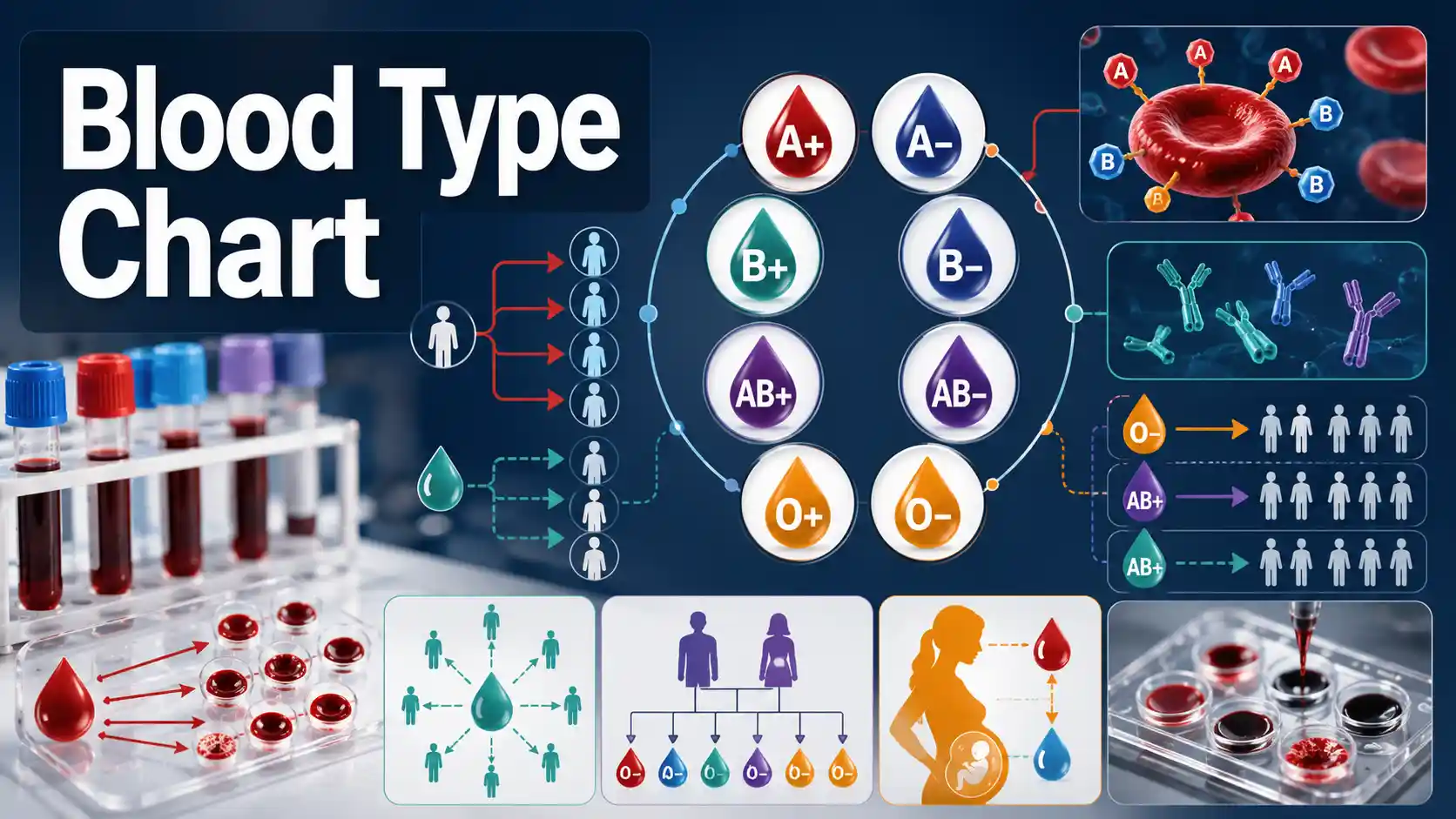
Use this blood type chart to compare ABO and Rh groups, understand blood donation and transfusion compatibility, review Rh factor in pregnancy, and see how parent blood types affect possible child blood types.
Short answer
The main blood groups are A, B, AB, and O. Each type can also be Rh positive or Rh negative, which creates the eight common blood types.
O negative is the broadest red blood cell donor type, while AB positive is the broadest red blood cell recipient type. Plasma compatibility works in the opposite direction.
Rh factor matters during pregnancy because an Rh-negative pregnant person can form antibodies if fetal blood is Rh positive. Prenatal screening and timely prevention reduce that risk.
What the chart shows
Blood type charts answer three common questions quickly: what each blood type means, who can usually donate to whom, and why Rh factor matters in transfusion and pregnancy. Readers who also compare metabolic markers can pair this page with the Blood Sugar Levels Chart, while cardiovascular readers often use the Blood Pressure Chart to review a different set of routine health values.
The compatibility guidance on this page reflects widely used ABO and Rh principles summarized by the American Red Cross and the Stanford Blood Center. Hospitals still confirm compatibility with laboratory testing because a simple chart cannot account for every antibody or clinical situation.
Blood type basics: ABO and Rh explained simply
ABO type depends on whether red blood cells carry A antigens, B antigens, both, or neither. Rh type depends on whether the D antigen is present. That is why a person can be O negative, A positive, AB negative, and so on. The antigen pattern shapes which antibodies the plasma can carry and, in turn, which donor red blood cells are broadly compatible.
If you want a fast comparison of all eight common blood types, the table below is the place to start. It is also useful when families are comparing parent and child patterns, especially alongside the Baby Growth Percentile Chartafter a birth workup or routine newborn testing.
ABO and Rh blood types at a glance
This reference table compares each major blood type, the antigens found on red blood cells, the plasma antibodies typically present, and the broad red-cell transfusion pattern.
| Blood type | Antigens on red cells | Antibodies in plasma | Can receive red cells from | Can donate red cells to |
|---|---|---|---|---|
| O− | No A, B, or Rh antigen | Anti-A, anti-B | O− | All blood types |
| O+ | Rh antigen only | Anti-A, anti-B | O−, O+ | O+, A+, B+, AB+ |
| A− | A antigen | Anti-B | O−, A− | A−, A+, AB−, AB+ |
| A+ | A and Rh antigens | Anti-B | O−, O+, A−, A+ | A+, AB+ |
| B− | B antigen | Anti-A | O−, B− | B−, B+, AB−, AB+ |
| B+ | B and Rh antigens | Anti-A | O−, O+, B−, B+ | B+, AB+ |
| AB− | A and B antigens | None against A or B | O−, A−, B−, AB− | AB−, AB+ |
| AB+ | A, B, and Rh antigens | None against A or B | All blood types | AB+ only |
Notes
- • This chart refers to red blood cell transfusion compatibility. Platelet and plasma compatibility use different rules.
- • Compatibility decisions in hospitals also consider crossmatching, antibodies, and the clinical situation.
Sources
- American Red Cross
- Stanford Blood Center
Blood type compatibility visual
The number of broadly compatible red-cell types differs by direction. O negative can donate red cells across all eight common ABO and Rh combinations, while AB positive can receive red cells from all eight. Hospitals still crossmatch a specific donor unit before transfusion whenever time allows.
1
types received
8
types donated to
2
types received
4
types donated to
2
types received
4
types donated to
4
types received
2
types donated to
2
types received
4
types donated to
4
types received
2
types donated to
4
types received
2
types donated to
8
types received
1
types donated to
Red blood cells
Broadest donor
O−
Broadest recipient
AB+
Compatibility focuses on antigens carried on donor red cells.
Plasma
Broadest donor
AB
Broadest recipient
O
Compatibility reverses because donor plasma carries antibodies.
Who can donate and who can receive?
Donation and receiving are not the same question. A donor chart tells you where a unit of red blood cells can generally go. A receiving chart tells you what red blood cells a patient can generally accept. The difference matters because the antibodies and antigens interact in opposite directions.
Red blood cell donation compatibility
Use this table when you want to see where a donated red blood cell unit can generally go. Hospitals still confirm compatibility before transfusion.
| If the donor is | Commonly compatible recipients |
|---|---|
| O− | O−, O+, A−, A+, B−, B+, AB−, AB+ |
| O+ | O+, A+, B+, AB+ |
| A− | A−, A+, AB−, AB+ |
| A+ | A+, AB+ |
| B− | B−, B+, AB−, AB+ |
| B+ | B+, AB+ |
| AB− | AB−, AB+ |
| AB+ | AB+ |
Notes
- • O negative red cells are widely used in emergencies, but O negative blood remains a limited resource.
Sources
- American Red Cross
Red blood cell receiving compatibility
Use this table when you want to know what red blood cell types a patient can generally receive. It summarizes the ABO and Rh pattern only.
| If the patient is | Can often receive red cells from |
|---|---|
| O− | O− |
| O+ | O−, O+ |
| A− | O−, A− |
| A+ | O−, O+, A−, A+ |
| B− | O−, B− |
| B+ | O−, O+, B−, B+ |
| AB− | O−, A−, B−, AB− |
| AB+ | All blood types |
Notes
- • AB positive is often called the universal red-cell recipient because no ABO or Rh restriction remains at this broad level.
Sources
- Stanford Blood Center
Plasma compatibility works differently
Plasma does not follow the same quick rule as red blood cells. Because plasma contains antibodies, AB plasma is widely compatible while O plasma is the narrowest. This is one reason a single phrase such as universal donor can be misleading if the blood component is not specified.
Plasma donation compatibility
Plasma compatibility runs in the opposite direction from red blood cell compatibility because plasma contains antibodies instead of red-cell antigens.
| Plasma donor type | Can often donate plasma to |
|---|---|
| AB | All ABO blood types |
| A | A and O |
| B | B and O |
| O | O only |
Notes
- • AB plasma is often called universal plasma because it lacks anti-A and anti-B antibodies. Rh factor matters less for plasma than for red blood cells, but local protocols can vary.
Sources
- Stanford Blood Center
- NHS
Red cells, plasma, platelets, and whole blood use different rules
A blood type compatibility chart is useful only when it names the component. Red blood cells carry antigens, plasma carries antibodies, platelets add separate ABO and Rh considerations, and selected trauma programs may use specially tested low-titer group O whole blood. A blood bank applies the correct rule to the actual product.
How compatibility changes by blood component
The safest match depends on which blood component is being transfused. Red blood cells and plasma use opposite ABO directions, while platelets follow more flexible, protocol-specific rules.
| Blood component | Main compatibility concern | Broad emergency concept | Important limitation |
|---|---|---|---|
| Red blood cells | A, B, and Rh antigens on donor red cells | O negative is the broadest emergency red-cell donor | Crossmatching and other red-cell antibodies still matter |
| Plasma | Anti-A and anti-B antibodies in donor plasma | AB is the broadest plasma donor | Hospitals select plasma by ABO compatibility and local policy |
| Platelets | ABO antigens, donor plasma antibodies, and Rh exposure | ABO-identical platelets are often preferred when available | ABO-mismatched platelets may be used under blood-bank protocols |
| Whole blood | Red cells and plasma are present together | Hospitals use specially selected and tested products | Compatibility depends on the product and transfusion protocol |
Notes
- • Always name the blood component when using the words universal donor or universal recipient.
- • Blood-bank staff choose products using testing, inventory, patient age, pregnancy potential, antibodies, and clinical urgency.
Sources
- American Red Cross
- Stanford Blood Center
How blood type inheritance works
A child inherits one ABO allele from each parent. Type O means two O alleles. Type A can mean AA or AO, and type B can mean BB or BO. AB means one A allele and one B allele. That simple pattern explains why two type A parents can have a type O child if both parents carry a hidden O allele.
The broad inheritance overview here aligns with patient education from Cleveland Clinic. If you want to confirm a person's actual blood type, laboratory testing matters more than family assumptions.
Possible child blood types by parent ABO groups
This simplified table shows the ABO blood types a child may inherit from two parents. It does not include rare subgroup patterns or laboratory exceptions.
| Parent 1 | Parent 2 | Possible child ABO types |
|---|---|---|
| O | O | O |
| O | A | O or A |
| O | B | O or B |
| O | AB | A or B |
| A | A | O or A |
| A | B | O, A, B, or AB |
| A | AB | A, B, or AB |
| B | B | O or B |
| B | AB | A, B, or AB |
| AB | AB | A, B, or AB |
Notes
- • Rh inheritance is separate from ABO inheritance. Two Rh-positive parents can have either an Rh-positive or Rh-negative child if both carry a hidden Rh-negative allele.
- • A blood type test is the only reliable way to confirm a child's type.
Sources
- Cleveland Clinic
How common is each blood type?
O positive and A positive are the most common blood types in the United States. AB negative is the rarest among the major ABO and Rh combinations. These patterns help explain why blood centers monitor inventory closely and encourage regular donation from every compatible group.
Common blood type prevalence in the United States
Blood type prevalence varies by ancestry and region. These values offer quick context and should not be used as a substitute for laboratory testing.
| Blood type | Approximate share of the U.S. population |
|---|---|
| O+ | 37.4% |
| A+ | 35.7% |
| B+ | 8.5% |
| O− | 6.6% |
| A− | 6.3% |
| AB+ | 3.4% |
| B− | 1.5% |
| AB− | 0.6% |
Notes
- • The most common blood type in the United States is O positive. The rarest among the major ABO and Rh combinations is AB negative.
Sources
- Stanford Blood Center
Why Rh factor matters in pregnancy
Rh incompatibility matters most when a pregnant person is Rh negative and the fetus may be Rh positive. Exposure to fetal red blood cells can lead the immune system to form antibodies. Those antibodies can affect a current or future pregnancy if they cross the placenta and attack fetal red blood cells.
Prenatal care uses blood typing and antibody screening early because prevention is easier than treatment. MedlinePlus provides a clear patient explanation of Rh incompatibility, while the page on pregnancy-specific health values can later complement this topic when your library expands.
Rh factor and pregnancy quick guide
Rh factor becomes especially important during pregnancy because a mismatch between a pregnant parent and fetus can trigger antibody formation in later pregnancies.
| Situation | Why it matters | Typical response |
|---|---|---|
| Pregnant person is Rh positive | Rh incompatibility is usually not a concern | Routine prenatal care and blood typing |
| Pregnant person is Rh negative and fetus may be Rh positive | The immune system can form antibodies against fetal red cells | Antibody screening and preventive Rh immune globulin when indicated |
| Bleeding, miscarriage, abdominal trauma, or invasive procedures | Fetal blood can mix with maternal blood | Prompt clinical review and Rh immune globulin when appropriate |
| Antibodies are already present | The current pregnancy can need closer monitoring | Maternal-fetal medicine follow-up and fetal surveillance |
Notes
- • Only a clinician can decide whether Rh immune globulin is needed and when it should be given.
Sources
- MedlinePlus
Testing, type and screen, and transfusion safety
A transfusion decision never relies on ABO and Rh alone. Clinicians often order a type and screen before surgery, labor, or hospital treatment. That process identifies the ABO group, checks the Rh factor, and looks for unexpected antibodies that may complicate transfusion. The NHS blood groups guide also explains how laboratory testing confirms blood type.
How blood typing is tested and used
Blood typing usually starts with forward and reverse grouping. Additional tests may be needed when transfusion safety, antibodies, or pregnancy requires more detail.
| Test or use case | What it shows | Where it matters most |
|---|---|---|
| ABO typing | Whether A and or B antigens are present on red blood cells | Transfusion planning, surgery, prenatal care, donation |
| Rh typing | Whether the D antigen is present | Transfusion planning, pregnancy, donation |
| Antibody screen | Whether unexpected red-cell antibodies are present | Before transfusion, during pregnancy |
| Crossmatch | Whether a specific donor unit is compatible with the patient | Hospital transfusion safety |
| Type and screen | ABO and Rh typing plus an antibody screen | Common pre-surgery and hospital workflow |
Notes
- • A quick home kit cannot replace hospital testing when transfusion safety matters.
Sources
- NHS
- Stanford Blood Center
Interactive tools
Check compatibility and inheritance quickly
These tools summarize the broad ABO and Rh pattern only. Hospitals still use crossmatching, antibody screens, and clinical judgment before a transfusion.
Red blood cell compatibility checker
Choose a blood type, then decide whether you want to review what that type can receive or donate.
Result
O− can generally receive red cells from:
O−
Possible child ABO types
Choose the parents' ABO groups to see which ABO blood types are usually possible for a child.
Result
Possible child ABO blood types
O, A, B, AB
This tool covers the usual ABO inheritance pattern only. Rh factor, rare subgroups, and unusual genetic situations need separate testing.
Related charts on ChartsLoom
Readers who use this page often compare it with broader health references, including oxygen and cardiovascular ranges. Explore these related charts for more context.
Frequently asked questions
What is the rarest blood type?
Among the major ABO and Rh combinations, AB negative is the rarest in the United States.
What is the most common blood type?
O positive is the most common blood type in the United States.
Can O negative donate to everyone?
O negative red blood cells are broadly compatible for emergency transfusion, but hospitals still confirm compatibility and antibody status whenever possible.
Can AB positive receive blood from any type?
AB positive can generally receive red blood cells from all ABO and Rh groups, which is why it is often called the universal red-cell recipient.
Is universal donor status the same for plasma?
No. AB plasma is often considered universal plasma because it does not contain anti-A or anti-B antibodies.
How can I find my blood type?
You can learn your blood type through a blood donation record, prenatal laboratory tests, hospital records, or a laboratory blood type test ordered by a clinician.
Does blood type affect pregnancy?
Yes. Rh incompatibility matters when a pregnant person is Rh negative and the fetus may be Rh positive. Prenatal screening helps prevent complications.
Can two O-type parents have an AB child?
No. Two parents with type O can pass only O alleles, so the child will also have type O in the usual ABO model.
Can two A-type parents have an O-type child?
Yes. That can happen if both parents carry one A allele and one hidden O allele.
Does diet change blood type?
No. Diet, supplements, and lifestyle habits do not change your inherited ABO or Rh blood type.
Why do hospitals still crossmatch if the chart already shows compatibility?
Compatibility charts cover only the broad ABO and Rh pattern. Patients can also have other antibodies that affect transfusion safety.
Do all transfusions use the same compatibility rules?
No. Red blood cells, plasma, and platelets have different compatibility principles and local protocols can vary.
Can a home blood typing kit replace a hospital test?
No. Home kits can be inaccurate and should not be used for transfusion decisions or urgent medical situations.
What is a type and screen?
A type and screen combines ABO and Rh typing with an antibody screen so a care team can prepare for a possible transfusion.
Sources
These references support the compatibility, pregnancy, prevalence, and testing information summarized on this page.
- American Red Cross — Blood Types: https://www.redcrossblood.org/donate-blood/blood-types.html
- Stanford Blood Center — Blood Types and Compatibility: https://stanfordbloodcenter.org/donate-blood/blood-donation-facts/blood-types/
- Cleveland Clinic — Blood Types: What They Are and Mean: https://my.clevelandclinic.org/health/treatments/21213-blood-types
- MedlinePlus — Rh Incompatibility: https://medlineplus.gov/rhincompatibility.html
- NHS — Blood Groups: https://www.nhs.uk/tests-and-treatments/blood-groups/